

You’ve seen the clips. Four people in a glass box, laughing, sprinting, smashing a ball off the back wall like it’s squash — and somehow having the time of their lives. That’s padel, and if your group chat hasn’t mentioned it yet, give it a week. This padel for beginners guide starts right there.
Here’s the thing nobody tells you on day one, though: padel looks easy, and that’s exactly why so many beginners end up with a sore elbow by week three. I learned that the fun way — well, the slightly painful way. This padel for beginners guide is the one I wish I’d had before my first game: the rules in five minutes, what it actually does for your fitness, and how to play it without joining the injury statistics.
What Exactly Is Padel?
Padel is a racket sport that mashes tennis and squash together and then removes the hardest parts of both. It’s played in doubles — two against two — on a court about a third the size of a tennis court (20 metres long, 10 wide), enclosed by glass and mesh walls. The ball can bounce off those walls and stay in play, which is where the magic happens: rallies last far longer than in tennis, and even a total beginner can keep a point alive. For padel for beginners, that wall is the best coach on the court.
The sport was invented in Acapulco, Mexico, in 1969 by Enrique Corcuera, who built the first court in his garden. For decades it stayed mostly a Spanish and Latin American thing. Then something flipped. Monthly searches for padel roughly doubled in two years — from about 1.19 million in late 2024 to 2.24 million by November 2026 — and courts started popping up in the US, UK, Canada and Australia faster than anyone could book them. It’s now routinely described as the world’s fastest-growing sport, and honestly, once you’ve played one match, you get it.
Why Everyone’s Suddenly Playing It
Three reasons, and they’re all honest ones.
First, the learning curve is kind. In tennis, your first month is mostly spent chasing balls into the fence. In padel, the underhand serve is forgiving, the court is small, and the walls save your worst shots. Most people rally properly within their very first session.
Second, it’s social in a way the gym never will be. It’s always doubles, so you’re playing with a partner and against two real humans, and the post-match coffee or dinner is practically part of the sport. That’s not a small thing — it’s the reason people actually stick with it.
Third, it’s a genuine workout disguised as a game. And unlike a treadmill, nobody has to motivate you to keep going, because you’re mid-rally and you want the point.
Padel is not the only fast-growing format, either — HYROX is another breakout fitness race drawing in new athletes.
Padel for Beginners: The Rules in Five Minutes
You don’t need the full rulebook — you need enough to walk on court and not look lost. This padel for beginners summary gives you exactly that. Here it is:
The serve is underhand. You bounce the ball behind the service line and hit it below waist height, diagonally into the opposite service box. No overarm serves, ever.
The ball must bounce first. After it crosses the net, it has to land on your opponents’ side before it touches the glass. If it hits the wall first, that’s a fault.
The walls are your friends. Once the ball has bounced in, it can hit the glass or mesh and the point continues. You can even play the ball off your own back wall, like in squash.
Scoring is tennis scoring. 15, 30, 40, game — deuce, advantage, the whole familiar system. Most casual games are best of three sets.
That’s genuinely it. You’ll pick up the rest — lets, faults, who stands where — in your first two games.
What Padel Actually Does for Your Fitness
Let’s put real numbers on this, because “it’s good cardio” tells you nothing.
Padel sits at roughly 6 METs for a relaxed recreational game and up to 10 METs in a fast competitive match, according to the Compendium of Physical Activities. A MET is just a measure of how hard your body is working compared to sitting still. Here’s the worked example, using the standard formula (calories = METs × body weight in kg × hours):
- A 75 kg player, one hour, relaxed game (6 METs): 6 × 75 × 1 = 450 calories
- Same player, one hour, competitive game (10 METs): 10 × 75 × 1 = 750 calories
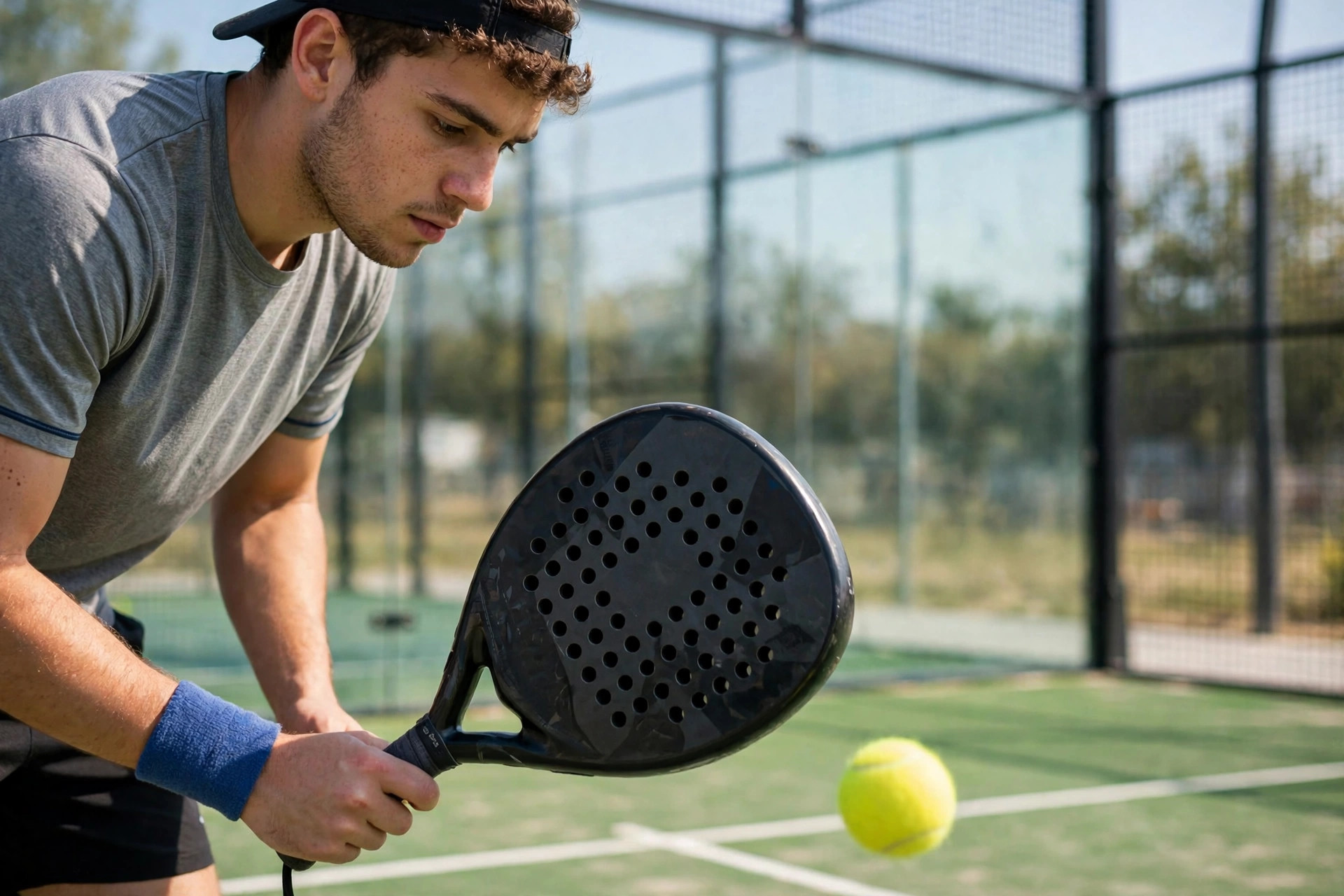
So a typical 90-minute session lands somewhere around 650 to 1,100 calories, depending on how hard you play — and that’s before you count what it does for your legs, glutes and core. Every rally is a series of short sprints, hard stops, lunges and rotations. It’s interval training, except you’re having too much fun to notice.
The catch? All those hard stops and sudden direction changes are exactly what injure unprepared beginners. Which brings us to the part most “how to play padel” articles skip entirely.
The Injuries Nobody Warns Beginners About
Padel has an injury problem that the hype doesn’t mention. A 2026 scoping review of padel injuries — 14 studies covering 3,581 players — found the sport carries a genuinely high injury rate: roughly 3 injuries per 1,000 training hours and 8 per 1,000 match hours. That’s in the same ballpark as tennis.
The pattern is clear. In the upper body, the elbow is the most commonly injured area, followed by the shoulder — and the injuries are mostly tendon problems, above all lateral epicondylitis, better known as tennis elbow. In the lower body, the knee and ankle take the most damage, mostly ligament injuries. A separate systematic review comparing padel, tennis and squash found elbow injuries made up 30–74% of all padel injuries in the studies it analysed. That’s not a rounding error. That’s the sport’s signature injury.
Why beginners? Because the classic beginner mistake is arming the ball — swinging hard with the wrist and forearm instead of rotating through the shoulder and hips. Add a racket that’s too heavy (research flags rackets over 350 grams as a risk factor), three games in your first week, and zero warm-up, and your elbow will file a complaint.
The good news: almost all of this is preventable, and the prevention is boringly simple.
How to Start Padel for Beginners Without Getting Hurt
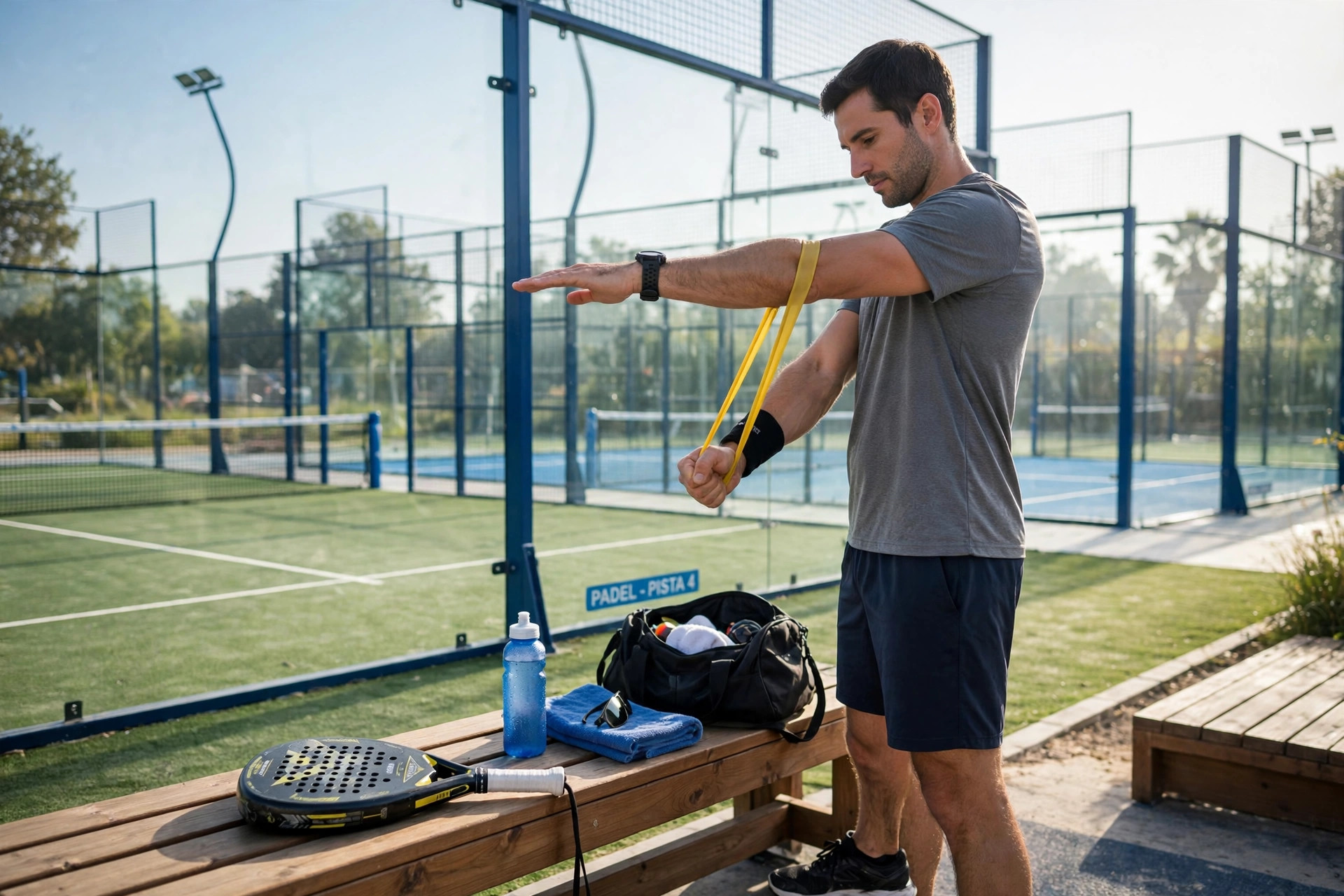
Warm up for ten minutes, every single time. Five minutes of light movement — jogging, side shuffles, arm circles — then a few gentle practice rallies before you play for points. Cold tendons and explosive lunges are a bad combination.
Buy a light, round racket. Round-shaped rackets have their weight closer to the handle, which means more control and less strain on your elbow. For your first racket, stay under 350 grams. Don’t buy the heavy diamond-shaped power racket the shop wants to sell you — that’s for players who already have the technique to handle it.
Learn the technique before the power. Your first three sessions should be about footwork and letting the ball come to you, not about smashing. If your elbow aches after a game, that’s feedback, not a badge of honour — rest it and check your grip and swing with a coach.
Play two or three times a week, not five. Your tendons adapt slower than your enthusiasm. Give them a day between sessions, especially in the first month. Following a recovery routine between matches helps your tendons adapt between sessions. And after you play, a 15-minute foam rolling routine does more for your legs than any ice bath ritual.
Wear proper court shoes. Running shoes are built to go forward. Padel is all sideways. Court shoes with lateral support protect your ankles on exactly the movements that cause most lower-limb injuries.
Padel for Beginners: Myth vs. Fact
Myth: “Padel is just mini-tennis, so my tennis elbow can’t happen here.”
Fact: Tennis elbow is literally the most common padel injury. The smaller court means more volleys, more quick wrist flicks, and more chances to overload the forearm tendon.
Myth: “It’s so easy that you don’t need to warm up.”
Fact: Easy to learn and easy on the body are different things. The injury rate per match hour is around 8 per 1,000 hours — real, not trivial.
Myth: “You need to be fit to start padel.”
Fact: It’s the other way round. Padel is one of the best ways to get fit precisely because the game pulls you into running you’d never do on a treadmill. Start at your level, build up gradually, and let the sport do the conditioning.
Your First Week of Padel for Beginners
Here’s a realistic starter plan, not a fantasy one:
- Day 1: Book a 60-minute court with a friend. Spend the first 15 minutes just rallying gently — no scoring, no smashing. Play one relaxed set.
- Day 2: Rest. Your legs will tell you why.
- Day 4: Second session. This time, ask the club about a 30-minute beginner lesson — one correction to your serve or backhand now saves months of bad habits.
- Day 6: Third session, 90 minutes, with a proper warm-up. Finish with five minutes of stretching and foam rolling.
Three sessions in week one, technique before power, and you will be a noticeably better — and uninjured — player by week two. That’s the whole secret.
FAQs
Is padel good exercise for weight loss?
Yes — a 75 kg player burns roughly 450 to 750 calories per hour depending on intensity, and a 90-minute session can top 1,000 calories. But the real weight-loss advantage is adherence: people actually show up for padel three times a week because it’s fun, and consistency beats any single workout’s calorie count.
Do I need my own racket to start?
No. Almost every club rents rackets for a few dollars, and that’s the smart move for your first few games. When you do buy one, choose a light, round-shaped racket under 350 grams — your elbow will thank you.
Is padel hard on your knees?
It can be, because of the constant stopping, starting and sideways movement — knee and ankle ligament injuries are among the most common in the sport. Good court shoes, a proper warm-up, and not playing five days in a row when you’re new go a long way. If you have an existing knee problem, check with your doctor first and build up slowly.
The Bottom Line
Padel earned its hype. It’s the rare sport that’s genuinely easy to start, seriously social, and a real workout — 450 to 750 calories an hour, full-body movement, and rallies that keep you coming back. Just respect the one thing the highlight reels don’t show: your elbow and your knees need a few weeks to catch up with your enthusiasm. Warm up, buy a light racket, learn the technique before the power, and play two or three times a week instead of five.
Do that, and padel won’t just be the sport everyone’s talking about this month. It’ll be the one you’re still playing next year.
This article is for general information only and isn’t medical advice. If you have a joint, tendon or heart condition, or you’re returning from an injury, talk to a doctor or physiotherapist before starting a new sport.