
Here’s a strange thought: the last time you shook someone’s hand, you might have learned more about their health than a blood pressure cuff would tell you.
I know how that sounds. A handshake isn’t a medical test. But over the past decade, researchers have quietly turned one of the simplest measurements in medicine — how hard you can squeeze — into one of the most reliable predictors of how long and how well you’ll live. And this month, the conversation exploded again: a new grip strength study started trending across fitness YouTube in the first week of November, and two fresh papers landed in the same week backing it up.
So let’s settle it properly. What does your grip actually say about you, what’s a “good” number, and — the part nobody talks about enough — what do you do if yours is weak?
What the Big 2026 Study Actually Found
The study driving all this noise came out in February 2026 in JAMA Network Open, and it’s unusually solid. Researchers at the University at Buffalo followed 5,472 women aged 63 to 99 for an average of 8.4 years. They measured two things: how hard each woman could squeeze a hand dynamometer, and how fast she could stand up from a chair five times.
The numbers were hard to ignore. Women in the strongest quarter for grip — squeezing more than 24 kilograms — had a 33% lower risk of dying during the follow-up than women in the weakest quarter, who squeezed under 14 kilograms. Every extra 7 kilograms of grip strength lined up with roughly a 12% lower mortality rate. Faster chair-stand times told the same story: every 6 seconds quicker meant about a 4% lower death rate.
Now, here’s what makes this study different from the usual “strong people live longer” headline. The researchers didn’t just measure strength and call it a day. Every woman wore an accelerometer for seven days, so the team knew exactly how much she moved and sat — no self-reported guesswork. They adjusted for walking speed and for C-reactive protein, a blood marker of inflammation. And the grip effect survived all of it.
Why This Study Is Different
Even more striking: the link held in women who weren’t meeting the standard 150 minutes of weekly aerobic exercise. Strength, in other words, was pulling its own weight as a health signal — it wasn’t just a side effect of being active.
A quick honesty check, because this matters: this was an observational study. It shows that strong grip and longer life travel together, not that squeezing a stress ball adds years to yours. A weak grip can also be an early warning sign of an illness nobody has spotted yet. But as a marker — a cheap, fast readout of how resilient your body is — it’s earned its reputation.
Why a Handshake Can Beat a Blood Pressure Reading
The Buffalo study isn’t an outlier. It’s the latest chapter in a story that started with one of the biggest health studies ever run.
The PURE study, published in The Lancet, measured the grip of 139,691 adults aged 35 to 70 across 17 countries. Over a median follow-up of four years, weaker grip was linked to higher death rates from all causes and from cardiovascular disease — and grip strength predicted cardiovascular events more strongly than systolic blood pressure did. Every 5-kilogram drop in grip lined up with about a 16% higher risk of dying from any cause and a 17% higher risk of cardiovascular death.
Think about that for a second. Your blood pressure gets checked at every doctor’s visit. Your grip almost never does. Yet in a sample of nearly 140,000 people, the squeeze told doctors more about heart risk than the cuff did.
Why? Because grip strength isn’t really about your hands. It’s a window into your total muscle mass, your nervous system, and your body’s ability to handle stress — illness, surgery, a bad fall. When those systems are strong, your grip is strong. When they’re quietly declining, your grip is often the first thing to show it.
The Fresh November Evidence
The research hasn’t stopped. In the first week of November 2026, two new papers added fresh weight:
First, a study in GeroScience used Mexico’s national aging survey to follow 1,917 adults aged 50 and older. The sex difference was dramatic. Men in the weakest quarter of grip strength had a death rate 5.56 times higher than men in the strongest quarter. For women, the weakest quarter still carried nearly double the risk. The authors were careful — one measurement, observational data, association not proof — but the signal was loud, especially for men.
Second, a study published November 7 in 3 Biotech looked at 6,839 middle-aged and older Chinese adults and found that relative grip strength — your grip divided by your body weight — mattered even more than absolute grip. Each one-standard-deviation drop in relative grip was linked to a 68% higher chance of having multiple cardiometabolic conditions at once: diabetes, heart disease, stroke. Relative strength, the authors concluded, is the number worth watching.
Put together, the picture is consistent across continents, ages, and study designs. And it explains why grip strength keeps trending every time a new paper drops.
What Counts as a “Good” Grip?
Numbers without context are useless, so here are the benchmarks that actually matter.
The European sarcopenia guidelines (EWGSOP2) — the closest thing to an official standard — flag grip strength below 27 kilograms in men and below 16 kilograms in women as low enough to warrant a conversation with a doctor. Those aren’t athletic targets; they’re the floor below which muscle weakness becomes a clinical concern.
The JAMA study’s quartiles give you a finer scale for women over 60: under 14 kg was the weakest group, 14–19 kg the second, 19–24 kg the third, and above 24 kg the strongest — the group with that 33% lower mortality risk. Pooled British data puts the picture in perspective: women’s grip peaks at a median of about 31 kilograms between ages 26 and 42, then declines from midlife onward.
Here’s a worked example, using the study’s own math. Imagine a woman in her late 60s who squeezes 17 kilograms — second quartile. If, over a year of sensible strength training, she builds that to 24 kilograms, that’s a 7-kilogram gain. In the Buffalo cohort, a 7-kilogram difference was associated with roughly a 12% lower mortality risk. That’s an association across a population, not a promise for one person — but it shows the scale of what’s at stake. Seven kilograms is not a heroic transformation. It’s a few months of dead hangs and farmer’s carries.
And for younger athletes reading this: if you’re a 40-year-old man deadlifting double your bodyweight but you’ve never actually measured your grip, you might be surprised. Grip is often the first thing to go when training gets sloppy — and strength starts slipping after 35, as 47 years of data recently confirmed.
How to Test Your Grip Strength at Home
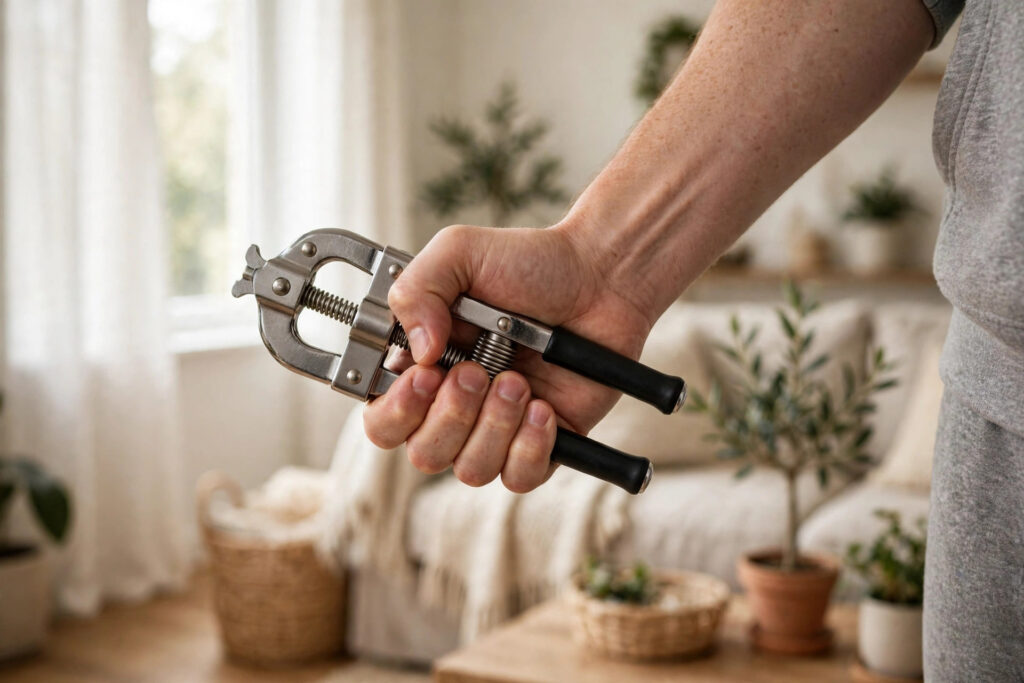
You don’t need a lab. You need a plan, and ideally a dynamometer — the handheld squeeze device clinics use. They cost about the same as a decent pair of lifting straps, and some gyms and physio clinics keep one at the front desk.
Here’s the standard protocol, the same one the studies used:
Stand up straight, arm relaxed at your side, dynamometer in your dominant hand. Squeeze as hard as you can for about three seconds — no jerking, no holding your breath. Rest a minute, then do it again. Three tries per hand, and your best score is your number. Compare it to the benchmarks above, not to your training partner.
No dynamometer? Two honest substitutes:
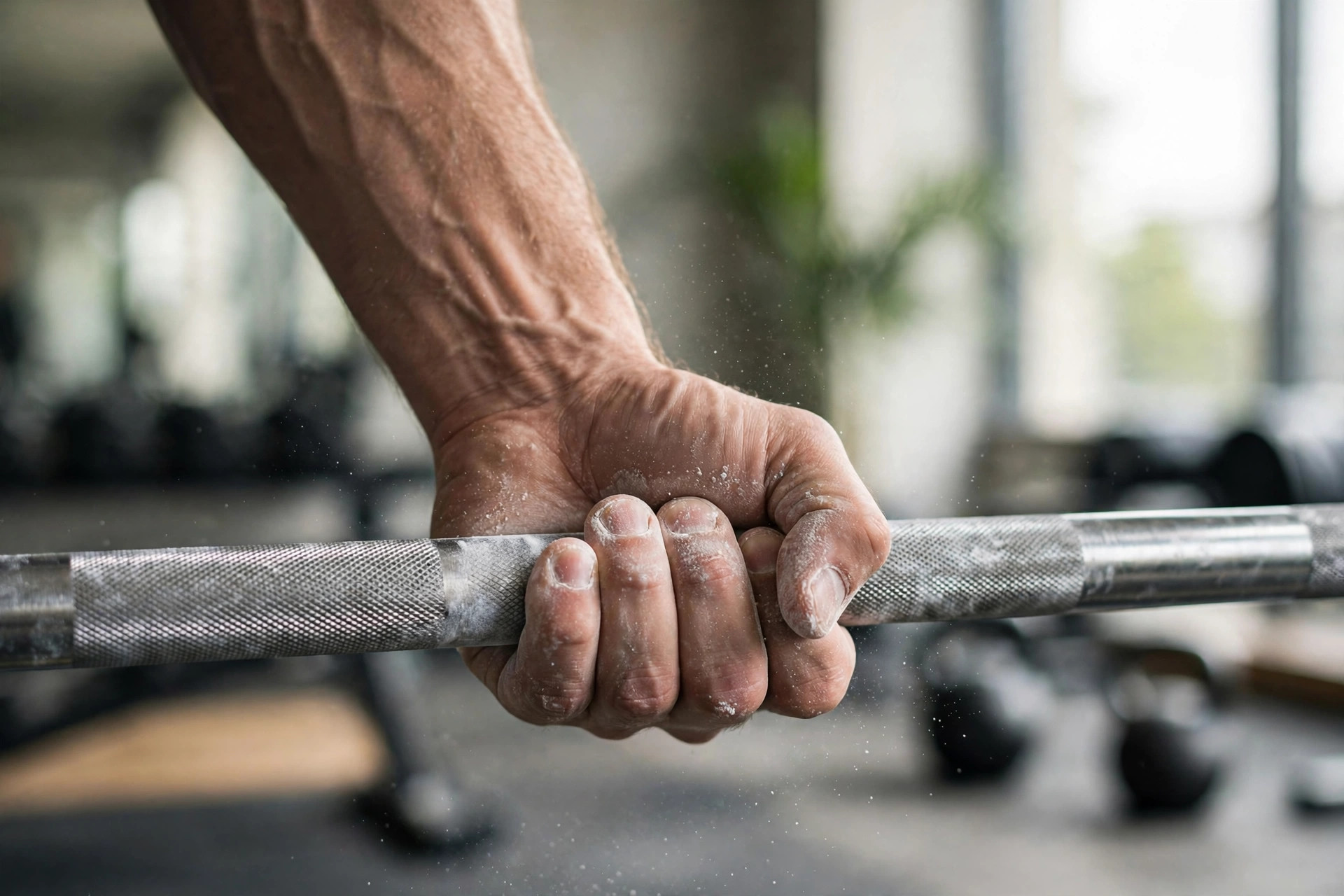
The dead hang. Grab a pull-up bar with an overhand grip and hang. If you can’t hold 30 seconds, your grip is a limiting factor. Sixty seconds is solid. Ninety seconds or more, and your grip is genuinely strong.
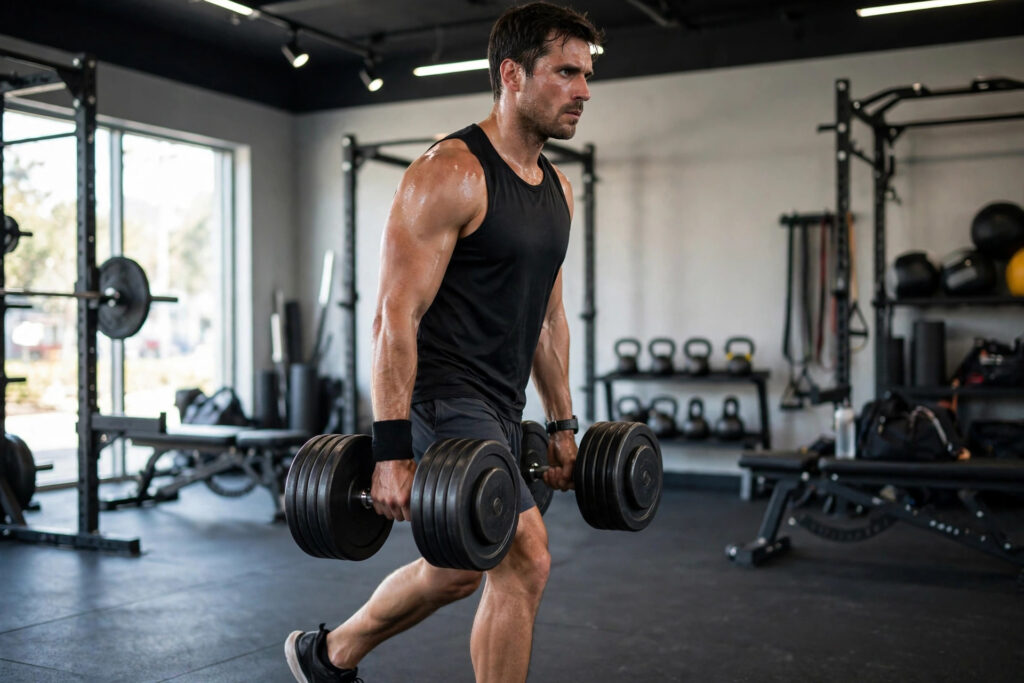
The farmer’s carry hold. Pick up two dumbbells at roughly half your bodyweight combined and walk. If you can’t carry them 40 metres without setting them down, your grip needs work.
One warning: test both hands. A big gap between your left and right is worth knowing about — asymmetry is a common injury flag in return-to-play screening.
How Athletes Actually Train Grip
The good news is that grip responds fast — faster than almost any other strength quality. It also transfers: a stronger grip means heavier deadlifts, better pull-ups, and a steadier racket or club. Here’s the simple version:
Dead hangs — 3 sets of 30–60 seconds, two or three times a week. Hang from a bar, shoulders relaxed, and just hold. When 60 seconds gets easy, add weight with a dip belt or switch to one-arm hangs.
Farmer’s carries — 3 sets of 40-metre walks with heavy dumbbells or kettlebells. This is the single best grip builder in the gym, and loaded carries like rucking train the same quality under real-world load.
Plate pinches — pinch two smooth weight plates together between thumb and fingers, hold for time. Three sets of 20–30 seconds per hand. Brutal, humbling, effective.
Towel pull-ups — drape two towels over a bar and pull yourself up gripping the fabric. It builds the kind of crushing, climbing grip that a straight bar never will.
Program it like any other strength work: two or three short sessions a week, at the end of your normal workout, and add a little time or weight every week. The 2026 strength training guidelines recommend at least two full-body strength sessions weekly for adults — grip work slots neatly into the last five minutes of those sessions. And if you’re already lifting, check your habits first: lifting straps are useful for heavy pulls, but if you wear them for everything, your grip never gets a reason to adapt.
Myth vs Fact
Myth: Grip strength only matters for lifters and climbers.
Fact: The biggest studies linking grip to longevity were done on ordinary older adults, not athletes. Your grip reflects whole-body muscle health, which is why it predicts outcomes far beyond the gym.
Myth: If your grip is weak, you’re doomed.
Fact: Grip is a marker, not a verdict. It’s a snapshot of where you are today — and one of the most trainable qualities in the body. Weak now doesn’t mean weak forever.
Myth: Squeezing a gripper while watching TV will add years to your life.
Fact: A gripper alone trains a narrow pattern. Real grip strength comes from hanging, carrying, and pulling heavy things. And no single exercise causes longevity — the studies show association, and the honest reading is that grip reflects overall strength and health, which is what you should build.
Myth: A strong handshake means you’re healthy.
Fact: One squeeze tells you very little on its own. What matters is your measured number against age benchmarks, how it changes over time, and the rest of the picture — blood pressure, labs, how you move, how you feel.
FAQs
What is a normal grip strength for my age?
There’s no single “normal” — it varies by sex, age, and body size. As a rough guide from the research: women peak around 31 kg in their late 20s to early 40s, then decline gradually. The clinical low-strength line is under 27 kg for men and under 16 kg for women (EWGSOP2). If you’re well above those lines and holding steady year to year, you’re in good shape. If you’re near or below them, it’s worth a chat with your doctor — and a strength program.
Can I improve my grip strength quickly?
Yes — grip is one of the fastest-responding strength qualities. Most people see meaningful gains in 4–8 weeks of consistent dead hangs and farmer’s carries, two or three times a week. The gains come from both stronger forearm muscles and better neural recruitment, which is why beginners improve so fast.
Does grip strength really predict how long I’ll live?
It predicts risk across large populations, and it does so remarkably well — better than blood pressure in the 139,691-person PURE study. But it’s an association, not a guarantee for any one person, and it works best as one piece of a bigger picture alongside activity, blood pressure, labs, and how you actually feel day to day.
The Takeaway
Your grip strength is a 30-second health check you can do anywhere — and the research behind it is some of the most consistent in all of exercise science. Test it. Write the number down. Train it for ten minutes a week. Then test it again in two months.
You might not add years to your life by squeezing harder. But if the number climbs, it means your muscles, your nerves, and your resilience are climbing with it — and that’s the part that actually matters.
This article is for general information only and isn’t medical advice. If your grip strength is very low, dropping fast, or very different between hands, talk to a doctor or physiotherapist before starting a training program.