


My phone buzzed at 9:47 p.m. last Tuesday. “You’ve reached 20,000 steps!” it announced, like I’d won something. I hadn’t been trying. I’d just had one of those days — a long walk before work, stairs instead of the lift, a meeting that turned into a wander around the block. And yet there it was: the round number that fitness influencers keep telling us is the new 10,000.
Here’s the awkward question nobody in those videos answers: is 20,000 steps actually twice as good as 10,000? Or are you just spending three extra hours a day walking for almost nothing?
I went to the actual research to find out — not the TikToks, the studies. And the answer is more interesting than either side admits.
What 20,000 Steps Actually Looks Like in Real Life
Before we talk about whether it’s worth it, let’s be honest about what it costs you. For most adults, 20,000 steps is roughly 8 to 10 miles — about 16 kilometres for a taller man, closer to 13 for a shorter woman, because stride length does the maths for you.
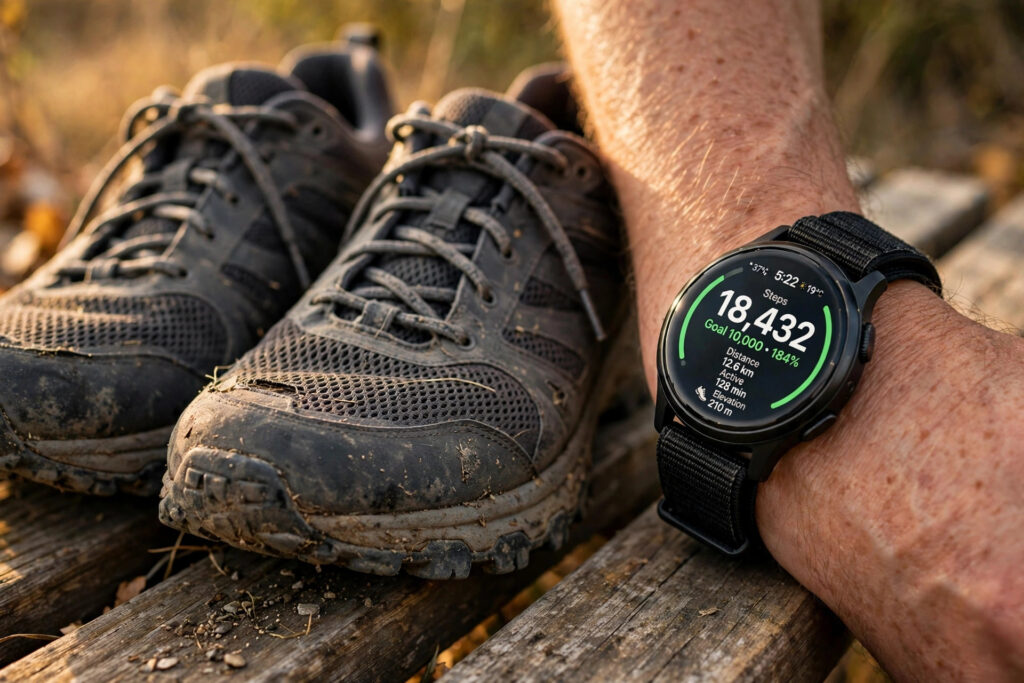
At a normal walking pace, that’s around 2.5 to 3.5 hours of walking. Not strolling to the fridge — actual walking, spread across a day. A postal worker hits it before lunch. An office worker has to try: a 45-minute morning walk, stairs all day, a lunch walk, and an evening walk after dinner, and you’re still probably short.
That’s the first thing to understand. 20,000 steps isn’t a goal you accidentally achieve. It’s a part-time job. So the real question is what you get paid for it.

Where the 10,000 Number Came From (Spoiler: Not Science)
Quick history lesson, because it changes how you read everything else — and the famous 10,000-step target was born in 1965 as the brand name of a Japanese pedometer — the Manpo-kei, literally the “10,000 steps meter” — released to ride the enthusiasm after the 1964 Tokyo Olympics. It was a catchy product name, not a medical discovery.
That doesn’t make it a bad target. It just means it was never the finish line — it was a guess that happened to land near the right neighbourhood. The research that followed spent the next sixty years figuring out where the real line sits.
What the Biggest Studies Actually Found
This is where it gets genuinely interesting, because the studies don’t all say the same thing — and the differences matter.
The 2022 meta-analysis that pooled everything. Researchers combined 15 international cohorts — 47,471 adults followed for a median of 7.1 years — and mapped the step-to-mortality curve properly. For adults over 60, the benefit flattened around 6,000 to 8,000 steps a day. For adults under 60, it flattened around 8,000 to 10,000. The most active quarter, averaging about 10,900 steps, had a 53% lower risk of dying than the least active quarter at about 3,550 steps. Above 10,000, the curve in this pooled data had mostly gone flat. You can read the 15-cohort meta-analysis in The Lancet Public Health for the full dose-response curves.
The 2023 meta-analysis that pushed further. A second, larger team pooled 17 cohorts — 226,889 people — and looked at even higher step counts. Their headline: benefits started at just 3,867 steps a day for all-cause mortality and 2,337 for cardiovascular death. Every extra 1,000 steps lined up with about 15% lower all-cause mortality, and every extra 500 with about 7% lower cardiovascular mortality. And crucially, they found no upper limit of benefit — people walking up to 20,000 steps kept gaining, even if each extra thousand bought less than the one before it.
The 2025 update. The most recent dose-response review, covering 24 cohort studies across eight health outcomes, again found no clear upper limit to step-related improvements.
So who’s right? Honestly, both. The 2022 analysis shows the curve flattening hard after 10,000 — the biggest gains are long gone by then. The 2023 analysis shows the curve never quite hits zero — it keeps creeping upward, just very slowly. Walking 20,000 steps isn’t twice as good as 10,000. It’s maybe a few percent better, bought with twice the time.
There’s one more study worth knowing about, because it explains the shape of that curve. In 2019, Harvard researchers followed 16,741 older women (average age 72) with research-grade accelerometers. The women averaging 2,700 steps a day died at nearly three times the rate of the most active group. But the magic happened early: going from 2,700 to 4,400 steps cut mortality by 41%. Going from 4,400 to 7,500 added a bit more. After 7,500, the curve went flat. The first few thousand steps do almost all the work.
The Worked Example: What 20,000 Steps Actually Burns
Let’s put real numbers on it, because “burns calories” is too vague to plan around.
Take an 80 kg person walking 20,000 steps — about 16 km at a moderate pace. Sports scientists estimate level walking costs roughly 0.53 calories per kilogram per kilometre. Do the maths: 0.53 × 80 × 16 = about 680 calories. A 65 kg person walking the same distance burns roughly 550.
That’s meaningful — it’s roughly a full meal’s worth of energy — but notice what it depends on: your body weight and the distance, not the step count itself. A lighter person burns less per step. And none of it counts if you “reward” the walk with an extra 700 calories at dinner, which is depressingly easy to do.
The time cost is the part people underestimate. At a brisk 100 steps a minute, 20,000 steps takes 200 minutes — three hours and twenty minutes. Even at a fast 120 steps a minute, you’re looking at nearly three hours. That’s the real price tag, and it’s paid in time, not effort.
The Benefits Nobody Measures in Death Rates
Here’s where the mortality charts undersell walking, and where 20,000 steps starts to make sense for some people. The studies above measure death. They don’t measure the things that make a day feel good.
A 2017 study of Scottish postal workers found that those averaging 15,000 or more steps a day had virtually no metabolic-syndrome risk factors — no raised blood pressure, no bad cholesterol pattern, no blood-sugar problems — unlike their desk-bound colleagues doing the same job in the same building. That’s not a small difference; it’s the difference between a body that’s coping and one that isn’t.
Then there’s the stuff that never shows up in a hazard ratio. A brisk walk is one of the most reliable mood tools we have — and walking in nature beats walking through traffic for anxiety and mood, in a 2022 trial. Long walks are where people think clearly, solve problems, and actually talk to each other. If you do your best thinking on foot, 20,000 steps isn’t a fitness goal. It’s a lifestyle that happens to be healthy.
Myth vs. Fact: The 20K Edition
Myth: 20,000 steps is twice as healthy as 10,000.
Fact: The mortality benefit mostly plateaus between 7,500 and 10,000 steps. Doubling your steps past 10,000 buys a small extra gain, not double.
Myth: You need 20,000 steps to lose weight.
Fact: Weight loss comes from the calorie gap, and 20,000 steps burns roughly 550–700 calories for most adults — real, but easily eaten back. Food still does the heavy lifting.
Myth: Walking doesn’t count as real exercise.
Fact: The World Health Organization counts brisk walking as moderate-intensity activity, and 150 minutes a week of it cuts mortality risk by about 31%. Your body doesn’t care whether the movement happened in a gym.
Myth: If you can’t hit 20,000, don’t bother.
Fact: This is the most damaging myth of the lot. Benefits start at under 4,000 steps. Going from 3,000 to 5,000 steps a day is one of the highest-return health moves that exists.
Should You Actually Do It?
It depends entirely on who you are and what your day looks like.
20,000 steps is worth trying if: you already walk a lot for work or pleasure, you enjoy long walks and have the time, you’re training for a walking event or a hiking trip, or you sit all day and want a hard target that forces you out of the chair. For these people, 20K is a structure, not a strain.
It’s probably not worth chasing if: you’re starting from 3,000 steps a day, you have joint problems or a busy schedule, or the target stresses you out. Your first goal should be 5,000, then 7,500. Those jumps buy you far more health per step than anything past 10,000 ever will.
And build up slowly either way. Jumping from 5,000 to 20,000 in a week is how people end up with shin splints, sore knees, and blisters — and then quit walking entirely. Add about 1,000 to 2,000 steps a week, wear shoes that actually fit, and pay attention to your knees and feet. If something hurts for more than a few days, back off. The research rewards consistency over years, not heroic weeks. And remember staying hydrated on long walks, especially if you’re out for hours in the heat.
One practical trick if you do go for it: split the walking. A 45-minute morning walk, a 20-minute lunch walk, and a 45-minute evening walk gets you most of the way there without any single session feeling like a march. And if you want those steps to work even harder, try turning some of those walks into rucking — the same time, more load, more benefit.
The Bottom Line
20,000 steps a day is not a scam and it’s not a miracle. It’s a big time commitment that buys you a small extra health gain over 10,000 steps — plus real benefits for your mood, your waistline, and your metabolic health that the mortality charts don’t capture.
If you love walking and your life fits around it, go for it. If you don’t, stop feeling guilty about the number on your wrist. The science is remarkably clear about one thing: the most valuable steps you’ll ever take are the first few thousand, the ones that get you off the couch. Everything after that is a bonus.
So check your step count tonight. If it’s under 4,000, that’s your project — not 20,000. And if you’re already at 10,000, you’re doing better than most of the research population ever did. The extra 10,000 is up to you.
FAQ — 20,000 Steps a Day
How many calories does 20,000 steps burn?
Roughly 550–700 calories for most adults, depending on body weight and pace — about 0.53 calories per kilogram per kilometre walked. An 80 kg person walking 16 km burns around 680 calories. The number comes from distance and weight, not the step count itself.
How long does it take to walk 20,000 steps?
About 2.5 to 3.5 hours at a normal to brisk pace. At 100 steps a minute it’s 200 minutes; at 120 steps a minute, about 2 hours 45 minutes. Most people who hit 20,000 spread it across the whole day rather than doing it in one go.
Is 20,000 steps a day bad for your knees?
For healthy knees, no — walking is low-impact and the research shows benefits continuing up to 20,000 steps. But jumping suddenly from a low step count to 20,000 can cause shin splints, foot pain, and knee soreness. Build up by 1,000–2,000 steps a week, wear proper walking shoes, and see a doctor if joint pain lasts more than a few days.
Conclusion — The Steps That Matter Most Are the First Ones
The 20,000-step trend is a useful reminder that movement matters — but the research tells a calmer story than the hype. Most of the health benefit arrives in the first 7,500 steps. Everything after that is a smaller and smaller bonus, paid for with hours of your day. Walk because you enjoy it, because it clears your head, because it gets you outside — not because a number on a screen told you that 19,999 wasn’t enough.
This article is for general information only and is not a substitute for professional medical advice, diagnosis, or treatment. Talk to your doctor before starting a new exercise routine, especially if you have a heart condition, joint problems, or another health condition.