

You know that moment when your doctor glances at your blood pressure reading, pauses, and says, “It’s a little high — let’s keep an eye on it”? That was me two years ago. 138 over 86. Not high enough for pills, not low enough to ignore. The advice was the usual: walk more, eat less salt, lose a few kilos.
So when a brand-new trial landed this autumn showing that one of the simplest exercises on earth — sitting against a wall, doing absolutely nothing — dropped systolic blood pressure by nearly 10 points in four weeks, I stopped scrolling. This isn’t a supplement ad. It’s a randomised controlled trial in a peer-reviewed journal, and the numbers are hard to ignore.
What the new study actually found
Researchers at Canterbury Christ Church University in England ran the trial and published it in BMJ Open Sport & Exercise Medicine on 29 September 2026. They recruited 100 adults, average age 37, who weren’t doing regular structured exercise, whose systolic pressure sat between 120 and 140 (normal to high-normal), and who weren’t taking blood pressure medication.
For the first four weeks, the exercise groups all did the same home routine, three times a week: four wall-squat holds of two minutes each, with two minutes of seated rest between holds. Eight minutes of actual work per session, 24 minutes a week.
After those four weeks, compared with the control group who did nothing, the wall-squat group’s resting systolic pressure was down 9.45 mmHg, diastolic down 5.62, and mean arterial pressure down 6.90 — all statistically significant, with the systolic result at p<0.001, meaning this almost certainly wasn’t chance.
Then came the clever part. For the next four weeks, the exercisers were split into four groups: keep going three times a week, drop to twice, drop to once, or stop entirely:
- Three times a week: systolic down 13.73 mmHg from the start — the group went from an average of 131.2 to 117.5.
- Twice a week: down 6.95 mmHg.
- Once a week: down 6.56 mmHg.
- Stopped completely: back to square one within a month — no different from the people who never trained.
Only the three-times-a-week group kept the deeper benefits too: improvements in total peripheral resistance, heart-rate variability, and baroreflex sensitivity — the body’s own blood-pressure control system — held up only at full frequency.
Why sitting still works
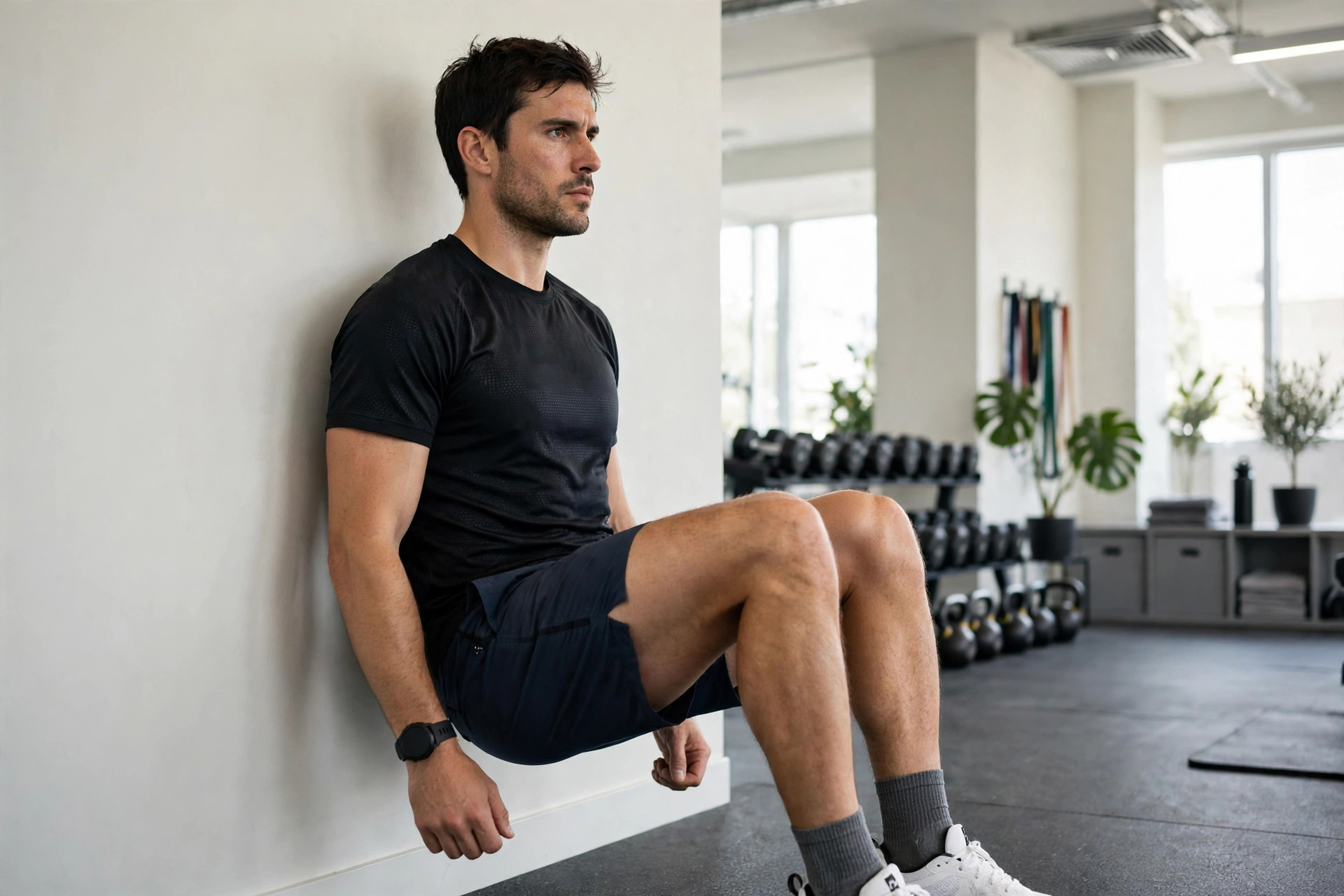
A wall sit is an isometric exercise: your muscles work hard without anything moving. You slide your back down a wall, bend your knees, and hold. Your quads scream, but your joints don’t budge.
While you hold, the sustained tension squeezes the blood vessels in your legs and your blood pressure temporarily rises. When you release, blood rushes back in. Repeat that four times, three times a week, for a month, and your blood vessels seem to learn to relax more efficiently at rest. The researchers measured exactly that: total peripheral resistance — how hard your vessels resist blood flow — improved in the frequent trainers.
This isn’t a one-off finding. A huge 2023 analysis in the British Journal of Sports Medicine pooled 270 randomised trials with 15,827 participants and compared five types of exercise. Isometric training came out on top, averaging a systolic drop of 8.24 mmHg — roughly double the 4.49 mmHg from aerobic exercise. Among individual exercises, the wall squat ranked first, averaging a 10.47 mmHg drop. The new trial lines up with that almost eerily well.
One honest caveat: the 2023 ranking rests on thin data for wall squats — only four trials fed that number, and no trial has ever randomised people directly to wall sits versus running. And a 2026 analysis of 24-hour blood pressure in people with diagnosed hypertension found the evidence for isometric training less certain across the whole day. Resting readings improve; the full-day picture is still being worked out.
The exact 8-minute routine
Don’t overcomplicate this. The volunteers weren’t doing anything fancy, and neither should you.
Find your position
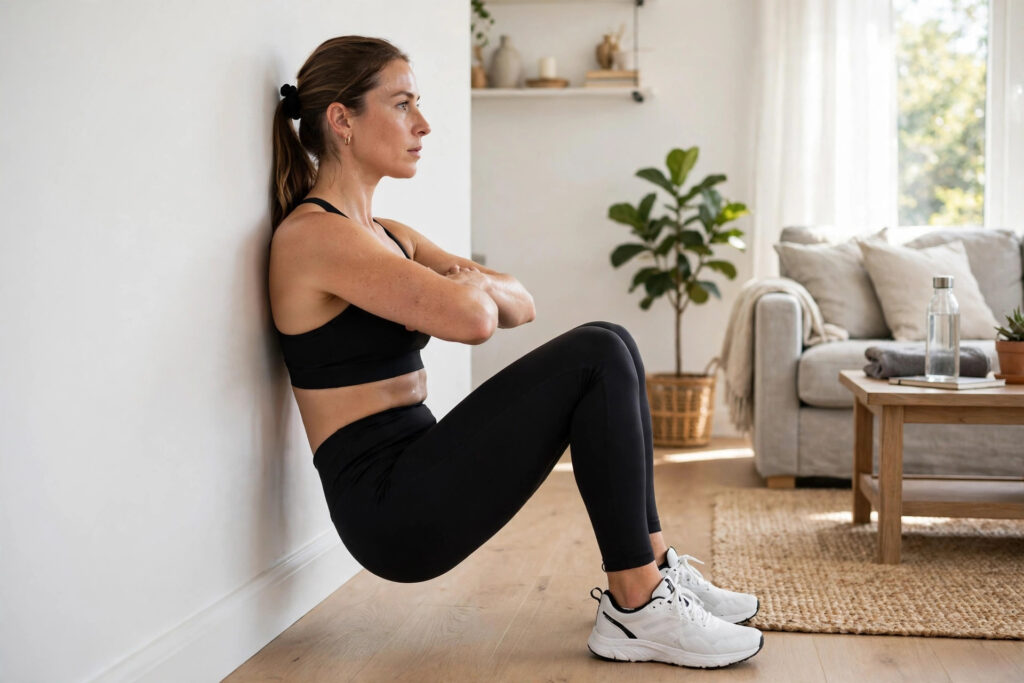
Stand with your back flat against a wall, feet about two feet out, shoulder-width apart. Slide down until your knees are bent at roughly 90 degrees — thighs parallel to the floor, like you’re sitting on an invisible chair. If 90 degrees is too much on day one, go higher. A shallower squat still counts; the study set each person’s knee angle individually in the lab.
Hold for two minutes
Set a timer. Two minutes is longer than you think — your quads will start complaining around the 60-second mark, and that’s normal. Breathe steadily. Don’t hold your breath; that spikes your pressure during the hold and defeats the purpose. If you need to come up early, come up, shake your legs out, and try again next round.
Rest, repeat, track
Sit down for two minutes of rest between holds — the recovery is part of the protocol, not a break to skip. Four holds, four rests: about 16 minutes wall-clock, 8 minutes of actual holding. Three sessions a week, with at least a day between them.
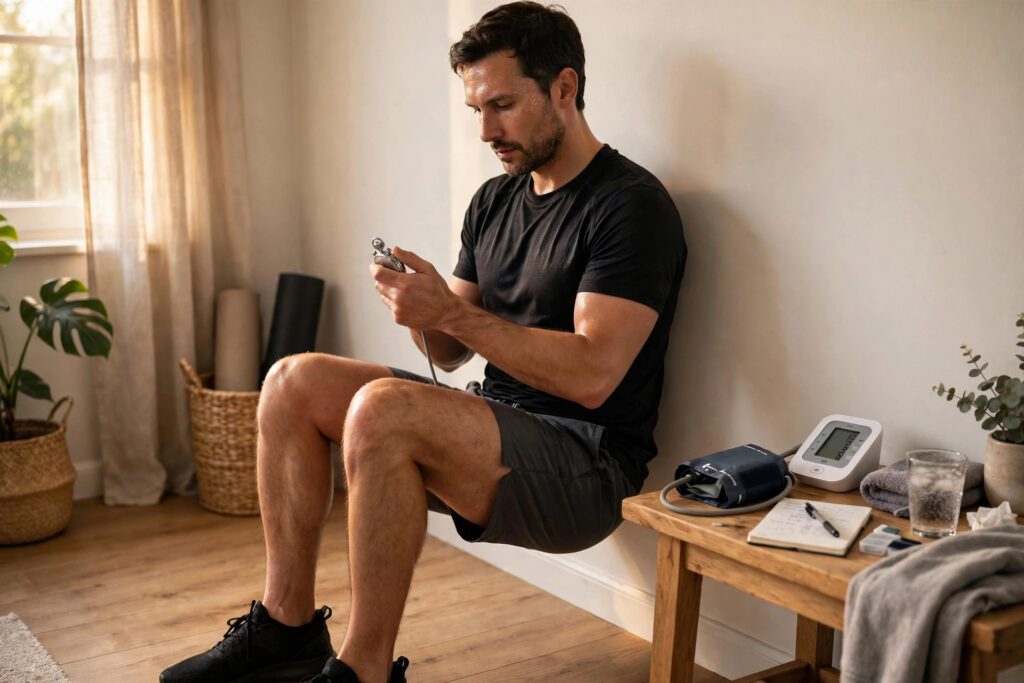
If you own a home blood pressure cuff, measure at the same time each day — morning, before coffee, after sitting quietly for five minutes. Write the numbers down. A cheap cuff turns a vague hope into a number you can watch move.
The catch the headlines keep skipping
You’ve probably seen the viral version: “Wall sits once a week lower blood pressure!” It’s true, technically. But it misses the part that matters most.
Nobody in this trial started at once a week. Every single person did twelve sessions in the first month — three a week, every week — before anyone was allowed to cut back. The once-a-week result is a maintenance dose, not a starting dose. It’s the difference between keeping a fire going with one log and trying to start one with a single match.
And the maintenance phase lasted only four weeks. We genuinely don’t know whether once a week keeps working at three months or six. The researchers said so themselves: longer studies are needed.
There’s a second catch. The volunteers were healthy adults in their late thirties with normal to high-normal pressure. Nobody had diagnosed hypertension, nobody was on blood pressure medication, and nobody was over 60. If that’s not you, the numbers above are a guide, not a promise — and if you have uncontrolled high blood pressure or heart disease, talk to your doctor first, because blood pressure rises sharply during an isometric hold even though it falls at rest afterwards.
Myth vs fact
Myth: “Wall sits replace cardio.” Fact: they don’t. A wall sit does nothing for your aerobic fitness or endurance. This is an addition to movement, not a replacement. Keep walking — the evidence for 5,000–7,000 steps a day is rock solid, and your daily step count is one of the simplest health markers to track. Think of wall sits as short exercise snacks you can slot in between your other activity.
Myth: “Once a week is enough.” Fact: only after a month of three sessions a week, and only for the four weeks studied. Three times a week gave more than double the benefit and kept the deeper vascular improvements that once-a-week didn’t.
Myth: “It works for everyone.” Fact: it worked for healthy, inactive adults with pressure in the 120–140 range. People with diagnosed hypertension, people on medication, and older adults weren’t in this trial. The 2023 meta-analysis included hypertensive people and still found isometric training effective on average — but medication decisions are for your doctor, not a wall.
A real-number example
Let’s make this concrete, using the study’s own averages — not a promise, just arithmetic on real data.
Say your systolic pressure is 136, close to the average volunteer at the start (131.2). You follow the protocol exactly: four two-minute holds, three times a week.
After four weeks, the trial’s average drop was about 9.5 points. That puts you around 126–127 — back inside the range most guidelines call normal. Keep going three times a week for another four weeks, and the average drop from baseline reached 13.7 points. That puts you near 122.
Cut back to once a week after that first month, and the trial says you’d hold on to roughly a 6.6-point drop — around 129. Still better than where you started, but you’ve given back about half the benefit. Stop entirely, and within four weeks you were indistinguishable from people who never trained.
The benefit isn’t banked. It’s rented, and the rent is three short sessions a week. Sixteen minutes a week, no gym, no equipment, no subscription. The cost is a wall and some willpower.
Who should talk to a doctor first
Most healthy adults can try this safely, but check with your doctor first if any of these apply: diagnosed hypertension (especially uncontrolled), heart disease, a history of stroke, kidney disease, or blood pressure medication. Blood pressure climbs during the hold itself, so anyone whose pressure is already high needs a professional to weigh the trade-off. The same goes if you have knee problems — a wall sit loads the knees, and a shallower angle or a different isometric, like a handgrip squeeze (which the 2023 analysis also rated highly at −7.10 mmHg systolic), may suit you better.
One more thing: wall sits are not a treatment for high blood pressure. They are an exercise with a surprisingly strong effect on resting pressure in healthy people. If your readings are consistently above 140/90, that conversation belongs with your doctor, not a wall. If your home readings run higher than your clinic readings, it could be masked hypertension, so mention it to your doctor too.
FAQs
How long does it take for wall sits to lower blood pressure?
In the 2026 trial, four weeks of wall squats three times a week lowered resting systolic pressure by about 9.5 mmHg compared with a control group. That’s fast for an exercise intervention — most aerobic programmes need eight to twelve weeks for similar changes. But the volunteers started in the normal to high-normal range, and four weeks is the minimum the evidence supports.
Are wall sits better than walking for blood pressure?
For resting systolic pressure specifically, the 2023 meta-analysis says yes — isometric training averaged an 8.24 mmHg drop versus 4.49 for aerobic exercise. But walking wins on almost everything else: heart health, mood, blood sugar, joints, and longevity. The smart answer isn’t either/or. Walk daily, and add three short wall-sit sessions a week on top. They do different jobs.
Can I do wall sits every day instead of three times a week?
The trial tested three times a week, and that’s the dose with evidence behind it. Daily sessions weren’t studied, and your muscles need recovery days. If you want to do something daily, make it walking or gentle movement, and keep the wall sits to three focused sessions.
The bottom line
A wall, two minutes, four times, three days a week. That’s the whole programme — and in a 100-person randomised trial, it cut resting systolic blood pressure by 9.5 points in a month and nearly 14 points in two months for the people who stuck with it.
The catch is honest and simple: you have to earn the benefit first with a month of consistent training, and you have to keep paying for it. Cut back to once a week and you’ll keep about half. Stop, and it’s gone within a month.
But for something that costs nothing, needs no equipment, and fits in the gap between your couch and your kitchen wall, that’s a remarkably good deal. Try it for four weeks. Measure before and after. Let the numbers decide.
This article is for general information only and isn’t medical advice. Wall sits raise blood pressure during the hold itself, so if you have high blood pressure, heart disease, or take blood pressure medication, check with your doctor before starting.