

My school bag weighed more than my little brother. I’m not exaggerating much — textbooks, a water bottle, lunch, and whatever else I’d stuffed in there, hauled up the hill to school every morning. I hated that bag. Twenty-odd years later, I found out soldiers do the same thing on purpose, and fitness influencers now pay good money for a fancier version of that same bag.
That thing has a name: rucking. Walking with weight in a backpack. And rucking for beginners is suddenly everywhere — NPR called it “an exceedingly practical fitness trend that might stick around,” and more than one fitness outlet has named it the workout trend of 2026. The question is whether the hype survives contact with the actual research. I’ve read the Army studies, the meta-analyses, and the fine print, so you don’t have to. Here’s what rucking really does, what it doesn’t, and how to start without wrecking your knees.
What Rucking Actually Is (And What It Isn’t)
Rucking is simple: you put weight in a backpack and you walk. The word comes from “rucksack,” military slang for a backpack, and the practice comes straight from military training, where soldiers have marched under load for decades. Most recreational ruckers carry 10 to 30 pounds and walk two to five miles at a brisk pace.
One important distinction before we go further: a backpack is not a weighted vest. A vest spreads the load across your chest and back; a pack hangs it behind you, on your shoulders and hips. That changes how you move, how your balance works, and which research applies. Most of the clinical trials on loaded walking actually used vests, not packs — I’ll flag that every time it matters, because borrowing vest results and selling them as rucking results is exactly how fitness myths are born. If you want the vest side of the story, I’ve covered what a weighted vest actually does in detail.
Rucking is also not a shortcut. It’s walking with the difficulty turned up one notch. The base is still walking, and walking already does for your heart more than most people give it credit for. The pack just asks your body to pay a little more for every step.
What the Research Actually Says
The best data on loaded walking comes from the US Army Research Institute of Environmental Medicine, the lab that has studied soldiers carrying heavy packs since the 1970s. In 2022, exercise physiologist David Looney and his colleagues published the most careful backpack study yet in Medicine & Science in Sports & Exercise. Thirty healthy, military-age adults walked on treadmills carrying backpacks loaded up to 66% of their body weight, at speeds from a slow stroll to a fast march, while researchers measured their actual energy burn with indirect calorimetry. The team used that data to build a new prediction model — the Load Carriage Decision Aid backpacking equation — which matched measured metabolic rates almost exactly. The older equations everyone had been using, including the famous Pandolf equation from 1977, consistently underestimated how much energy heavy backpacking costs.
The direction of the effect was never in doubt: add load, burn more. An earlier laboratory study by Huang and Kuo in the Journal of Experimental Biology found that metabolic rate rises roughly linearly with load — about 7.6 extra watts for every additional kilogram carried at a constant walking speed. Your heart rate climbs to match, which is the whole point: the same walk, at the same pace, becomes a genuine moderate-intensity workout instead of a stroll.
Fat Loss
The fat-loss evidence is real but borrowed. A 2026 systematic review and meta-analysis in Osteoporosis International pooled nine randomized trials with 368 middle-aged and older adults. People who added a weighted vest to their exercise lost 2.67 kg more body fat than people doing their usual activity, and 0.73 kg more than people doing the same exercise without the vest. The authors rated the body-fat evidence as high certainty. That’s a genuine, measured effect — but remember, those were vest trials. The calorie mechanism is identical for a backpack, so the fat-loss finding transfers reasonably well. The bone findings don’t transfer as cleanly. The full meta-analysis is on PubMed.
Bone Density
And the bone story is where the hype outruns the data. The same 2026 meta-analysis found that vest-plus-exercise improved bone density at the hip and spine compared with doing nothing — but when a vest was added to an exercise program, there was no confirmed extra bone benefit over the exercise alone, and that comparison rested on a single study.
The long-term picture is mixed too. A five-year study from Oregon State followed 18 postmenopausal women doing weighted-vest exercise plus jumping: they maintained their hip bone density while the control group lost 3.8 to 4.4%. Impressive — but 18 people, and jumping was part of the program, not just walking. Then the INVEST trial in 2025 followed 150 older adults wearing vests during a year of weight loss and found the vest did not prevent hip bone loss. So no: rucking is not a proven bone treatment. It’s a plausible bonus, not a promise.
One more honest limit: rucking won’t build muscle the way lifting does. Loaded walking makes your legs and trunk work harder, but no study has shown it to be a hypertrophy stimulus. If strength is the goal, you still need resistance training. Rucking is a cardio and fat-loss tool that happens to make your legs tired — not a replacement for the gym.
The Calorie Math: What a Pack Actually Adds
Here’s where it gets concrete. The Pandolf equation, published by US Army researchers in 1977 and still the reference model for loaded walking, predicts your energy burn from five inputs: your body weight, the load, your speed, the gradient, and the surface. The formula looks intimidating, but the idea is simple — every kilogram you carry costs energy, and the cost rises with speed.
Let me run it for two real people, on flat pavement, at a brisk walking pace.
Example 1: 70 kg person, 15 kg pack (about 21% of body weight), 4.8 km/h. Unloaded, that walk burns about 251 kcal per hour. With the pack, about 292 kcal per hour. That’s 41 extra calories an hour — a 16% bump.
Example 2: 80 kg person, 8 kg pack (10% of body weight), 5 km/h. Unloaded: about 302 kcal per hour. With the pack: about 324 kcal per hour. That’s 22 extra calories an hour — a 7% bump.
What the Numbers Mean
Two lessons fall out of those numbers. First, the load matters more than anything else: doubling the pack from 10% to 21% of body weight more than doubled the extra burn. Second, the effect is real but modest. Three 45-minute rucks a week at the heavier load adds up to roughly 90 extra calories a week — about one banana. Nobody is rucking their way to a six-pack on calories alone. The real value is the cardio stimulus and the habit: a walk that actually raises your heart rate, done consistently, three times a week, without beating up your joints the way running does.
One caveat on the numbers themselves: validation studies found the original Pandolf equation underpredicts energy burn by 12 to 33% at higher loads and faster speeds. The Army’s newer 2022 model corrects that. So treat my figures as a floor, not a ceiling — your real burn is probably a little higher.
Rucking Myths vs Facts
Myth: “Rucking burns two to three times the calories of walking.”
Fact: At realistic beginner loads, the bump is 10 to 40%. At 10% of body weight it’s about 7%. The 2–3x claims come from calculators that plug in military loads — 30-plus kilos — that no beginner should be carrying.
Myth: “It builds muscle like lifting.”
Fact: No direct evidence. Loaded walking increases muscle activation in the legs and trunk, but that’s not the same as building muscle. Keep your strength sessions.
Myth: “Heavier is always better.”
Fact: Load changes how you walk — your stride, your posture, the forces through your knees and spine. The research sweet spot for general fitness sits around 10 to 20% of body weight. Past that, you’re training for a military march or a mountain, not for health.
Myth: “It’s a proven bone builder.”
Fact: Mixed and thin. One small five-year study was positive; the largest recent trial was null; the 2026 meta-analysis found no confirmed extra bone benefit from adding load to exercise. Plausible, not proven.
Your First 4 Weeks of Rucking
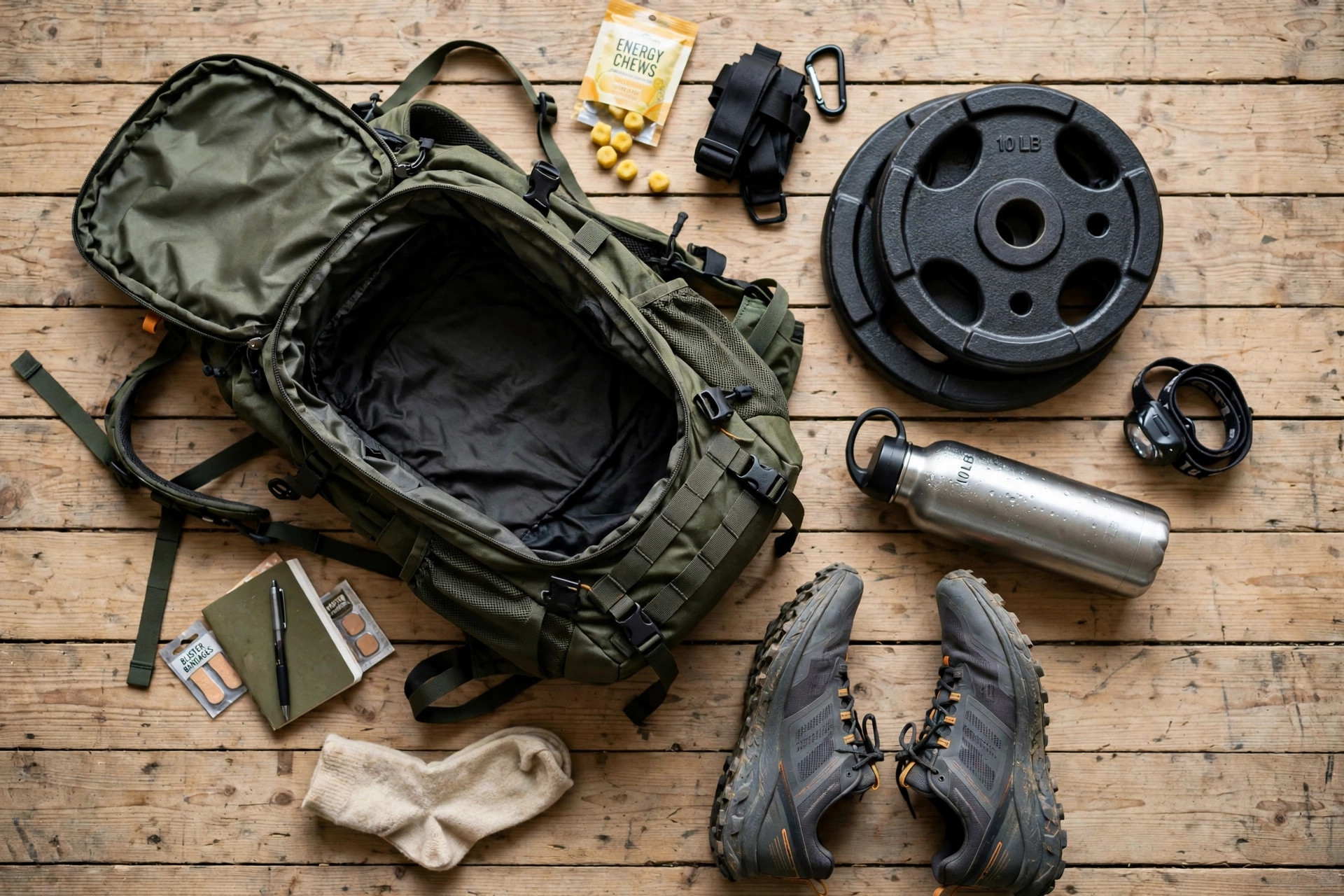
Start lighter than your ego wants and lighter than the internet tells you. Ten percent of your body weight is the right starting point — for a 70 kg person, that’s 7 kg, roughly a couple of water bottles and some books. Here’s the build-up:
Week 1: 10% of body weight, twice a week, 20 to 30 minutes on flat ground. Brisk pace — you can talk, but you’re slightly breathless.
Week 2: Same weight, three times a week, 30 minutes. Add one gentle hill if it feels easy.
Week 3: 15% of body weight, three times a week, 30 to 40 minutes.
Week 4: 15 to 20% of body weight, three times a week, 40 to 45 minutes, with one hilly route.
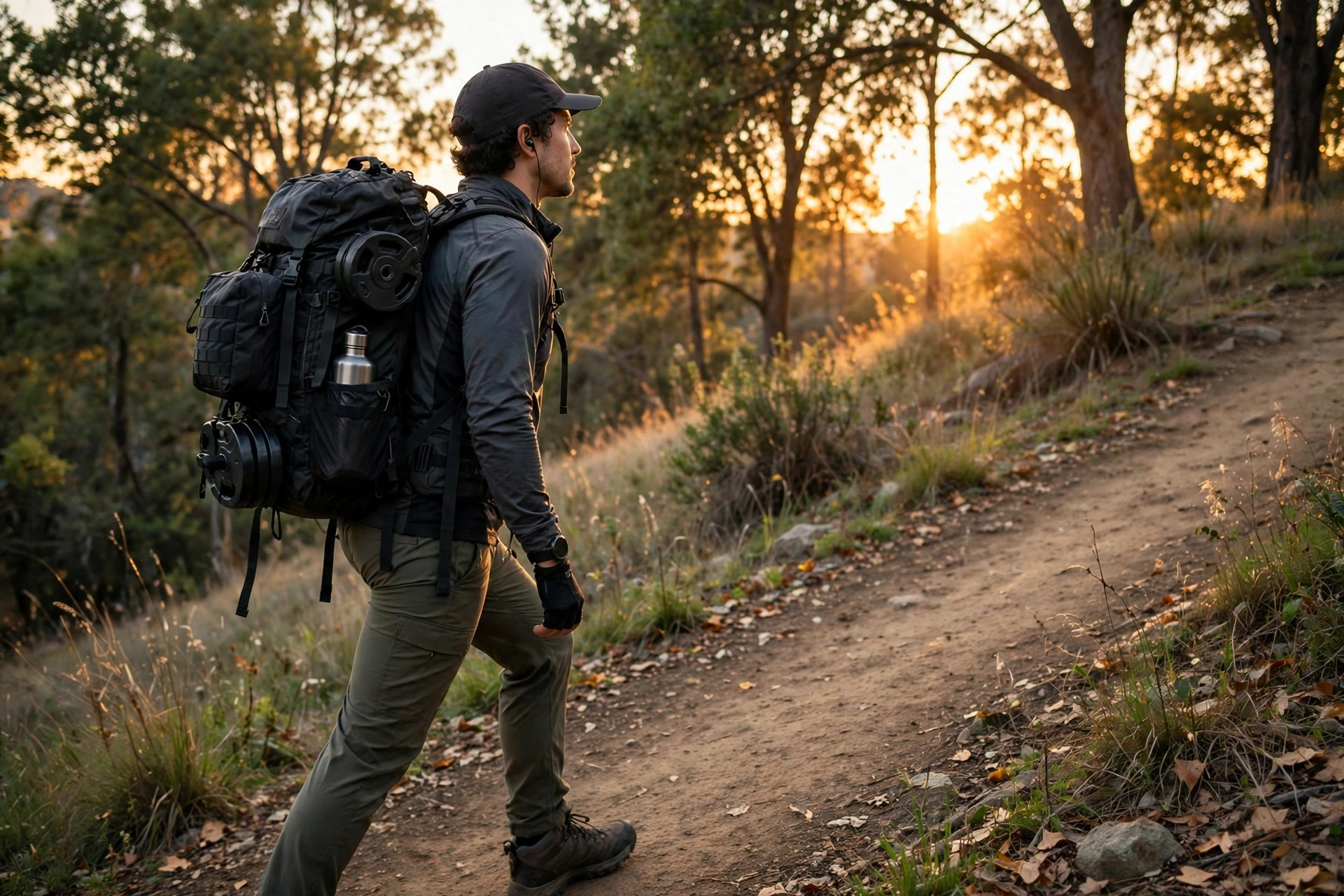
A few rules that matter more than the numbers. Wear the pack high and tight against your back, with the weight close to your body — a loose pack swinging behind you is a backache waiting to happen. Use the hip belt if your pack has one; your hips should carry the load, not your shoulders. Good walking shoes, not flat fashion trainers. And always leave a rest day between rucks for the first month — your feet, knees, and lower back are adapting to a new stress, and adaptation happens on rest days.
Rucking also slots neatly into an easy aerobic base — the slow, conversational training that makes up most of an endurance athlete’s week. If you already run, a ruck is a joint-friendly way to add aerobic volume on a rest day. If you don’t run, it’s the easiest way to make walking count as training.
Who Should Check With a Doctor First
Rucking is low-impact, but it is not no-impact. The extra load stresses your back, knees, shoulders, and pelvic floor. Check with a clinician first if you have back, neck, or shoulder pain, joint problems in your hips, knees, or ankles, a heart condition or high blood pressure, balance problems, or osteoporosis. The same applies if you’re pregnant, recently gave birth, or have pelvic floor symptoms like leakage or prolapse — the added weight increases downward pressure. And if anything hurts while you ruck — sharp knee pain, lower-back pain that doesn’t ease after a few minutes — stop, lighten the pack, and figure out why before your next walk. Soreness in your traps and calves the first week is normal. Joint pain is not.
How heavy should my ruck be to start?
Ten percent of your body weight, for 20 to 30 minutes, two or three times a week. For most people that’s 6 to 9 kg. It will feel almost too easy on day one — that’s the point. Your joints and connective tissue adapt more slowly than your muscles, and the people who quit rucking are almost always the ones who started at 20 kg and paid for it by Thursday. Add about 5% of body weight every two to three weeks, and stop around 20% unless you’re training for something specific.
Does rucking build muscle?
Not in any meaningful way. Loaded walking raises muscle activation in your legs, glutes, and core, and your calves will certainly feel it on hills — but no study has shown rucking to be a hypertrophy stimulus. Think of it as cardio with a strength flavour, not strength training. If you want muscle, pair rucking with two resistance sessions a week; the combination covers far more than either one alone.
Is rucking bad for your knees?
Less bad than running, more demanding than plain walking. There’s no impact phase — your foot never slams into the ground the way it does in a run — but the added load changes your gait and measurably increases the forces through your knees and hips. The evidence so far is reassuring for healthy knees at sensible loads, and the risk rises with the weight and with pre-existing joint problems. Start light, progress slowly, use a hip belt, and keep most of your walking on forgiving surfaces like trails and grass rather than concrete.
The Takeaway
Rucking is the rare fitness trend that mostly deserves the attention. It’s walking with the difficulty turned up one notch: the same walk you already know how to do, with a pack that turns it into real cardio, burns measurably more calories, and asks nothing of you but a backpack and a pair of shoes. The Army’s own research backs the calorie and cardio effects with unusual precision — and the same research keeps the claims honest. It won’t build muscle, it won’t magically rebuild your bones, and the calorie bump at beginner loads is modest. What it will do is turn three ordinary walks a week into training you’ll actually stick with. Start at 10% of your body weight, walk briskly, and let the pack do the talking. Your school bag never knew it was onto something.
This article is for general information only and is not medical advice. If you have a heart condition, back or joint problems, or you’re pregnant or returning to exercise after illness or surgery, talk to your doctor before starting rucking or any loaded walking program.