
I spent last winter paying $55 a month for a gym I visited twice a week — when the weather cooperated, when traffic cooperated, when my motivation cooperated. Then I did the maths, and it annoyed me enough to change everything. A home gym set isn’t about turning your spare room into a fitness influencer’s studio. It’s about removing every excuse between you and the workout. And right now, a lot of people are arriving at the same conclusion: searches for a home gym set are up 122% year over year, peaking this November, as people stop renting their workouts and start owning them.
The question isn’t whether to build one. It’s what to buy first — because buy in the wrong order and you’ll own a very expensive clothes rack.
Why Everyone’s Suddenly Shopping for a Home Gym Set
November is home gym season for a simple reason: the weather turns, the days shorten, and the drive to the gym starts feeling like a second workout. Add in membership prices — a mid-range commercial gym now runs $40 to $60 a month in most US cities, or $480 to $720 a year — and the maths starts to look obvious. A well-planned $1,000 home gym set pays for itself in under two years, and a leaner $500 setup does it in about ten months.
But there’s a second reason, and it’s the one that matters more: convenience is adherence. The workout you actually do beats the perfect workout you skip. A home gym set lives ten steps from your bedroom. No commute, no waiting for the squat rack, no hunting for a parking spot. That sounds like a small thing until it’s the difference between training three times a week and training once. And if your schedule only allows short bursts of movement some days, those count too — small sessions still add up.
But Can a Home Gym Set Actually Build Real Muscle?
This is the honest question, and the research gives an honest answer: yes — for most people, most of the way.
The American College of Sports Medicine, the world’s largest sports medicine organisation, updated its training guidelines in 2026 for the first time in 17 years. After reviewing data from more than 30,000 participants, its conclusion was blunt: non-traditional training — resistance bands, bodyweight exercises, home-based routines — can build strength, promote muscle growth and improve physical function. One of the review’s authors, kinesiology professor Stuart M. Phillips, summed it up in a line worth remembering: “The best resistance training program is the one you’ll actually stick with.” The review also found no major difference between gym machines and free weights like dumbbells and barbells for building strength.
Smaller head-to-head trials back that up. A 2019 meta-analysis by Lopes and colleagues, published in SAGE Open Medicine, pooled seven studies with 224 participants and found no statistically significant difference in strength gains between elastic resistance training and conventional weight training. And in a 2015 trial published in the Journal of Strength and Conditioning Research, Calatayud and colleagues had trained lifters do either bench press or elastic-band push-ups at matched effort for five weeks — both groups gained similar bench-press strength.
There are limits, and I’d rather tell you now than have you discover them in a year. Heavy legs and back eventually need heavy loads, and a small apartment has a ceiling on how much weight you can store. Trials run weeks to months, not years. But for your first year or two of serious training, the equipment barely matters. Effort and volume do.
The Only 5 Pieces Your Home Gym Set Needs
Buy in this order. Each piece unlocks the next, and if you stop after piece two, you can still train your whole body.
1. Adjustable dumbbells. One pair replaces an entire rack of fixed dumbbells — typically 15 to 30 separate weights — in about four square feet. Expect $130 to $300 for a quality pair, or $400-plus for selectorized sets like the Bowflex SelectTech 552. Skip the cheap screw-collar adjustables under $300: they’re slow to change and the collars loosen mid-set.
2. An adjustable bench. Flat, incline, decline — it opens up bench press, incline press, seated overhead press, rows, and step-ups. A solid one costs $110 to $250.
3. Resistance bands. A full set runs $30 to $50 and adds pulling movements, warm-ups, and assistance work your dumbbells can’t cover. They’re also the cheapest way to train while travelling.
4. A pull-up bar. A doorway bar costs $30 to $60 and gives you the single best upper-body pulling exercise there is. Check your door frame first — and your ceiling height if you plan to kip.
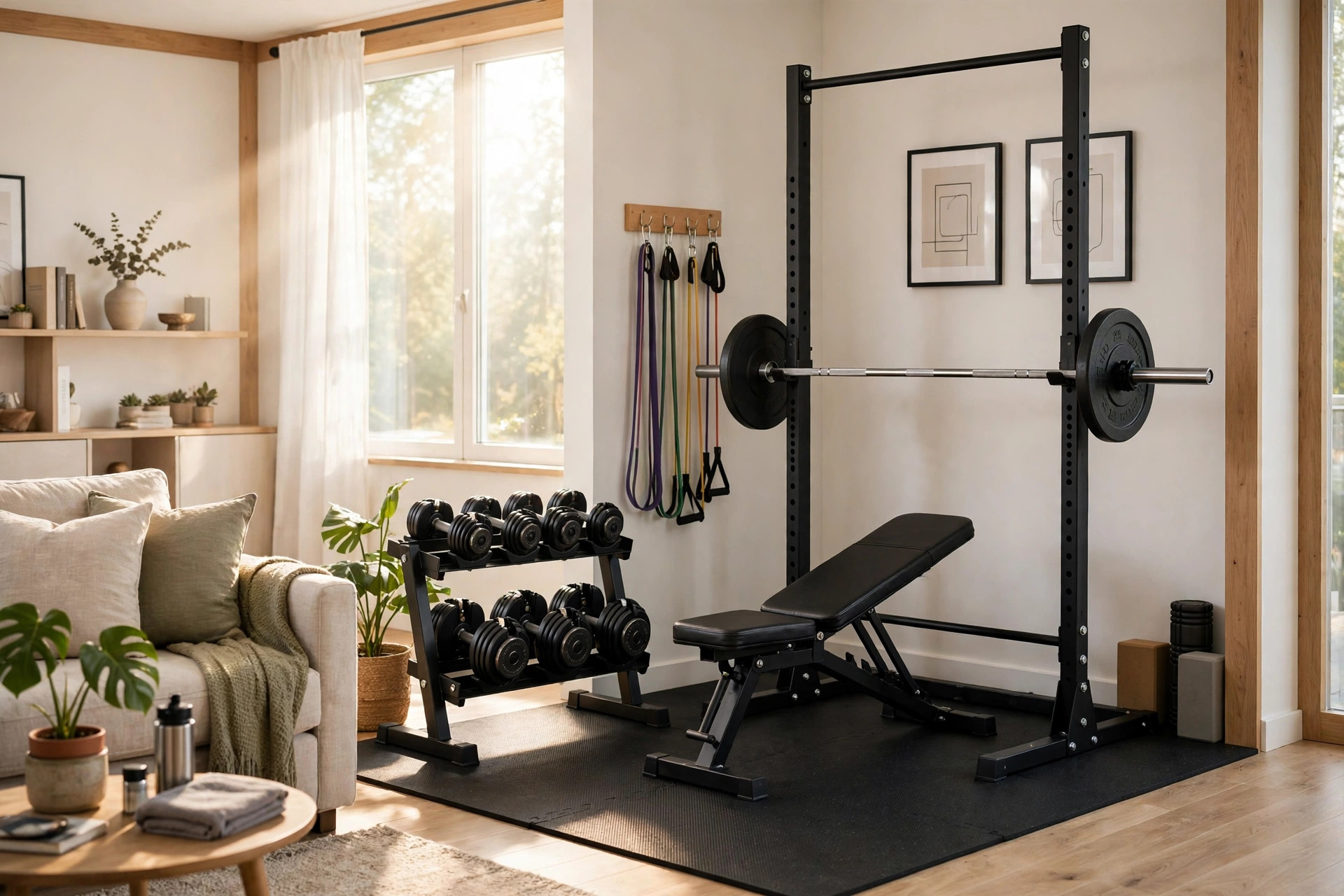
5. A power rack, barbell, and plates. This is the “real gym” upgrade, and it comes last for a reason: it’s the most expensive and the most space-hungry. A rack needs roughly 60 to 80 square feet and at least 7.2 feet of ceiling clearance for pull-ups. Budget $300 to $500 for the rack, $150 to $250 for an Olympic barbell, and $300 to $450 for a 300 lb plate set.
That fifth step is optional. Pieces one through four cover every major movement pattern — squat, hinge, push, pull, carry — and they’ll keep a beginner progressing for a year or more.
The Real Numbers: 3 Budgets That Work
Here’s the worked example, because vague advice helps nobody. Prices below are typical US retail ranges surveyed in September 2026.
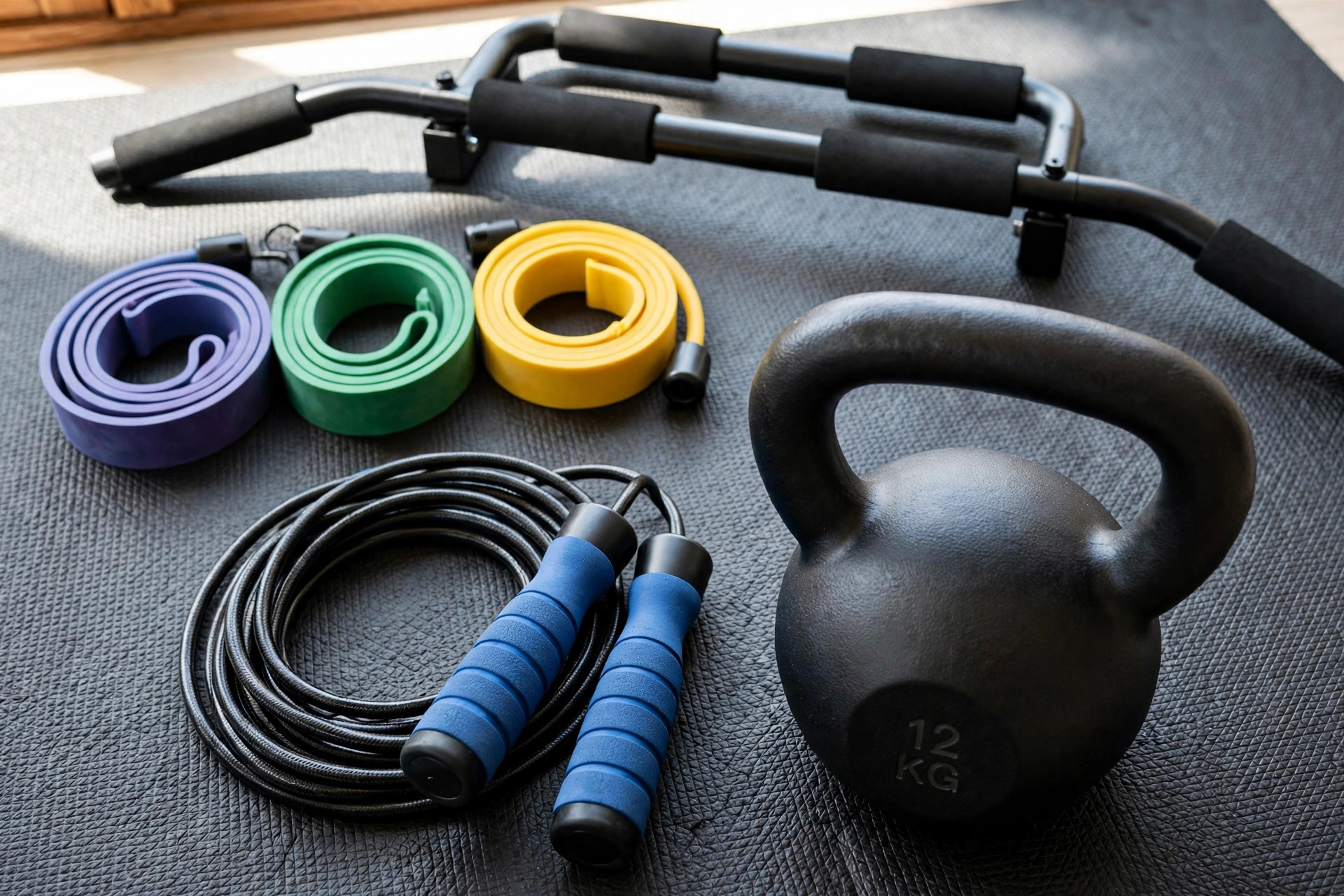
The $70 starter. A mat, a doorway pull-up bar, and a resistance band set. That’s roughly 30 exercises and real progress for months. If money is tight, start here without shame — a 2019 meta-analysis says bands build strength just fine.
The $330–$530 sweet spot. Adjustable dumbbells ($130–$300 on sale, often around $399 for a premium set) plus an adjustable bench ($109–$130). This covers around 130 exercises and is the setup I’d recommend to most people. Against a $50-a-month membership, it pays for itself in about 11 months — and then it’s free forever.
The $560–$780 full setup. Everything above plus a power rack and barbell. Over 200 exercises, every major compound lift, and a setup that can carry you for years. At $50 a month for a gym, this breaks even in about 13 months.
The minimum space for a dumbbell-and-bench home gym set is a 6×6 ft clear floor area — about the size of a yoga mat plus a step in each direction. A rack setup needs a 10×10 ft area. Measure before you buy, not after.
What to Skip: 3 Home Gym Myths
Myth: You need an all-in-one machine first. Fact: it has the worst price-to-exercises ratio of anything on the market. A single cable machine can cost more than the entire $500 dumbbell-and-bench setup and cover fewer movements. Buy the basics first; add a cable machine later if you still want one.
Myth: Bodyweight training can’t build muscle. Fact: the trial record says otherwise. Matched for effort, bodyweight and band work produced strength gains comparable to barbell training in the studies above. What bodyweight can’t do easily is progressive overload past a point — which is exactly why dumbbells come first on the shopping list.
Myth: More equipment means better results. Fact: most people use three or four pieces for 90% of their training. The garage full of gear looks impressive on social media; the person with dumbbells, a bench, and a consistent routine gets the results. Buy the next piece only when your current setup genuinely limits you.
Your First Week With a Home Gym Set
Theory is cheap, so here’s a concrete starting plan — three sessions, 30 to 40 minutes each, with a rest day between:
Day 1 — Push and legs: Goblet squats (3×10), dumbbell bench press (3×10), overhead press (3×8), walking lunges (3×12 steps). If you’re new to the goblet squat, hold one dumbbell vertically against your chest — it teaches upright posture better than any coaching cue I’ve heard.
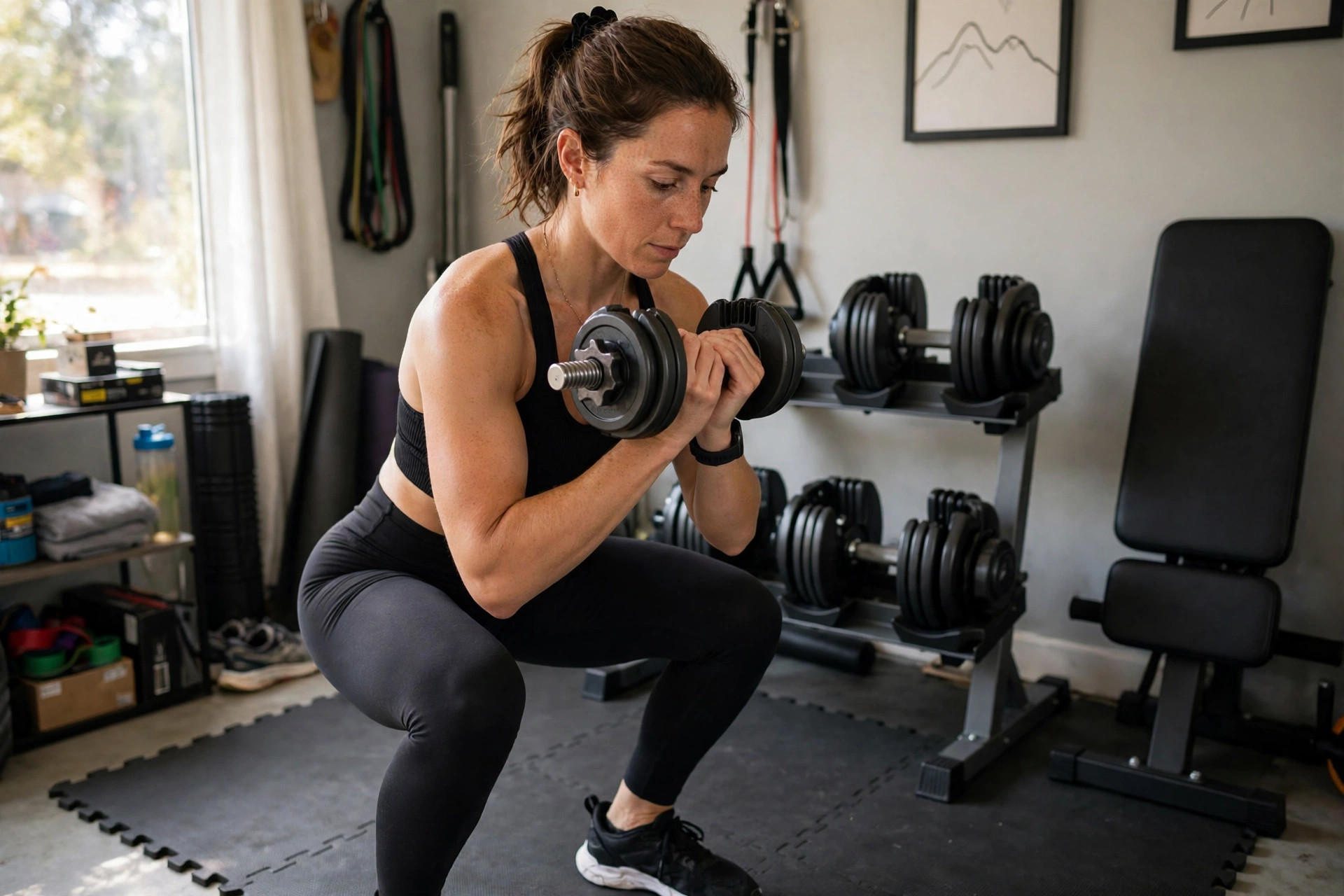
Day 2 — Pull and hinge: Romanian deadlifts with dumbbells (3×10), one-arm dumbbell rows (3×10 each side), band pull-aparts (3×15), pull-ups or band-assisted pull-ups (3× as many as you can). Finish with a two-minute farmer’s carry — grab the heaviest dumbbells you can hold and walk. And once bodyweight gets easy, a weighted vest is the cheapest way to add load without buying new plates.
Day 3 — Full body: Repeat Day 1’s squat and press, swap in dumbbell Romanian deadlifts, and add 10 minutes of easy cardio — a brisk walk counts, and if you want the science on why walking works, our breakdown of the 10,000-step myth is a good companion read. Rest 48 hours before training the same muscles again — a proper recovery routine matters as much as the workout itself; strength is built during recovery, not during the set.
Two sessions a week is the evidence-backed minimum for strength gains. Three is the sweet spot for most people. Four is for when you’re hooked — and you probably will be.
FAQs
Is a home gym set cheaper than a gym membership?
Yes, after the break-even point. At $50 a month, a $530 dumbbell-and-bench setup pays for itself in about 11 months. A $900 rack setup breaks even in about a year and a half. After that, every workout is free — and the equipment keeps its resale value if you ever quit.
How much space do I need for a home gym set?
A dumbbell-and-bench setup needs a 6×6 ft clear area. Add a power rack and barbell and you’ll want 10×10 ft with at least 7.2 ft of ceiling height. Measure your space, including ceiling height, before ordering anything heavy.
Can beginners build muscle with just dumbbells and bands?
Yes. The ACSM’s 2026 guidelines and multiple trials, including the Lopes meta-analysis and the Calatayud bench-press study, found strength gains from bands, bodyweight, and dumbbells comparable to gym machines when effort and volume were matched. Start with two to three sessions a week and add weight when you can finish all your sets with two reps to spare.
The Bottom Line
A home gym set isn’t a luxury purchase or a shortcut — it’s a trade. You trade a monthly fee and a commute for a one-time cost and ten steps to your workout. Start with adjustable dumbbells and a bench, add bands and a pull-up bar, and only buy the rack when your legs outgrow the dumbbells. The research says the equipment matters far less than the consistency, and consistency is exactly what a home gym set buys you. Measure your space, set a budget, and buy in order. Your future self — the one training at 6am in gym shorts, coffee still in hand — will thank you.
This article is for general information only and is not medical advice. Talk to a qualified health professional before starting a new training programme, especially if you have an existing condition, injury, or are returning to exercise after a break.