


For sixteen years, the advice about prostate cancer screening was basically a shrug: talk to your doctor, weigh the pros and cons, decide for yourself. That changed on November 12, 2026.
The American Cancer Society has issued its first updated prostate cancer screening guideline since 2010 — and this time, it doesn’t hedge. It tells men exactly when to get tested, how often, and what happens if the number comes back high. If you’re a man over 45 — or you love one — this is the new playbook.
What Actually Changed?
The old guideline, written in 2010, never directly recommended routine screening. It asked men to have a “shared decision-making” conversation with their doctor and then decide. In practice, that meant a lot of men never got tested at all.
The new guideline, published in CA: A Cancer Journal for Clinicians (Hoffman et al., 2026), flips that approach. After reviewing the accumulated evidence — including the European ERSPC trial, which found about a 20% relative reduction in prostate cancer deaths among men invited to screening — the ACS concluded the benefits of PSA-based screening now clearly outweigh the harms.
Here’s the short version: most men should get a PSA blood test every two years from age 50 to 69. Men at higher risk start earlier and test every year. And after 75, screening stops.
Find Your Schedule in 30 Seconds
Your screening plan depends on which group you’re in. Find yourself below — that’s your schedule.
At average risk — a non-Black man with no close family history of prostate cancer — get a PSA blood test every two years, from age 50 through 69.
If you’re Black — Black men face a higher risk of developing prostate cancer and of dying from it — get a PSA test every year, starting at age 45 through 69.
If you have a strong family history — a father, brother, or son diagnosed before age 65, or more than one first-degree relative diagnosed at any age — get a PSA test every year, from age 45 through 69.
One first-degree relative was diagnosed at 65 or older — get a PSA test every two years, from age 45 through 69.
If you’re 70 to 74 — talk it through with your doctor. The balance of benefits and harms gets murkier at this age, so the guideline calls for an individual decision. If you do keep screening, it’s every two years.
If you’re 75 or older — the ACS does not recommend screening. The same goes for any man with a life expectancy under ten years.
One more change worth knowing: the guideline no longer recommends the digital rectal exam (DRE) as part of routine screening. The PSA blood test does the job better, and the finger exam adds little.
What Happens If Your PSA Comes Back High?
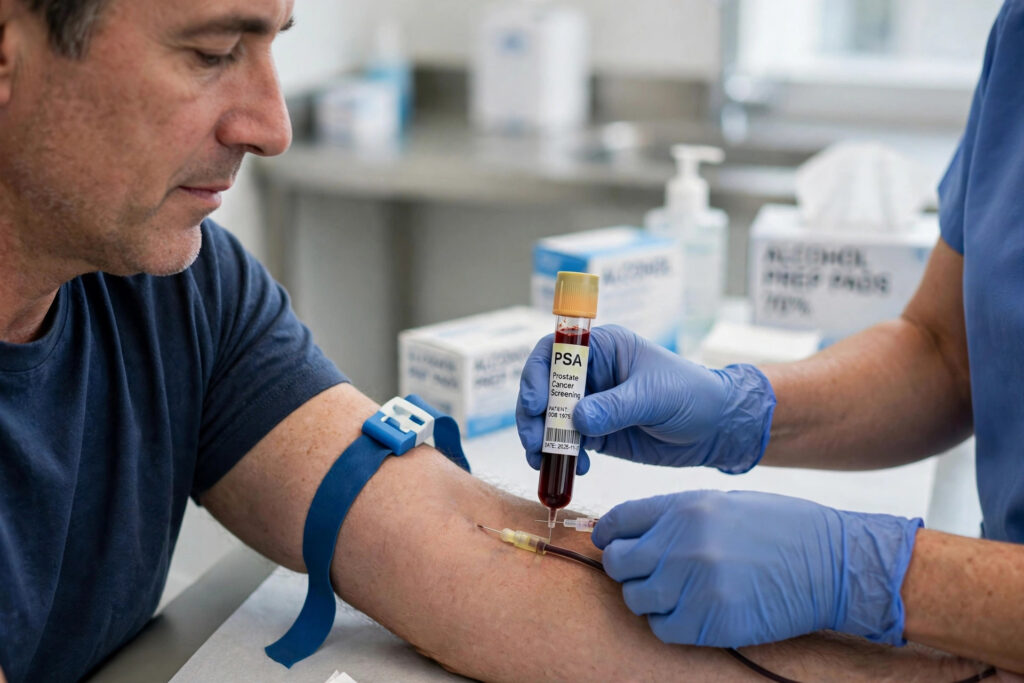
A PSA test measures prostate-specific antigen, a protein made by the prostate, in your blood. It’s a thirty-second blood draw. But the number is a signal, not a diagnosis — infections, an enlarged prostate, even a long bike ride the day before can push it up. That’s why the new guideline lays out a step-by-step path instead of leaving you and your doctor to improvise.
Step one: repeat the test. A PSA of 3.0 ng/mL or higher is considered elevated if you’re 45 to 69; for men aged 70 to 74, the line is 6.5 ng/mL. But one reading isn’t enough. PSA levels bounce around, so the guideline says to repeat the test, usually within two weeks to three months, to confirm the result.
Step two: secondary testing. If the repeat test is still high, most men should now be offered an MRI of the prostate and/or a validated biomarker test before anyone talks about a biopsy. This is a big deal — it means fewer unnecessary biopsies, because the MRI can show whether there’s actually something suspicious to aim at.
Step three: a biopsy only if it’s warranted. A biopsy is still the only way to confirm prostate cancer. But under the new approach, you reach that step with far more information than a single blood number.
Think of it like a smoke alarm: the PSA is the alarm, the repeat test checks whether it was a real fire or burnt toast, the MRI looks for smoke — and only then does anyone call the fire brigade.
A Real-Number Example: Why This Matters
The American Cancer Society estimates that 333,830 men in the United States will be diagnosed with prostate cancer in 2026, and about 36,320 will die from it. It’s the second-leading cause of cancer death in American men, behind lung cancer.
Now the screening numbers. The ERSPC trial — one of the largest screening studies ever run, following more than 160,000 men — found that inviting men to PSA screening cut prostate cancer deaths by roughly 20% in relative terms. For every 100 prostate cancer deaths that would have happened without screening, about 80 happen with it.
Here’s what that looks like for one person. Take David, 52, average risk, no family history. Under the new guideline, he gets a PSA test this year and every two years after that — roughly ten tests between now and 69. Each one is a thirty-second blood draw. If one comes back at, say, 3.4, he repeats it in a month, gets an MRI if it’s still high, and only faces a biopsy if the MRI shows something real. Ten blood draws over seventeen years to catch a cancer while it’s still curable: that’s the trade the guideline is asking men to make. And it’s a trade the evidence now supports.
The Old Advice vs. the New Advice
| Old guidance (2010) | New guidance (2026) | |
|---|---|---|
| Average-risk men | No direct recommendation — “discuss it with your doctor” | PSA every 2 years, ages 50–69 |
| Black men | Same shared decision-making | PSA every year, starting at 45 |
| Strong family history | Same shared decision-making | PSA every year, starting at 45 |
| After a high PSA | No standard next step | Repeat in 2 weeks–3 months, then MRI/biomarker |
| Rectal exam | Commonly part of screening | No longer recommended for routine screening |
| Age 75+ | Vague | Screening not recommended |
One thing that hasn’t changed: the U.S. Preventive Services Task Force (USPSTF) still has its own, more cautious guidance — individualised decision-making for men 55 to 69 — and it’s in the process of updating it. If your doctor follows the Task Force rather than the ACS, ask them about the new guideline directly.
Myth vs. Fact
Myth: “A high PSA means I have cancer.”
Fact: Not even close. An enlarged prostate, an infection, or recent vigorous exercise can raise PSA. That’s exactly why the new guideline insists on a repeat test and an MRI before a biopsy is even discussed.
Myth: “Prostate cancer is so slow that screening doesn’t matter.”
Fact: Many prostate cancers are slow-growing, and some never need treatment. But the aggressive kind kills more than 36,000 American men a year. Screening’s whole job is to tell the two apart early, while the dangerous ones are still treatable.
Myth: “I’m fit and healthy, so I don’t need to worry about this.”
Fact: Prostate cancer doesn’t check your gym attendance. It has no early symptoms — by the time you feel something, it’s usually advanced. Fitness lowers your risk of many diseases; it doesn’t make you immune to this one. That’s why this belongs on every active man’s health list alongside testosterone checks and grip strength — the simple numbers that quietly predict how you’re ageing.
Why This Belongs on an Athlete’s Health List
Prostate cancer is an age game, and the men reading this site are ageing athletes. The 52-year-old who runs marathons and the 60-year-old who still deadlifts are exactly the people this guideline is written for. Staying strong into your sixties — the kind of thing we wrote about in losing strength at 35 — only matters if the rest of you is still there to enjoy it. Active men are often the worst at preventive care: we track heart rate, sleep, and macros, then skip the blood test that takes thirty seconds. If you can schedule a race six months out, you can schedule a PSA test.

What to Do This Week
Three things, and none of them takes long. First, work out which group you’re in — average risk, higher risk, or the 70–74 conversation group. Second, book the blood test: if you’re 50 or over and haven’t had a PSA test, ask your doctor for one at your next visit. If you’re 45 or over and Black or have a strong family history, same thing, just sooner. Third, know your number — write it down when the result comes back, because PSA is most useful as a trend over time.
If your doctor hasn’t heard about the November 2026 update yet — it only came out five days ago — bring it up. The American Cancer Society’s own summary lays out every recommendation in plain language.
The Bottom Line
Sixteen years of “talk to your doctor and decide for yourself” is over. The American Cancer Society now says, plainly: average-risk men, a PSA test every two years from 50 to 69. Higher-risk men, every year from 45. A high result gets repeated, then checked with an MRI — not rushed to a biopsy. And after 75, you can stop.
It’s a small change to your calendar. But for the one man in eight who will face this diagnosis in his lifetime, those blood draws are the difference between finding it early and finding it late — so go book the test.
Frequently Asked Questions
At what age should I start prostate cancer screening?
Average-risk men: start at 50, test every two years through 69. Black men and men with a strong family history: start at 45, test every year through 69. Men with one first-degree relative diagnosed at 65 or older start at 45 but test every two years.
What PSA level is considered high?
A PSA of 3.0 ng/mL or higher is elevated for men aged 45 to 69, and 6.5 ng/mL or higher for men aged 70 to 74. A single high reading isn’t a diagnosis — repeat the test within two weeks to three months to confirm it.
Do I still need a rectal exam for prostate screening?
No — the updated guideline does not recommend the digital rectal exam (DRE) as part of routine screening, because the PSA blood test is more effective.
This article is for general information only and is not medical advice. Prostate cancer screening decisions are personal — talk to your own doctor about your age, risk factors, and family history before starting or stopping any screening.