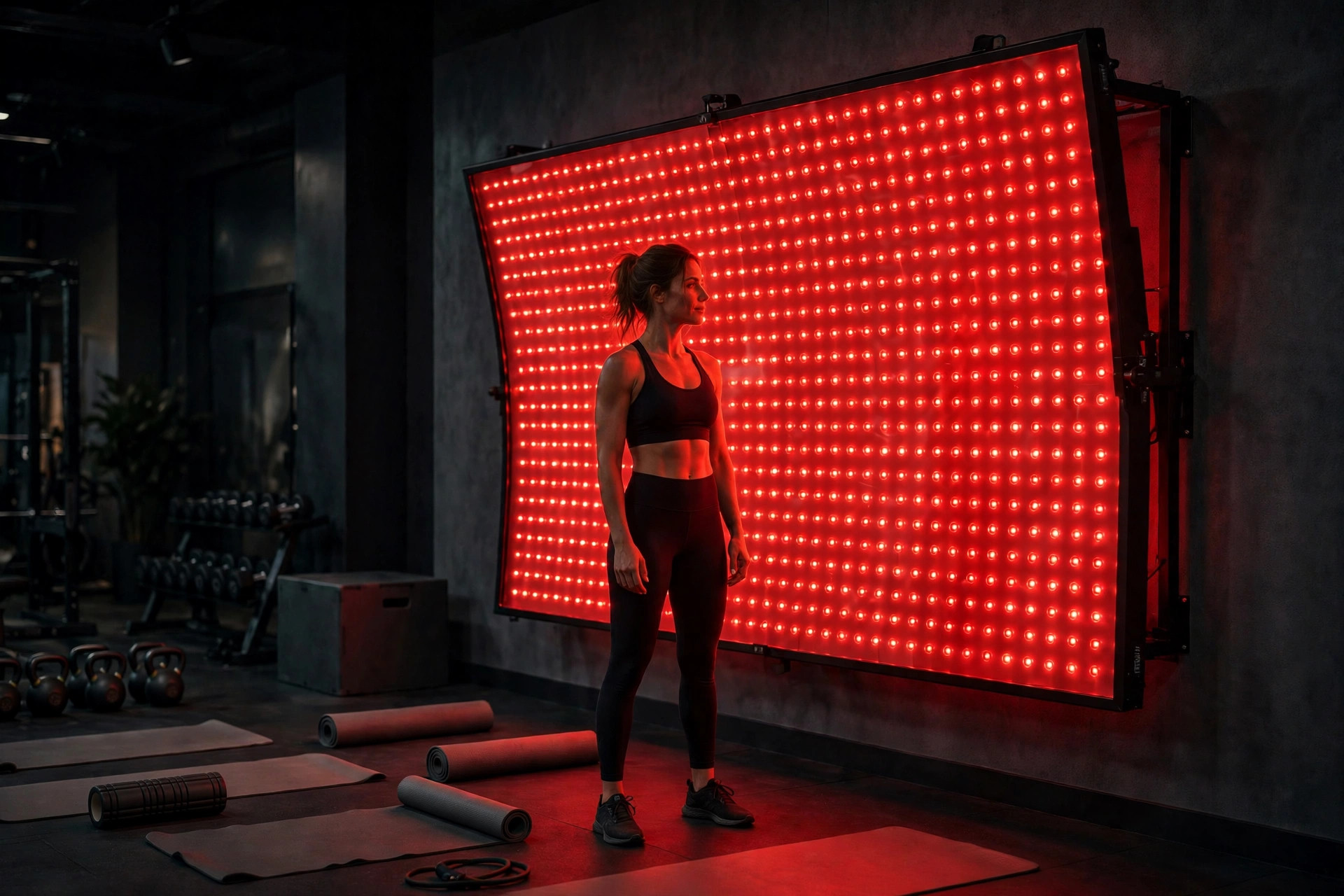

There’s a red glow coming from the corner of my gym now. A panel the size of a small fridge sits by the stretching mats, and every evening there’s a queue of people standing in front of it like they’re waiting for a bus. Nobody talks. They just stand there, bathed in red light, looking faintly embarrassed and faintly hopeful.
I get it. The promise is seductive: stand in front of a light for ten minutes and your sore legs recover faster. Searches for the gear are up more than 100% year over year. But does it work? I read the trials instead of the ads. The answer is more interesting — and more annoying — than either side admits.
What Red Light Therapy Actually Is
Scientists call it photobiomodulation, which is a terrible name for a simple idea. You shine specific wavelengths of red and near-infrared light onto your skin, and the light gets absorbed by an enzyme called cytochrome c oxidase inside your cells’ mitochondria — the little engines that produce energy. The theory is that the light nudges those engines to work more efficiently, which reduces oxidative stress and calms inflammation. Less inflammation, faster repair.
Red light (roughly 630–660 nanometres) works near the surface; near-infrared (roughly 810–850) reaches deeper, into muscle. Most decent devices combine both. The science isn’t new — researchers have studied low-level light therapy since the 1960s, including NASA wound-healing experiments. What’s new is the marketing: clinic science now hangs on bedroom walls.
What the Research Really Shows
The best evidence is a 2024 meta-analysis in Lasers in Medical Science pooling 34 randomised controlled trials of light applied to muscles before exercise. The results were real but small: muscle endurance improved (effect size 0.31), strength recovery improved (0.24), and creatine kinase — a blood marker of muscle damage — dropped by about 78 units. Real effects — and modest ones. Nobody turned superhuman; they just recovered a little better.
A 2026 meta-analysis of 23 placebo-controlled trials found the same pattern — small improvements — with the authors concluding the evidence is “insufficient to define optimal protocols.” In plain English: it seems to help a bit, but nobody can tell you exactly how to do it yet.
Then the twist: in the 2024 analysis, benefits showed up in athletes and in physically inactive people — but NOT in regularly active non-athletes. Athletes push hard enough to create damage light can help repair; inactive people have more room to improve. If you’re a serious athlete, that’s good news. If you train three times a week and feel fine, the light may have nothing left to fix.
What about soreness? A 2025 meta-analysis of 19 trials found light before exercise reduced it, but rated the evidence low certainty. A 2026 network meta-analysis found light therapy cut soreness scores by roughly 18 to 19 points on a 100-point scale at 24 and 48 hours after hard exercise — a difference you’d notice the morning after leg day, but not a miracle. Ice baths help soreness too — our ice baths vs cold showers guide covers when each makes sense.
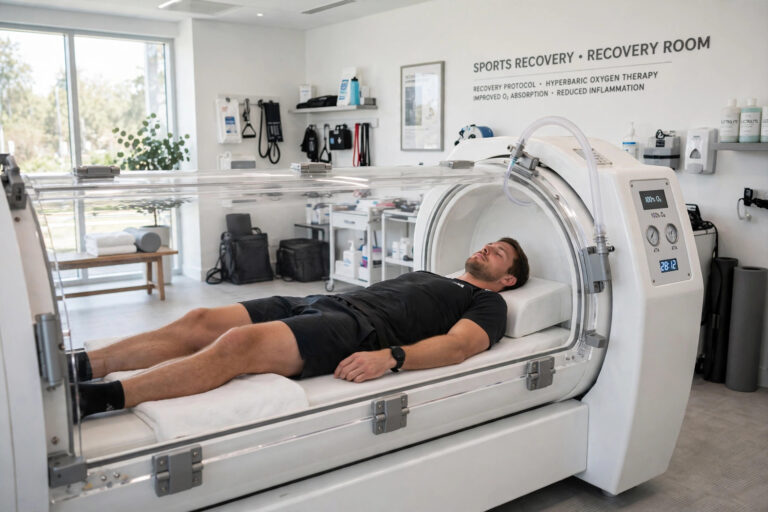
A 2025 umbrella review of 204 randomised trials found significant effects for only 12 of 35 outcomes — the hype has run ahead of the proof. And whole-body light beds? A 2025 review of five studies found no benefit for performance or fatigue, though two reported better sleep. It’s the same story as hyperbaric oxygen therapy, which we reviewed recently — interesting science, modest proof, high price tag.
The Dose Problem: Why Your Panel Isn’t the Study Device
Here’s the part the ads never mention, and it’s the most important thing in this article.
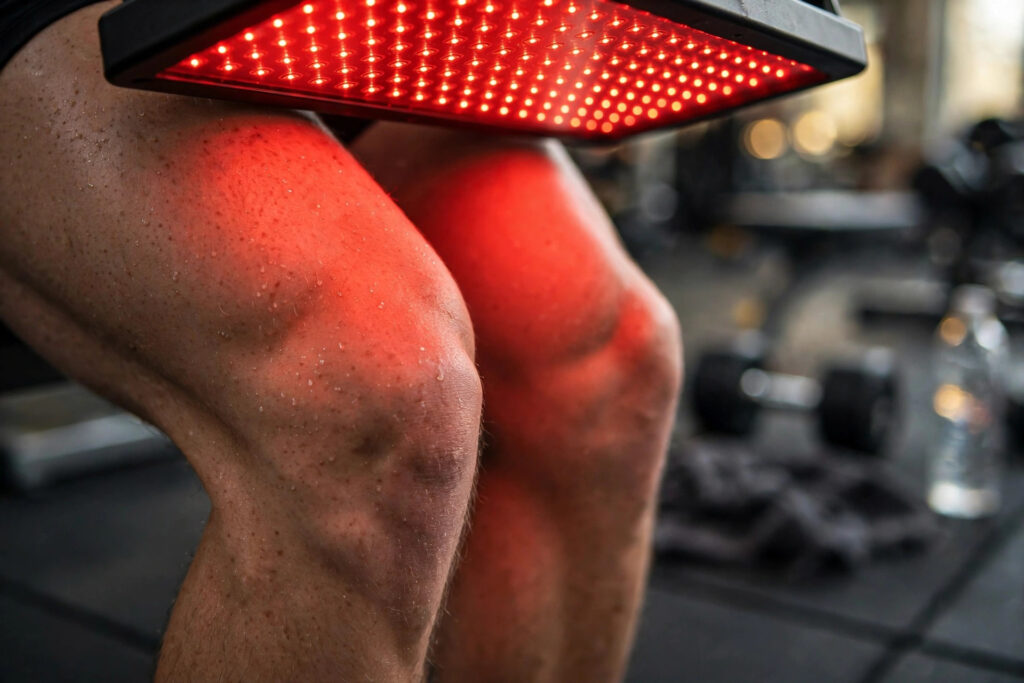
Almost every trial that found a benefit used a laser or an LED cluster pressed directly against the skin, delivering a carefully measured dose — typically 60 to 300 joules of total light energy per muscle group, according to an analysis of the positive trials by Leal-Junior and colleagues. Contact matters. Distance matters enormously, because light intensity falls off fast as you move away from the source.
Now do the maths on a home panel. Say the manufacturer rates it at 100 milliwatts per square centimetre at 15 centimetres away — a common spec. Ten minutes at that distance gives 60 joules per square centimetre (100 milliwatts × 600 seconds). But step back to half a metre — how most people actually use them — and intensity can drop to a quarter or less; a metre away, you might be getting a tenth. You’re still glowing red. You’re just not getting the study dose.
The studies tested a medical device held against a muscle. The product on your wall is a different experience — same wavelengths, wildly different dose, nobody measuring anything. Home panels may still do something. You just can’t assume the trial results apply to how you’re using yours.
Myth vs Fact: The Short Version
Myth: “FDA cleared means the FDA says it works.” Fact: FDA clearance (510(k)) means a device was found substantially equivalent to an existing device for a specific use — wrinkles, or minor muscle pain. Clearance is not approval, and says nothing about how big the benefit is. “FDA registered” means even less: the manufacturer just listed itself in a database.
Myth: “More light is better — just use it longer.” Fact: photobiomodulation has a sweet spot. Too little light does nothing, and too much can actually work against you — researchers call it a biphasic dose response. Twenty minutes isn’t automatically twice as good as ten.
Myth: “It’s completely risk-free because it’s just light.” Fact: it’s low risk, not no risk. The most common side effects are mild skin irritation and eye strain, and the long-term data doesn’t exist yet — these devices haven’t been in home use long enough to study for decades.
If You’re Going to Try It, Do It Like This
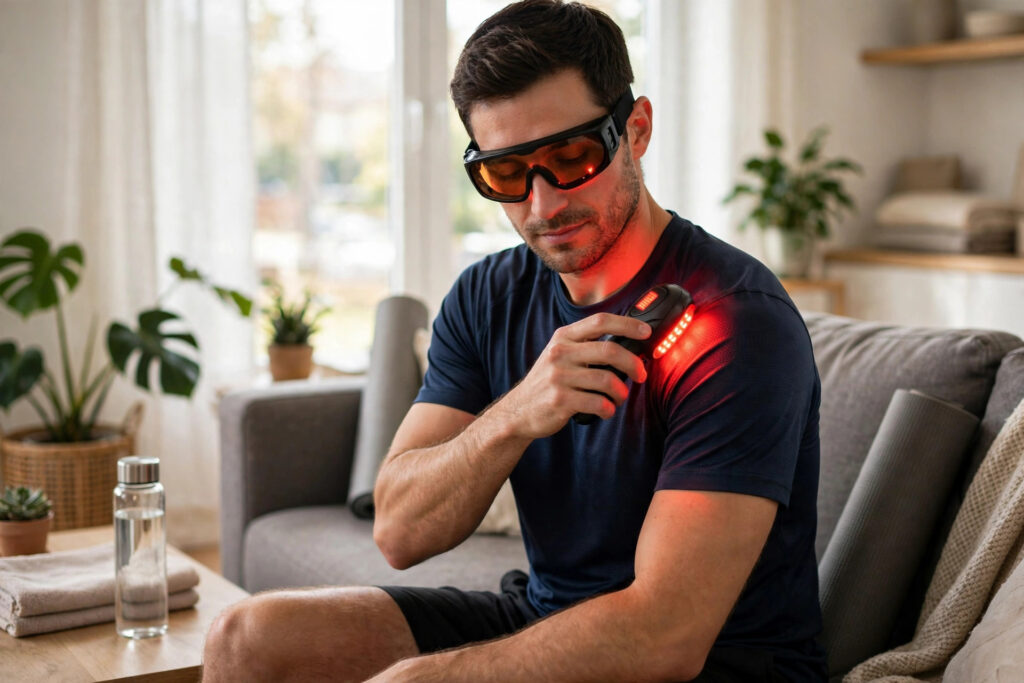
Use it BEFORE training, not after — nearly all the positive trials applied light before exercise, the single biggest mismatch between the research and how most people use their panels. Get close: ten to twenty minutes, three to five times a week, panel 15 to 30 centimetres from the target muscle, skin exposed. If the manual says “stand one metre away,” that’s a comfort instruction, not a dosing one. Wear eye protection — the red glow is obvious, the near-infrared isn’t, and your eyes don’t know the difference. Give it four to six weeks and judge it properly: keep a soreness log, rating your legs 1 to 10 the morning after leg day. If the numbers don’t move, the panel is a lamp. Don’t judge it on vibes.
Who Should Be Careful
Red light therapy is generally considered safe in the short term, with few adverse events in trials. But “generally safe” has edges: if you take medication that makes skin light-sensitive — some antibiotics and acne treatments do — check with your doctor first. If you’re pregnant, there isn’t enough data to say either way, so most clinicians advise caution. And if you have a skin condition, a history of skin cancer, or an unexplained lump or wound that won’t heal, get that checked first. Skip cheap panels with no published specs — good makers publish wavelengths and irradiance; bad ones publish testimonials.
Frequently Asked Questions
Does red light therapy actually work for muscle recovery?
A little, sometimes. Pooled trials show small improvements in endurance, strength recovery, and soreness when light is applied before exercise — but the effects are modest, the evidence certainty is low to moderate, and the studies used clinical devices pressed against the skin, not home panels used from a distance. A real effect — but not the transformation the ads promise.
How long does it take to see results from red light therapy?
Most trials ran for several weeks, so don’t judge it after one session. Four to six weeks of consistent use — three to five sessions a week, before training — is a fair trial. Track something concrete, like your soreness score the morning after a hard session. If nothing changes in six weeks, it isn’t going to.
Is red light therapy safe to use every day?
Short-term studies report very few side effects, mostly mild skin irritation. But there’s no long-term data on daily home use over years, and more isn’t better — overdoing it can reduce the benefit. Most protocols use it three to five times a week, not daily, with eye protection. On photosensitising medication or with a skin condition? Talk to a doctor first.
The Bottom Line
Red light therapy is real science wrapped in oversized marketing. The effect is genuine but small — a little less soreness, a little faster strength recovery — and it only shows up when the dose is right: before training, close to the skin, consistently for weeks. The person standing a metre from a wall panel for five minutes after their workout is getting the ritual, not the treatment.
If you already own a panel, use it properly and track the results — you might be one of the people it genuinely helps. If you don’t own one, fix your sleep and protein first; they move the needle more than any light ever will, as our roundup of the best recovery techniques for athletes explains. And if you do buy one, choose a manufacturer that publishes its wavelengths and irradiance.
The red glow in the corner of the gym isn’t a scam. It’s a small tool being sold as a big one. Use it like a small tool, and it might earn its place in your routine.
This article is for general information only and is not medical advice. Red light therapy is not a treatment for any medical condition. If you have a health condition, take medication that affects light sensitivity, or are pregnant, speak to a qualified healthcare professional before using a light therapy device.