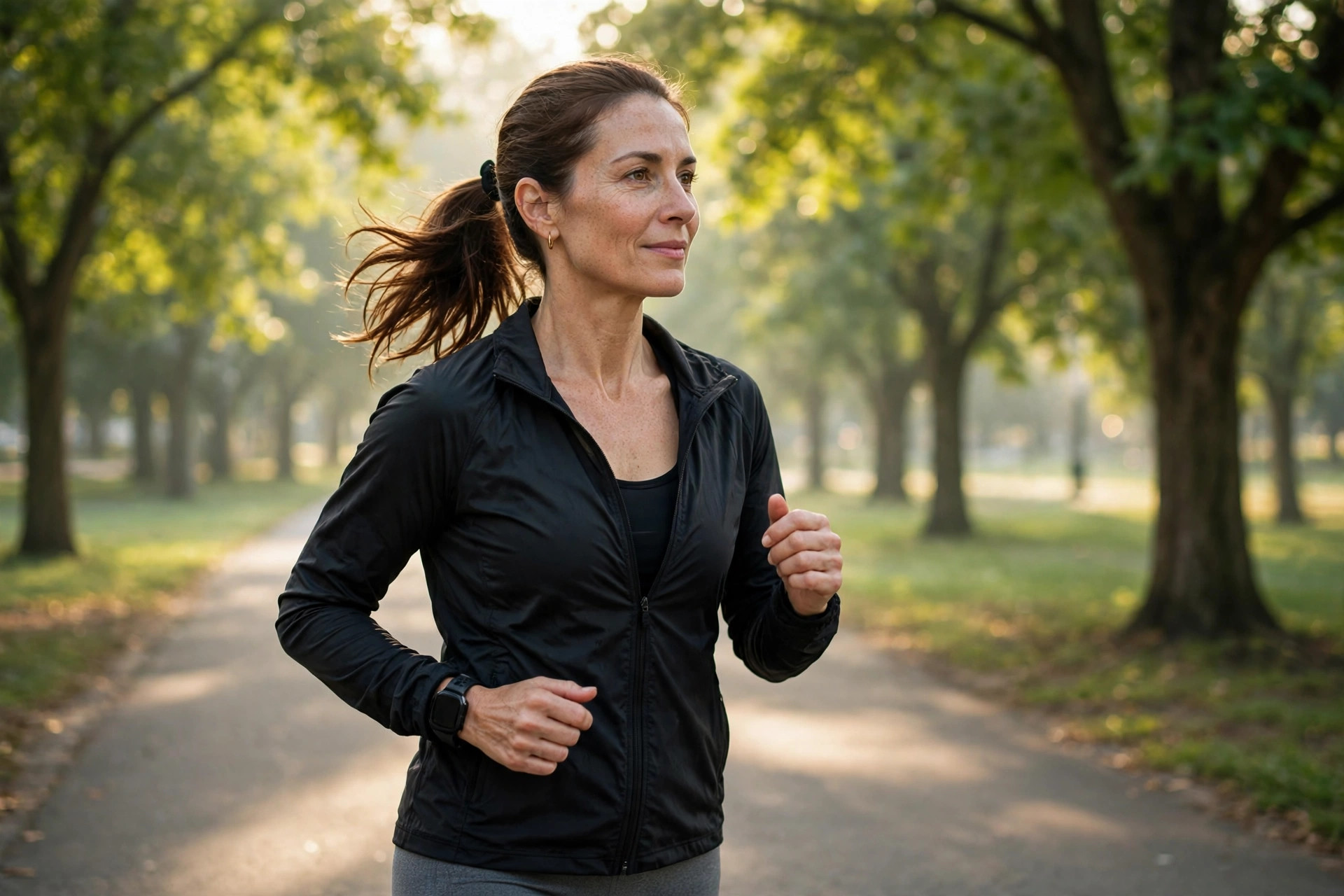

You’re 42. You train four times a week, you’ve done the same Tuesday run for years, and lately it feels like someone quietly turned the difficulty up. Your sleep is broken, your patience is shorter, and your period — reliable as clockwork for two decades — has started doing whatever it wants. Nothing is “wrong” exactly. But nothing feels quite like you either.
If that sounds familiar, you might be meeting perimenopause. And here’s the part nobody tells you at 40: it doesn’t arrive with a drumroll. It creeps in, one weird symptom at a time, years before your periods actually stop.
What Is Perimenopause, Really?
Perimenopause is the transition leading up to menopause — the years when your ovaries start winding down and your estrogen and progesterone levels stop following their old, predictable rhythm. Instead of a smooth decline, your hormones swing. Some months estrogen surges higher than ever; other months it drops. That’s why the symptoms feel so random.
Most women notice the first changes in their 40s, though some spot them in their late 30s. The transition typically lasts four to eight years, according to The Menopause Society, and it ends once you’ve gone 12 months without a period — that’s menopause itself, which arrives at an average age of 51 in the US.
The Symptoms That Show Up First
Perimenopause symptoms at 40 rarely look like the textbook list. They show up disguised as other things — stress, a bad week, getting older. These are the ones women notice first:
Your cycle changes shape. This is usually the earliest sign. Your period might come a week early, then skip a month, then arrive heavier than you’ve had in years. The Mayo Clinic notes that if your cycle length varies by seven days or more from your normal pattern, you may be in early perimenopause. If you go 60 days or more between periods, you’re likely in the late stage.
Your sleep falls apart. You fall asleep fine, then wake at 3 a.m. wired and sweating, or you can’t fall asleep at all. Night sweats are the obvious culprit, but many women find their sleep gets lighter and more broken even without them. Poor sleep then feeds everything else — the irritability, the fog, the flat workouts.
Your mood shifts. Tearfulness, irritability, anxiety that seems to come from nowhere. Many women tell me they feel like themselves, just… louder. It’s not weakness and it’s not “just stress” — fluctuating estrogen affects serotonin and other brain chemicals directly.
Brain fog moves in. You walk into a room and forget why. You lose words mid-sentence. It’s unsettling, and it’s one of the most common complaints of this stage. The good news: for most women it eases after the transition.
Your body changes the rules. Joints ache in the morning. Recovery from a hard session takes an extra day. Weight settles around your middle even though your eating hasn’t changed. None of this happens overnight — it accumulates, which is exactly why it’s so easy to miss.
Why Your Workouts Suddenly Feel Harder
This is the part that hits active women hardest, and the part almost nobody explains. Estrogen isn’t just a reproductive hormone — it helps your muscles repair, keeps your bones dense, and influences how your body uses fuel. When it starts swinging, your training response changes with it.
The research here is genuinely striking. The SWAN study — the largest long-term study of the menopause transition in North American women — found that significant bone loss begins about a year before your final period and runs fastest for roughly three years around that point. Over the five to seven years surrounding menopause, women can lose up to 20 percent of their bone density. That’s not a slow drift. That’s a window where what you do matters enormously.
Muscle takes a hit too. Studies tracking women through the transition show lean mass dropping by around 2.5 percent during perimenopause and nearly 6 percent after menopause, compared with premenopausal baselines. Same training, same food — less muscle kept. It’s not your imagination that the weights feel heavier.
What Actually Helps
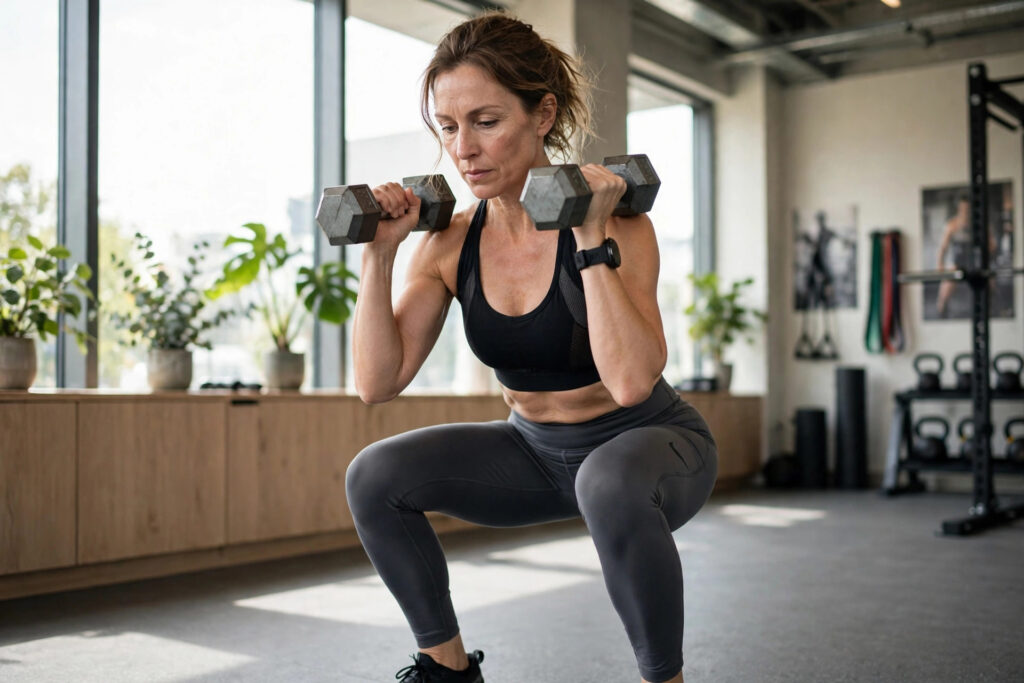
Strength training is the single most useful tool you have. Of everything studied in menopausal women, resistance training has the strongest, most consistent evidence. Two to three sessions a week of progressive strength work preserves — and in some cases increases — bone density at the hip and spine, the two sites most vulnerable to fracture. A 2023 meta-analysis in the journal Menopause pooled 12 randomized trials and found resistance training safe, with no serious adverse events, and more effective than aerobic exercise alone at reducing hot flashes.
A small Swedish trial adds a vivid detail: 15 weeks of strength training three times a week cut moderate-to-severe hot flashes by 43.6 percent, against just 2 percent in the comparison group. It was a small, unblinded trial, so take the exact number with a grain of salt — but the direction of the evidence is consistent.
Aerobic exercise still matters — just not for hot flashes. A Cochrane review found aerobic exercise alone doesn’t reliably reduce hot flashes. That’s worth knowing, because a lot of women are told to “just walk more” and then feel like failures when the flushes don’t stop. Walking, cycling and running still help your heart, your mood, your sleep and your weight — they just aren’t a hot-flash treatment. Aim for around 150 minutes of moderate activity a week, alongside the strength work.
Sleep is a lever, not a luxury. Broken sleep makes every other symptom worse, and perimenopause is a prime time to get serious about it: a cool, dark bedroom, a consistent wake time, caffeine cut off by midday, and screens out of the last hour before bed. If night sweats are the problem, moisture-wicking sleepwear and a fan genuinely help. If sleep stays wrecked for weeks, that’s worth a doctor’s visit on its own.

Protein still counts. With muscle repair slowing as estrogen falls, aim for roughly 1.6 grams of protein per kilogram of body weight a day, spread across meals rather than loaded into one. And if sleep is your weak spot, magnesium is worth a chat with your clinician — many athletes already use it for recovery.
A Sample Week That Fits Real Life
Here’s what a perimenopause-friendly training week can look like — no heroics, just consistency:
- Monday: Full-body strength, 40 minutes (squat, hinge, push, pull, carry)
- Tuesday: 30-minute brisk walk or easy cycle, plus 10 minutes of stretching
- Wednesday: Rest or gentle yoga
- Thursday: Full-body strength, 40 minutes, slightly heavier than Monday
- Friday: 20–30 minutes of intervals or a favourite class
- Saturday: A longer walk, hike or swim — the fun one
- Sunday: Full rest
Notice what’s missing: no six-day grind, no punishment sessions. Two strength days protect your bones and muscle, the easy cardio protects your heart and sleep, and the rest days are doing real work too — recovery is slower now, and respecting that is a strategy, not a surrender.
Myth vs. Fact
Myth: “Perimenopause only starts at 50.”
Fact: Most women begin in their 40s, and some notice changes in their late 30s. Starting at 42 isn’t early — it’s textbook.
Myth: “A blood test will tell you if you’re in perimenopause.”
Fact: Hormone levels swing wildly day to day during this stage, so a single test can’t diagnose it. The Menopause Society and the American College of Obstetricians and Gynecologists both say diagnosis is based on your age, your cycle changes and your symptoms — not a lab number.
Myth: “Hot flashes last a year or two.”
Fact: The SWAN study found the typical hot-flash run lasts a median of 7.4 years. That sounds daunting, but it also means it’s worth treating properly rather than white-knuckling through it.
Myth: “Exercise will fix your hot flashes.”
Fact: Strength training shows real promise, but aerobic exercise alone doesn’t reliably reduce them. Exercise is still worth doing for your bones, mood, sleep and heart — just don’t judge it by the flush count.
When to See a Doctor
Most perimenopause symptoms are normal, but a few things deserve a prompt appointment: bleeding after you’ve gone 12 months without a period, periods so heavy you’re soaking through protection hourly, bleeding between periods, or symptoms — mood, sleep, hot flashes — that are wrecking your daily life. There are effective treatments, including hormone therapy for suitable candidates and non-hormonal options, and you don’t get extra credit for suffering through it.
Also worth ruling out: thyroid problems and low iron can mimic perimenopause almost exactly, and both are common in this age group. A simple blood test sorts that out.
FAQs
Can perimenopause start at 35?
Yes, though it’s less common. Most women begin in their 40s, but changes can appear in the late 30s, and perimenopause before 40 is considered early and worth a medical evaluation. If your cycles have changed and you’re in your mid-30s, don’t assume you’re imagining it — track your symptoms and talk to your doctor.
Does exercise really help with perimenopause symptoms?
Strength training two to three times a week has the best evidence: it protects bone density and muscle, and a 2023 meta-analysis found it also reduces hot flashes more effectively than aerobic exercise alone. Aerobic exercise helps mood, sleep and heart health, but don’t expect it to stop hot flashes on its own. The honest answer is that exercise changes how your body experiences the transition — it doesn’t switch the transition off.
Will I definitely gain weight during perimenopause?
Not definitely, but the odds shift. Hormonal changes push fat toward the abdomen and make muscle harder to keep, which slowly lowers your metabolic rate. Women in the SWAN study gained roughly a quarter of a kilo a year through midlife on average. Strength training, enough protein and good sleep are the most effective countermeasures — and they work better than cutting calories hard.
The Takeaway
Perimenopause symptoms at 40 aren’t a sign that your body is failing you — they’re a sign that it’s changing the rules, and that the playbook that worked at 30 needs an update. The women who navigate this stage best aren’t the ones who push harder through it. They’re the ones who lift heavy twice a week, protect their sleep like it’s training, eat enough protein, and stop blaming themselves for changes driven by hormones.
You spent years building a strong, capable body. This stage doesn’t undo that. It just asks you to train it a little differently — and to give yourself the same patience you’d give a training partner.
This article is for general information only and is not medical advice. Perimenopause affects every woman differently, so talk to your doctor or another qualified healthcare professional before starting a new exercise programme, changing your diet, or adding a supplement — especially if you have an existing health condition or your symptoms are severe.