
I first heard about aqua pilates from a training partner who’d torn her meniscus and couldn’t do a single bodyweight squat without wincing. Three weeks later she was doing full Pilates sequences — in a pool. “It feels like cheating,” she told me, “until your core starts shaking on rep eight.”
She wasn’t exaggerating, and she’s not alone. Searches for aqua pilates jumped 171% year over year this November, making it one of the fastest-rising fitness searches in the US right now. Pilates in water sounds like a spa-day gimmick. The research says something more interesting: it’s a genuinely useful training tool for athletes — especially the injured, the overtrained, and anyone whose joints have started filing complaints.
Here’s what it is, what the science actually supports, and how to try it without wasting a session.
What Is Aqua Pilates, Exactly?
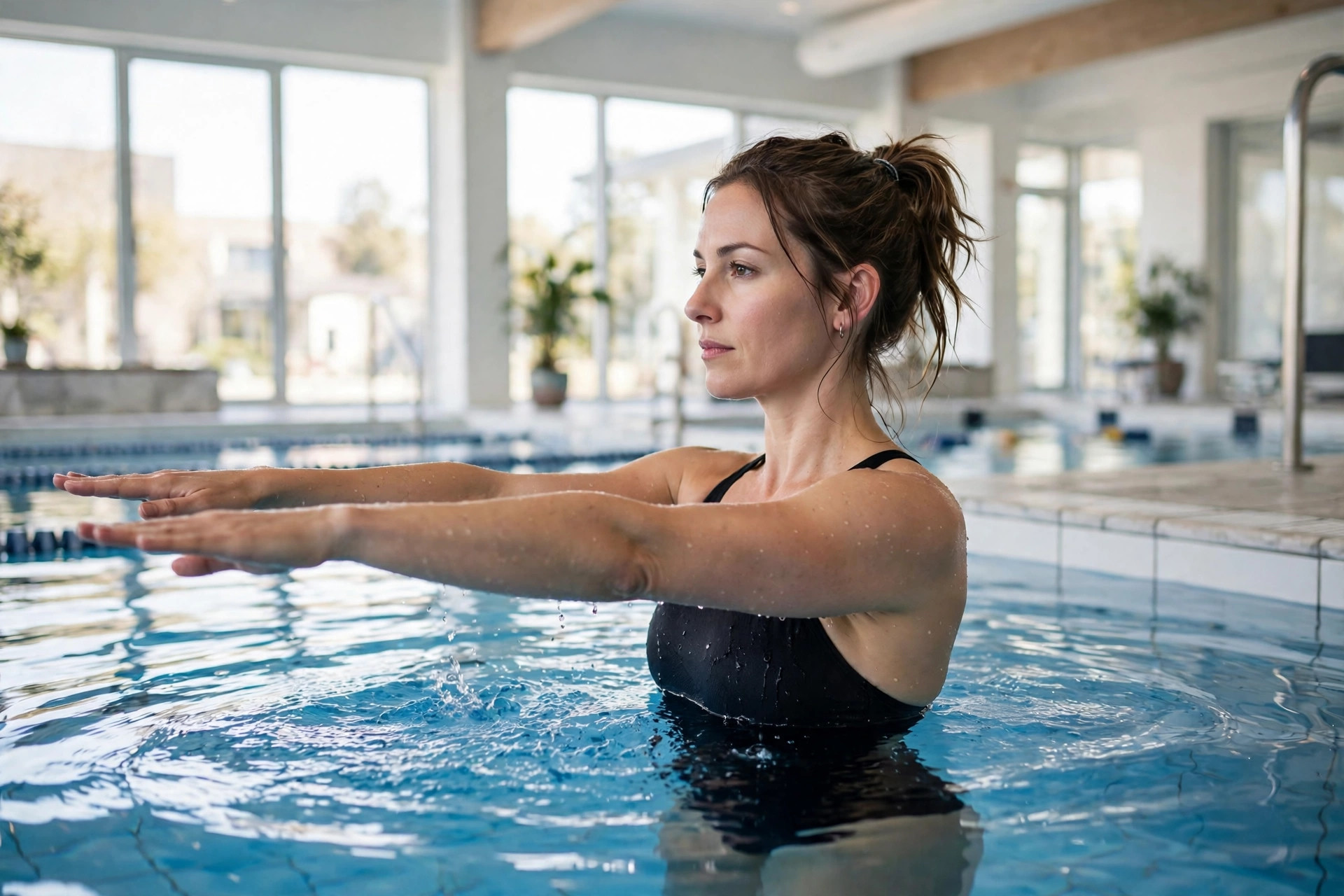
Aqua pilates — sometimes sold as “aqualates” — takes classic mat and reformer Pilates exercises and adapts them for chest-deep water. Same principles: breath, control, pelvic alignment, shoulder stability, slow deliberate movement. Different environment: the water holds you up and pushes back at the same time.
That combination is the whole point. Buoyancy unloads your joints while water resistance loads your muscles from every direction. A leg lift that feels easy on a mat becomes a genuine fight against drag in the pool — and your stabilisers, the small muscles that keep you upright, work overtime just to keep you balanced in a medium that never stops moving.
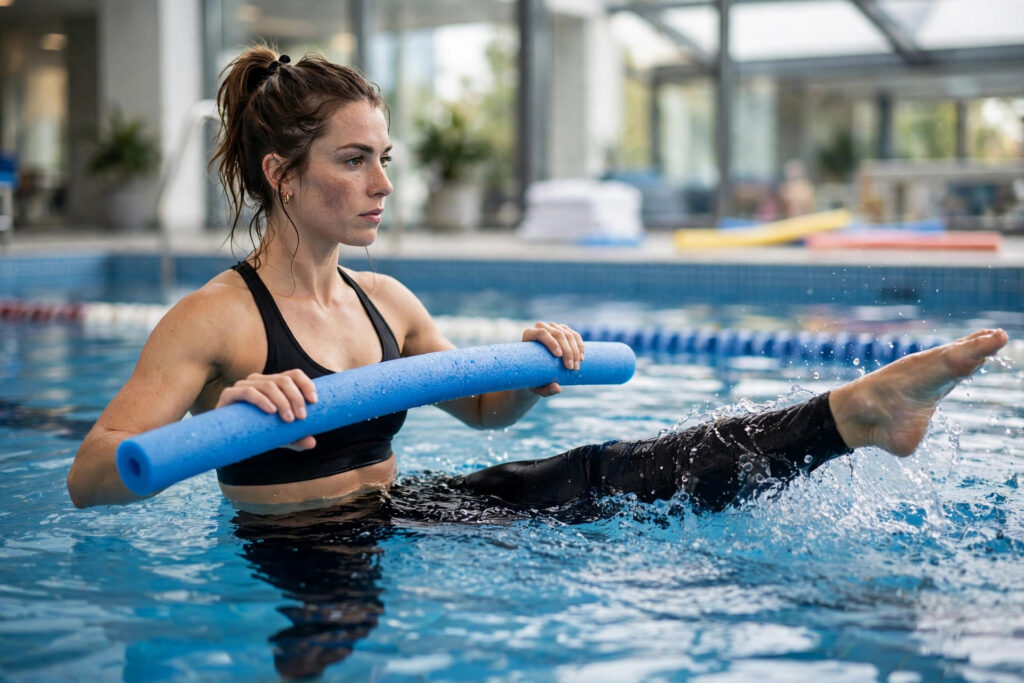
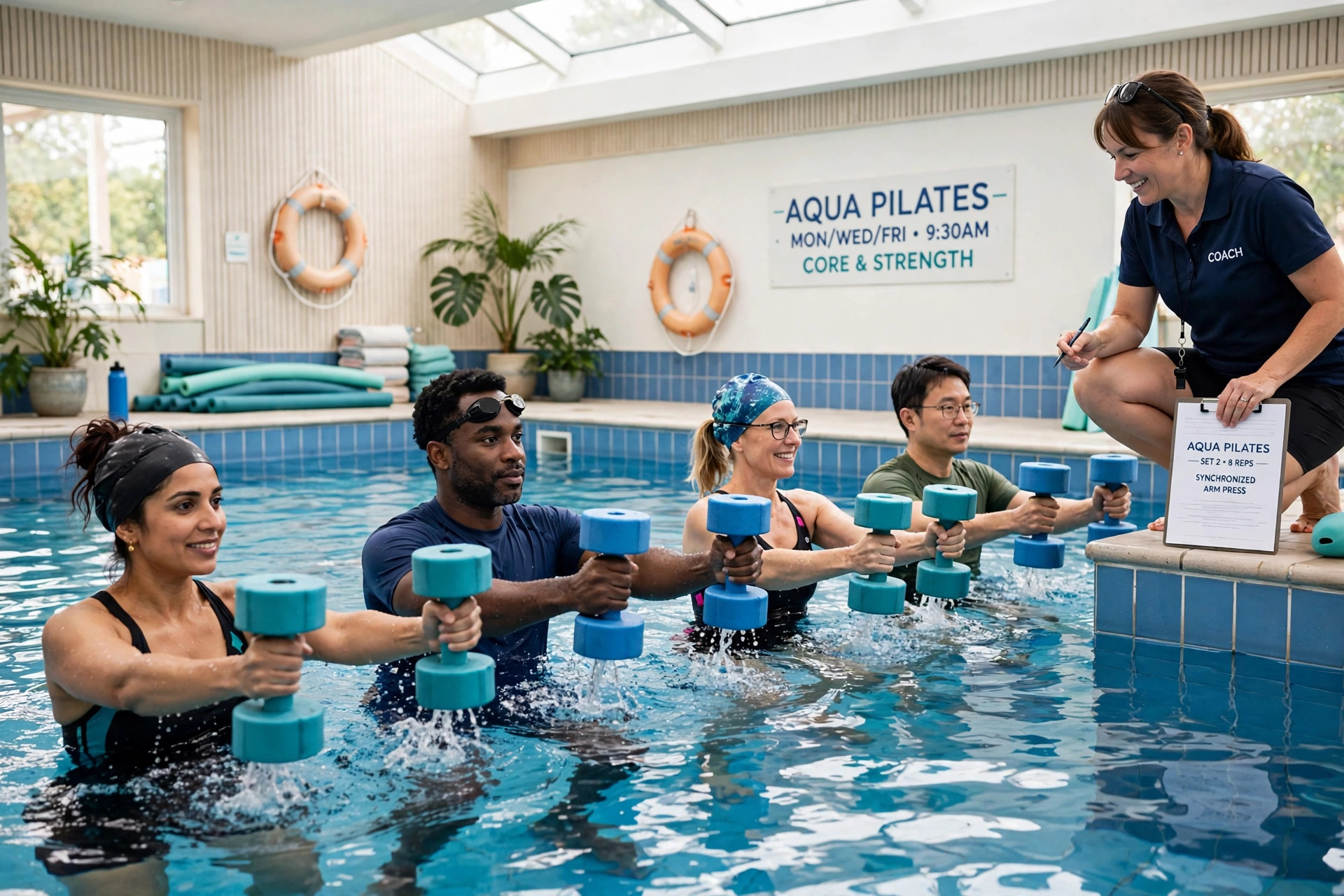
Classes usually run 45 to 60 minutes, in a warm pool, with music somewhere around 100–128 beats per minute. Instructors often use foam dumbbells, pool noodles (woggles) or webbed gloves to dial the resistance up or down. Reps tend to run higher than on land — around 20 per move instead of 10 — because the water cushions each one.
Why Athletes Are Paying Attention
Most of us discover aqua pilates the same way: something hurts, and the physio says “keep moving, but stop pounding.” Runners with shin splints, lifters with cranky knees, anyone coming back from a layoff — the pool lets you train hard without the impact bill.
But it’s not only a rehab tool. Water adds roughly 12% more resistance to every movement compared with air, and that resistance is omnidirectional — push one way, the water pushes back; change direction, it pushes back again. That makes it a surprisingly honest core workout. You can’t cheat a pool exercise with momentum the way you can on land. The water notices.
There’s a recovery angle too. After a brutal training block, a low-impact aqua pilates session keeps blood flowing and joints moving without adding load — the same logic behind the recovery techniques many athletes already swear by. And for older athletes, the fall risk is basically zero. You can’t fall over in chest-deep water.
What the Research Actually Says
Let’s be straight: aqua pilates itself is a small field. There aren’t hundreds of trials. But the studies that exist are encouraging, and the wider evidence on aquatic exercise is strong.
A 2018 study from Niğde University put healthy young women through a 12-week aqua-pilates programme — two 60-minute sessions a week. After three months, the group showed statistically significant improvements in body weight, BMI, body fat percentage, flexibility, dynamic balance, arm and leg strength, and lung capacity. Small study, but the effect sizes for body fat, balance and strength were moderate — not trivial.
A 2024 randomised trial in the Journal of Back and Musculoskeletal Rehabilitation tested six weeks of aqua pilates against aqua stretching in 40 people with ankylosing spondylitis, a painful inflammatory spine condition. Both groups improved: pain scores dropped, walking test results improved, fatigue fell, and quality of life rose. An earlier 2022 trial by the same research group, published in BMC Sports Science, Medicine and Rehabilitation, found the same pattern over four 60-minute sessions a week — significant gains in pain, function, quality of life and spinal range of motion.
Zoom out to aquatic exercise generally and the picture gets stronger. A 2022 meta-analysis of 20 trials found aquatic exercise cut pain by 0.61 points versus no exercise — and by 0.28 points even against land-based exercise — while improving quality of life and joint function. A 2025 systematic review in Geriatrics, covering 12 trials in older adults with osteoarthritis, found water-based programmes significantly improved balance, stiffness, pain and walking ability.
The honest caveat: most of this research is in people with joint problems or chronic conditions, not healthy competitive athletes. The benefits for a fit 25-year-old will look different from the benefits for a 65-year-old with knee arthritis. What transfers cleanly is the mechanism — less joint load, more resistance, better balance — and that’s exactly what an athlete in recovery needs.
The Real Numbers: What Water Actually Does to Your Body Weight
Here’s the worked example that convinced me this isn’t a gimmick. Buoyancy offloads a predictable share of your body weight depending on how deep you stand:
- Waist-deep: roughly half your body weight is supported
- Chest-deep: around 70% is supported
- Neck-deep: close to 90% is supported
So picture a 90 kg athlete standing chest-deep in the pool. Their knees and ankles are carrying about 27 kg instead of 90 — while their muscles are still working against water resistance on every rep. That’s the trade aqua pilates offers: joints get a 70% discount, muscles pay full price. For someone rehabbing a knee or managing an overloaded Achilles, that maths changes everything.
The flip side matters too. Because the water supports you, aqua pilates won’t build bone density the way running or heavy lifting does — your skeleton needs impact to stay strong. Treat it as a complement to land training, not a replacement.
Myth vs Fact: Aqua Pilates Edition
Myth: It’s just floating around. Easy.
Fact: Water resistance increases with speed, so the harder you push, the harder it pushes back. Slow, controlled moves are manageable; explosive ones will humble you fast.
Myth: It’s only for older people or rehab.
Fact: It started there, and the research reflects that. But the core challenge and balance demand are real for any age — plenty of healthy athletes now use it as a deload-week tool.
Myth: You can’t get a real workout without sweating.
Fact: You do sweat — the pool just hides it. Heart rate and perceived effort in water exercise can match land training; the cooling effect just makes it feel easier than it is.
Myth: It replaces your strength training.
Fact: It doesn’t. Water can’t replicate heavy progressive overload. Use it for recovery, mobility, core control and joint-friendly conditioning — and keep your barbell days.
A First Session: What to Actually Do
You don’t need a class to start, though a good instructor helps enormously with form. If your gym has a pool, here’s a simple 20-minute starter you can do on your own:
Warm-up (5 minutes): Walk laps in chest-deep water, then add gentle marching with high knees. Let your body adjust to the temperature and the feeling of moving through resistance.
Core set (10 minutes): Try standing Pilates “hundreds” — arms extended, small pulsing movements while you brace your core. Then slow leg lifts to the side, front and back, 10 per leg per direction. Move deliberately; the water will punish sloppy form by tipping you sideways, which is actually the point.
Balance and stretch (5 minutes): Stand on one leg and hold for 30 seconds, then switch. Finish with a gentle chest opener using a pool noodle behind your back, and slow spinal twists.
Two or three sessions a week is a sensible starting dose — the same frequency used in the 12-week study. If you’re using it for rehab, check with your physio first, especially if you have a heart condition or uncontrolled blood pressure: water pressure changes how your heart works, and cold water can spike it further.
Who Should Try It — and Who Should Skip It
Try it if: you’re returning from injury, your joints complain after hard training weeks, you want a low-impact core and balance session, or you need a deload week that still feels like training.
Think twice if: you’re chasing maximum strength or bone density (land training wins), you’re uncomfortable in water, or you have a condition that makes pool exercise risky — talk to your doctor first.
Skip the hype if: someone sells it as a miracle cure for anything. It’s a good training tool with real, modest evidence behind it. That’s enough.
FAQs
Is aqua pilates good for weight loss?
It can help, but indirectly. The 12-week study found reductions in body weight and body fat percentage, but aqua pilates burns fewer calories than running or cycling. Its real value is keeping you training consistently when impact exercise isn’t an option — and consistency is what drives weight loss.
Do I need to know how to swim?
No. Sessions happen in chest-deep water where you can stand comfortably, and most moves keep your head well above the surface. Being comfortable in water helps, but swimming ability isn’t required.
How is aqua pilates different from aqua aerobics?
Aqua aerobics is usually faster, music-driven cardio with bigger movements. Aqua pilates is slower, more controlled, and focused on core stability, alignment and precision — the Pilates principles, just in water. If you want a sweat-soaked cardio session, pick aerobics. If you want control, balance and joint-friendly strength, pick pilates.
The Bottom Line
Aqua pilates is having its moment for a good reason: it solves a real problem. Athletes need ways to train hard without wrecking their joints, and the pool offers a rare combination — heavy resistance for muscles, almost no load for joints, and a balance challenge that land exercises can’t replicate.
The evidence is modest but real: better balance, flexibility, strength and pain scores in the studies we have, and a strong case from aquatic exercise generally. It’s not a replacement for your main training. It is, though, one of the smartest tools for the weeks when your body says “not today” to impact — and the fact that searches are up 171% suggests a lot of athletes are figuring that out at the same time.
Next time your knees are talking back to you, skip the couch. Get in the pool.
This article is for general information only and isn’t medical advice. If you’re injured or have a health condition, talk to a qualified healthcare professional before starting a new exercise programme.