
My training plan used to live on a spreadsheet I’d printed out and stuck to the fridge. Twelve weeks, neat little boxes, every interval written in pen. It looked serious. It lasted about nine days.
Then life happened — a late meeting, a bad night’s sleep, a cold that wouldn’t quit — and the spreadsheet didn’t care. Tuesday said threshold intervals, so Tuesday got threshold intervals, even though my legs felt like wet sand. I followed the plan perfectly and got slower. A static plan can’t see you.
An AI cycling coach can. Or at least, that’s the promise. Searches for AI cycling training are up 275% in a year, and one WorldTour team just signed a €100 million deal to put AI at the centre of everything they do. So the question isn’t whether this is happening — it’s whether a robot coach can actually make you faster, or whether it’s just expensive guesswork with a nicer dashboard.
I read the actual research to find out. Here’s what it really says.
What AI Cycling Training Actually Is (and Isn’t)
“AI cycling training” covers two very different things, and mixing them up is how people get disappointed.
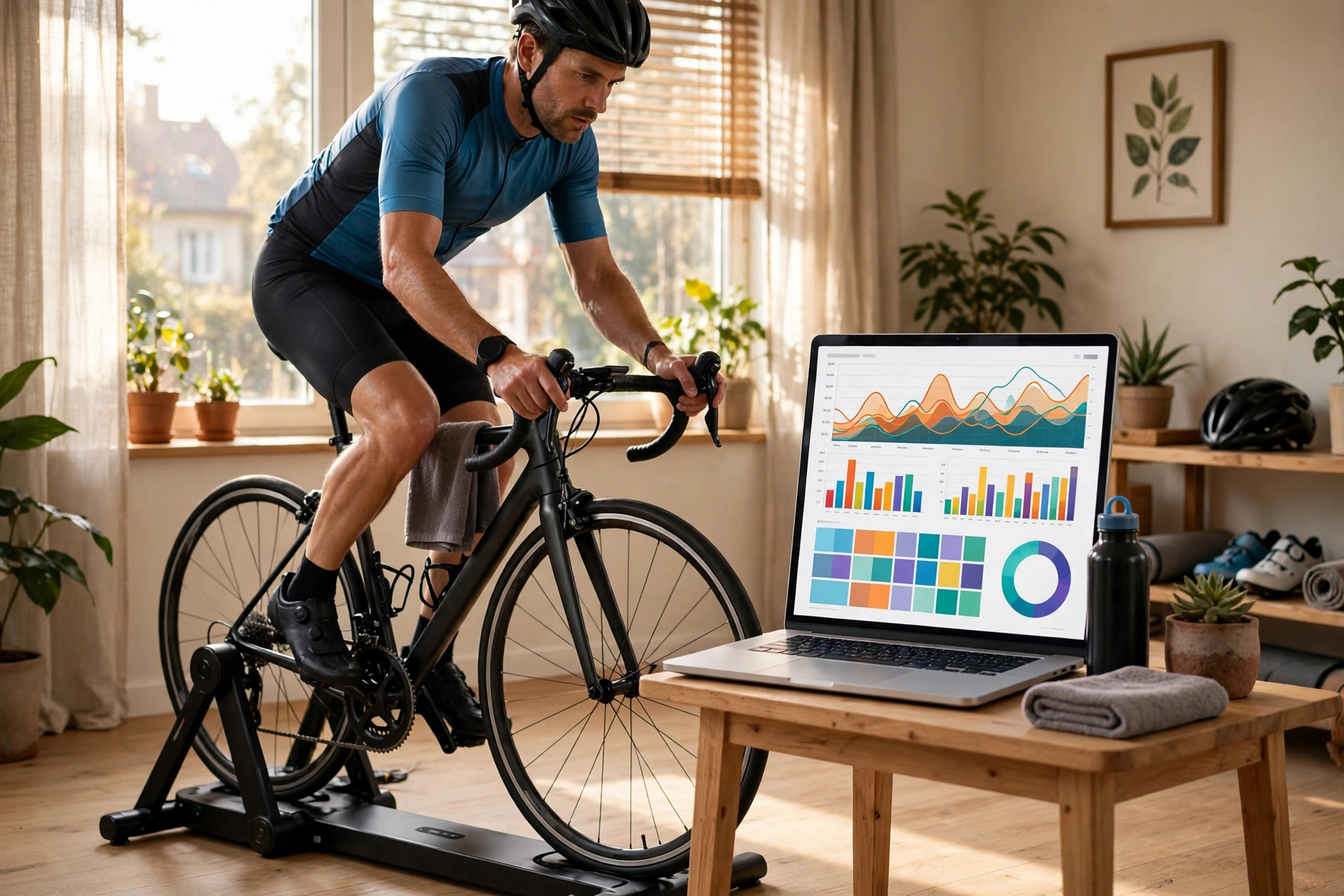
The prescribers tell you what to ride, when, and how hard. Apps like TrainerRoad, Athletica.ai and AI Endurance build a full structured plan, then rewrite it after every ride based on what your power meter, heart rate monitor and sleep tracker report. Slept badly? Your heart rate variability tanked? The threshold session becomes an easy endurance spin, automatically, before you’ve even had your coffee.
The analysers don’t prescribe anything — they just show you what happened. Tools like Intervals.icu and WKO5 track your fitness, fatigue and power curve over months and flag patterns you’d never spot yourself.
Most riders end up somewhere in the middle: an app that prescribes, plus a human brain that checks whether the prescription makes sense. That middle ground is exactly where the evidence points.
The Numbers Behind the Hype — What the Research Really Says
Here’s the honest picture, and it’s more interesting than either the hype or the scepticism.
The strongest new evidence comes from a 2026 preprint. Researchers built a data-driven framework that takes a cyclist’s everyday power and heart-rate data, learns how that individual responds to training, and works backwards to prescribe future sessions. Tested on 18 athletes and validated against lab tests, their optimization suggested a potential average performance increase of 5.5%. In real terms: a rider with a 250-watt FTP would be looking at roughly 264 watts — the difference between getting dropped on the club ride climb and being the one doing the dropping. For the full methodology, see a 2026 preprint that built a full data-driven framework for personalized cycling plans.
A second study, published in 2025, tackled the question coaches actually lose sleep over: is this rider responding to training at all? Twenty well-trained cyclists did monthly fitness tests over five months at 75% of their functional threshold power, while researchers tracked cardiovascular drift — the way heart rate creeps up at a fixed power output. Machine-learning models classified each athlete as a responder or a non-responder with cross-validation accuracy between 0.87 and 0.90. In plain English: the algorithms could spot, weeks before a human coach would notice, whether the training was working or just wearing someone down.
What the Research Hasn’t Tested Yet
But nobody has actually tested an LLM-written cycling plan in a peer-reviewed study. The October 2026 “State of AI in Cycling Training” report says so plainly: the published studies on AI-written exercise plans cover strength training, running and clinical exercise, not power-based cycling. What exists rates those plans as moderate in quality, with intensity — the variable cyclists care about most — the least consistent part.
And the headline numbers the platforms quote? Take them with a pinch of salt. TrainerRoad says its new AI is “27% more likely to give you the right workout” and reports a 2.0% failure rate in hard zones, a 33% improvement on its old system — figures from the company’s own forum posts, with no published method and no sample sizes. Same goes for the claim that the AI can predict your FTP 28 days out with 95% accuracy within 3%. It might be true. Nobody independent has checked. Even at the very top, accuracy is modest: Visma-Lease a Bike’s AI nutrition predictions are reported at 52% to 82%.
The Worked Example: What 90% Completion Actually Buys You
So if the science is still catching up, why do so many riders swear by these apps? The answer isn’t magic — it’s maths.
TrainerRoad reports that riders following its AI-generated adaptive plans complete 90% of their prescribed workouts, compared with roughly 60–70% for people following static plans. Let’s run that through a real 12-week block.
Say your plan has four rides a week. That’s 48 sessions in twelve weeks.
- Static plan at 65% completion: you finish about 31 sessions. Seventeen vanish — skipped because you were tired, or ill, or the plan asked for intervals on a day your body said no.
- AI plan at 90% completion: you finish about 43 sessions. Only five vanish.
That’s twelve extra training sessions in three months — not because the AI wrote better workouts, but because it wrote workouts you could actually do on the day. The intervals got easier when you were wrecked and harder when you were flying, so you stopped failing sessions and stopped dreading them. Consistency, not cleverness, is the real product. And consistency is the one thing every cycling study agrees actually makes you faster.
There’s a flip side, though, and a Cycling Weekly editorial late last year nailed it: recreational cyclists risk becoming too reliant on AI and losing the ability to read their own bodies. The best riders I know use the AI as a second opinion, not a boss.
Myth vs Fact: Three Things Everyone Gets Wrong About AI Coaching
Myth: AI coaches replace human coaches.
Fact: No AI system currently provides race-day strategy, tactics, technique feedback, or the psychological side of training. What AI does brilliantly is data processing and consistency. What it can’t do is context. A human coach costs $150–400 a month for a reason, and that reason isn’t spreadsheets.
Myth: AI FTP detection is as good as a lab test.
Fact: It’s a good estimate, not a measurement. The platforms’ accuracy claims are self-reported and untested by independent researchers. Use the number to set your training zones — just don’t tattoo it on your arm. If your zones feel wrong, they probably are, whatever the algorithm says.
Myth: More data automatically means faster riding.
Fact: Garbage in, garbage out. An AI coach fed by a power meter that hasn’t been calibrated in six months and a heart-rate strap you only wear on Tuesdays is making confident decisions on bad information. The riders getting the most from these tools are the ones with clean, consistent data — and they’re also the ones who’d probably get faster on any plan.
When AI Coaching Works — and When It Falls Apart
It works best when your life is messy. Shift workers, parents, anyone whose schedule changes weekly — that’s where an adaptive plan earns its money, because it keeps re-planning around the week you actually had instead of the week you planned to have. It’s also genuinely useful for indoor riders, where every variable is measured.
It falls apart at the edges. Illness, injury, grief, a new baby — the messy human stuff — is exactly where an algorithm has the least to say. It can see your heart rate; it can’t see that you’re going through a rough month. It also can’t fix the stuff that never shows up in a .fit file: your bike fit is off, your position is costing you watts. No amount of adaptive intervals fixes a bad position on the bike.
One more honest warning: if you’re a beginner without a power meter, most of this isn’t for you yet. AI cycling training runs on power data. Without it, the algorithm is guessing from heart rate alone — a noisy, lagging signal.
How to Try It Without Wasting Money
Start with the free trial, and test it like a scientist. Most platforms offer one to two weeks free. Don’t just ride and see how it feels. Pick one thing to measure — your completion rate, or your power at a fixed heart rate — and compare it honestly with the month before.
Feed it clean data for two weeks first. Wear the heart-rate strap every ride. Calibrate the power meter. Log your sleep. An AI coach is only as good as its inputs, and two weeks of clean data beats two months of patchy data.
Keep a human in the loop. That doesn’t have to mean hiring a coach — a monthly check-in with a knowledgeable riding buddy works, or simply asking yourself once a week whether this plan still makes sense for the event you’re targeting. Algorithms don’t know what your goals are — only what your data says.
Don’t pay for two platforms. They all do roughly the same thing now, and switching every month means the algorithm never learns you. Pick one, commit to a full training block, and judge it at the end.
And keep doing the basics no app can do for you. Strength work still matters — the ACSM’s 2026 strength guidelines are clear that two sessions a week support everything else you do on the bike. The 80/20 polarized approach still works whether a robot or a human writes the plan. And your tracker is only useful if you know what your fitness tracker actually gets right — and what it gets wrong.
Frequently Asked Questions
Is AI cycling training worth it for beginners?
It can be, but with a caveat. If you’re new to structured training, an AI plan gives you structure you’d otherwise have to build yourself. But without a power meter the plan is working with limited information, so keep your expectations modest. Learn to ride consistently first — three rides a week, every week — and the AI becomes far more useful once there’s real data to learn from.
Can AI coaching replace a human coach?
For most riders, no. AI is better at processing your data and keeping you consistent; a human is better at everything that isn’t in the data. The sweet spot is an AI plan plus occasional human input — a coach, a club mentor, or an honest training partner who’ll tell you when you’re overdoing it.
Do I need a power meter for AI cycling training?
Strictly speaking, no — most platforms will build a plan from heart rate alone. But power is the language these systems think in, and without it you’re getting a watered-down version. If you’re serious enough to pay for an AI coach, a power meter is the purchase that unlocks what you’re paying for.
The Bottom Line
AI cycling training isn’t a gimmick, and it isn’t magic. The real evidence says machine learning can genuinely predict how you’ll respond to training and prescribe plans worth around 5% — a meaningful jump for any rider. The less glamorous truth is that most of the benefit comes from something simpler: an adaptive plan you actually finish, because it bends around your life instead of breaking against it.
So try it, but try it with your eyes open. Treat the vendor numbers as marketing until independent researchers verify them. Keep your own judgement in the loop. The fastest riders in the world still have human coaches and human instincts — the algorithm is just the newest tool in the box, not a replacement for the box.
The robot can write your plan. Only you can ride it.
This article is for general information only and isn’t medical advice. If you have a heart condition, a history of cardiac issues, or any health concern, talk to a doctor before starting a new training programme.