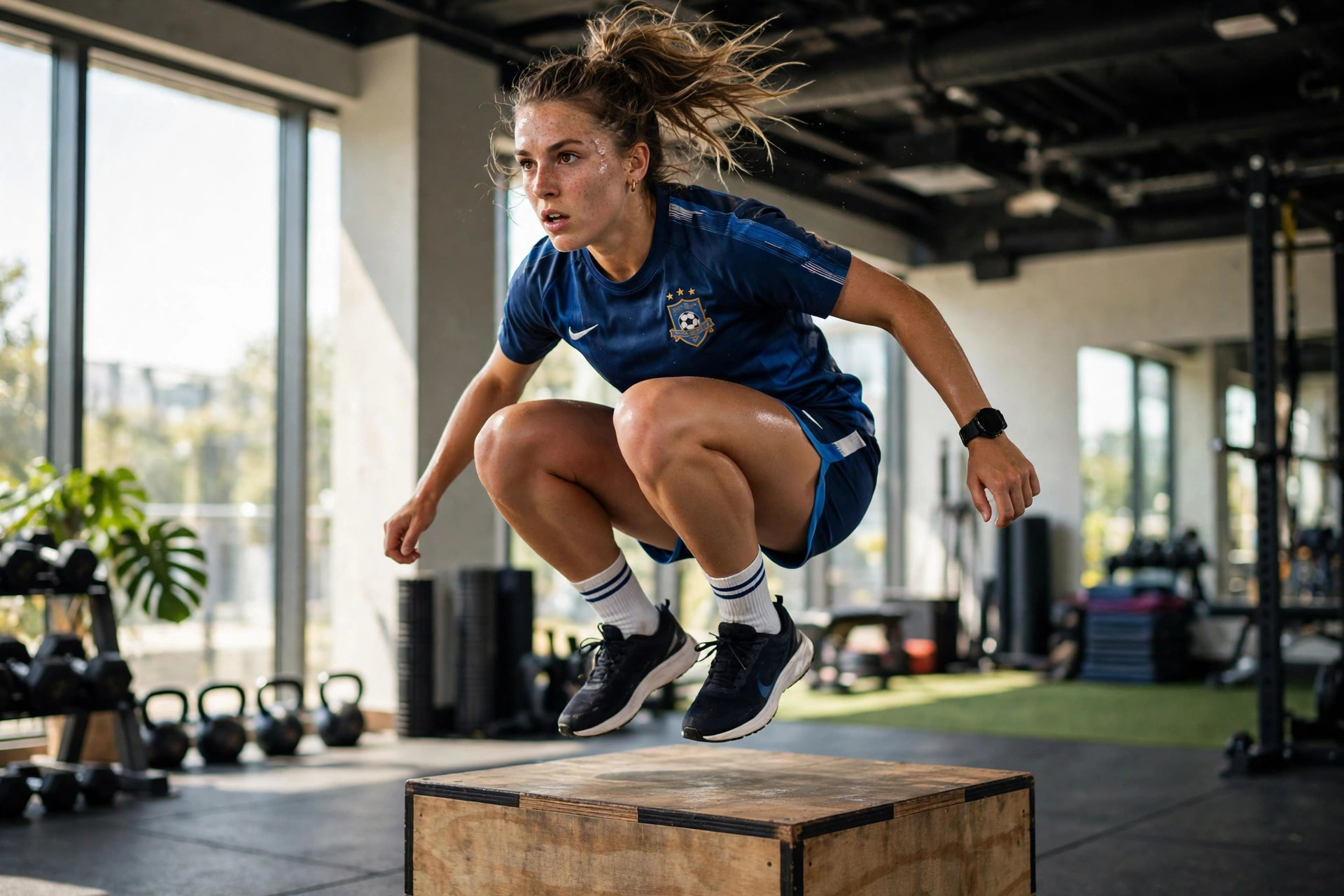

Picture this. Two wingers, same team, same training, same fitness. One of them gets to a loose ball a half-step sooner, every single time. She doesn’t look stronger. She doesn’t look fitter. She just… leaves the ground differently. Quicker first step, springier landing, gone before the defender has even turned.
That half-step has a name, and it’s not talent. It’s plyometrics — jump training — and for female team-sport athletes, it’s one of the most underused tools in the gym. A brand-new analysis of 36 studies says it plainly: plyometric training female athletes do regularly improves jumping, sprinting, throwing and agility. Not a little. Measurably, across nearly a thousand athletes.
And yet most women’s teams still treat jump training as an afterthought — a few box jumps tacked onto the end of a session, or skipped entirely because nobody’s quite sure how much is enough, or whether it’s safe for knees. This article fixes that. Here’s what the research actually says, how much you need, and an 8-week plan you can start on Monday.
What Plyometrics Actually Are (and What They Aren’t)
Plyometrics is a fancy word for a simple idea: train your muscles to stretch and snap back, fast. Jump up, land, jump again. The stretch-shortening cycle, coaches call it — your muscles and tendons load like a spring on the way down and release that energy on the way up.
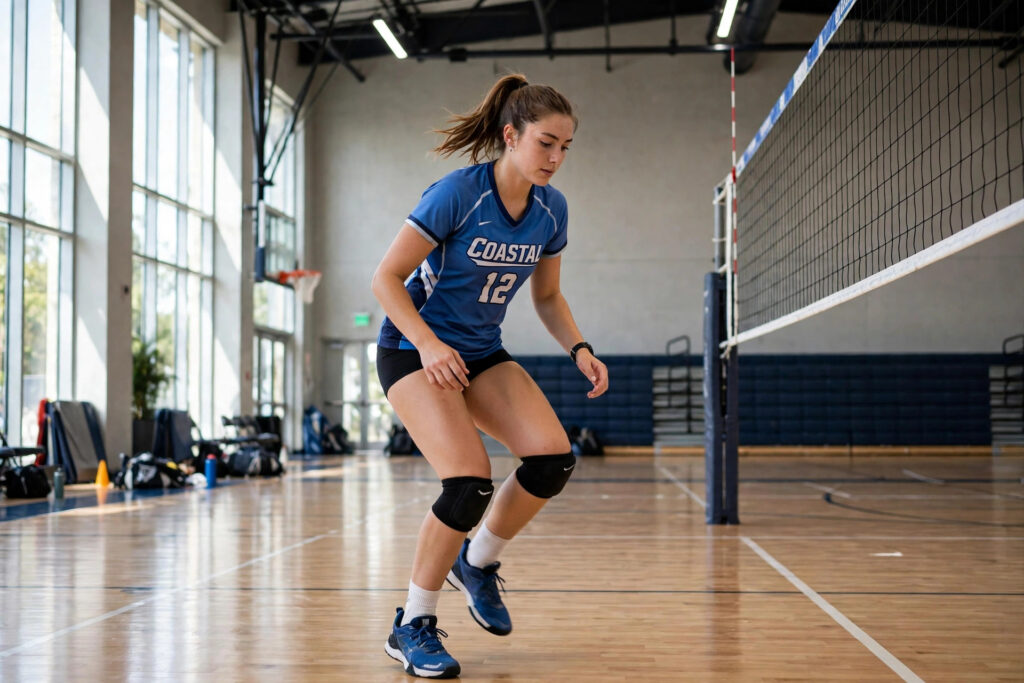
Think of the movements you already do in your sport. A volleyball player blocking at the net. A basketball guard exploding off one foot for a layup. A soccer striker jumping for a header, landing, and sprinting again before she’s even fully upright. Every one of those is a plyometric movement. The training just isolates it, repeats it, and loads it progressively — box jumps, depth jumps, bounding, lateral hops, medicine-ball throws.
What plyometrics aren’t: they aren’t heavy lifting, and they aren’t cardio. They’re not a warm-up game, either, though they often get treated like one. A proper plyometric session is short, sharp, and done fresh — never at the end of a session when your legs are already cooked. That’s the first mistake most teams make, and it’s also the one that gets people hurt.
What 36 Studies Say It Actually Does
In May 2026, researchers published the biggest analysis yet of plyometric training in female team-sport athletes: 36 studies, 921 players, pooled together in Frontiers in Physiology. The results are the kind of thing that makes you wonder why this isn’t standard practice.
Vertical jump improved with a standardised effect of 0.67. Horizontal jump, 0.70. Sprinting, 0.85. Throwing, 0.91. Agility — the change-of-direction stuff that wins games — 1.09, the biggest effect of the lot. In research terms, anything above 0.8 counts as a large effect. Three of the five outcomes cleared that bar.
A second review, published in Sports Medicine – Open and highlighted in early November 2026, looked at 31 more studies with 609 adult female athletes and found the same story from a different angle: countermovement jump height up, reactive strength index up sharply, and sprint times over 10, 20 and 30 metres all faster.
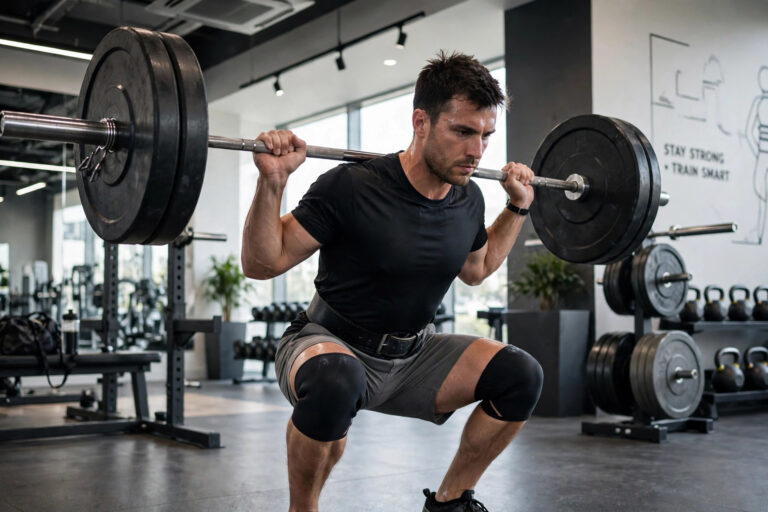
Here’s the honest part, though, because the honest part matters. The same 36-study analysis found that lower-body strength barely budged. Upper-body strength improved; leg strength didn’t, at least not from jumping alone. Plyometrics make you springy, not strong. If you want stronger legs, you still need the barbell — and the strength training guidelines we covered last week are the place to start.
And the evidence isn’t perfect. The researchers rated their certainty as very low to moderate, and for some sprint and agility results, the prediction intervals — the range where a future study’s result would probably land — stretched across zero. Translation: plyometrics work on average, clearly, but individual teams and players will see different-sized gains. That’s not a reason to skip it. It’s a reason to track your own numbers instead of trusting someone else’s.
The Dose That Actually Works
This is the question every coach asks, and for once the research gives a straight answer.
The November 2026 review found a minimum effective dose: eight to twelve weeks, eight to twenty sessions total, at one to two and a half sessions a week. Less than that and the jump-height gains don’t reliably show up. More than that and you’re into diminishing returns unless the programme is carefully periodised.
Eight weeks, twice a week. That’s sixteen sessions. It fits inside a normal pre-season, and it’s the number I’ll build the plan around below.
One more number worth knowing: adolescents respond even better than adults. A 2025 analysis found countermovement jump improvements nearly twice as large in teenage players as in adults, and sprint gains that showed up in teenagers but not reliably in adults. If you coach a girls’ youth team, this is the single highest-return training you can add — and the earlier the better, as long as landing technique comes first.
The Knee Question Nobody Can Dodge
Let’s talk about the thing that stops a lot of female athletes from jumping: knees. Female athletes tear their ACL at several times the rate of men playing the same sport, and it’s natural to wonder whether adding jump training is pouring fuel on that fire.
The evidence points the other way — if the jumping is done right. A meta-analysis of 13 trials with nearly 14,000 female team-sport athletes found that exercise-based injury-prevention programmes — the kind that build plyometrics into the warm-up — cut overall injury risk by about 35%, lower-limb injuries by a similar amount, and ACL injuries by roughly 38%. But there’s a catch, and it’s a big one: the benefit only showed up clearly when players actually did the programme at least 75% of the time. Half-hearted compliance got half-hearted protection.
The mechanism makes sense when you watch a player land. Most ACL injuries happen in the first fraction of a second after landing or cutting — knee collapsing inward, trunk leaning, all the force arriving at once. Plyometric training, done with coaching, teaches the opposite pattern: land soft, knees tracking over toes, hips back, quiet feet. You’re not just building spring; you’re rehearsing the landing that keeps you on the pitch.
The risk is real when plyometrics are done badly — high boxes, fatigued athletes, no coaching, “just jump as high as you can” — which is why the plan below starts low, starts with landing, and never does jumps after a hard conditioning session.
Your 8-Week Starter Plan (With Real Numbers)
Here’s the extra bit: an actual plan, with the numbers worked out, so you can see exactly what “the dose” looks like in practice.
The currency of plyometric training is ground contacts — every time your feet hit the floor. The research dose works out to roughly 60 to 120 contacts per session, two sessions a week, for eight weeks. Here’s how that adds up:
- Weeks 1–2 (learn to land): 2 sessions a week, about 60 contacts each. Low box step-offs, landing and sticking it. Squat jumps, 3 sets of 8. Lateral line hops, 3 sets of 10 seconds. Total: 240 contacts.
- Weeks 3–5 (build the spring): 2 sessions a week, about 80 contacts each. Box jumps onto a low box, countermovement jumps, single-leg hops in place, medicine-ball chest passes. Total: 480 contacts.
- Weeks 6–8 (add speed and direction): 2 sessions a week, about 110 contacts each. Depth jumps from a low box, bounding, lateral bounds, 180-degree jump turns. Total: 660 contacts.
Grand total: 1,380 ground contacts over 16 sessions in 8 weeks. That sits squarely inside the effective dose the research found — 8 to 20 sessions, 1 to 2.5 a week, 8 to 12 weeks — and the progression is gentle enough that your knees will thank you instead of filing a complaint.
Three rules, non-negotiable. One: do it fresh, at the start of the session, after a proper warm-up — never after sprints or conditioning. Two: quality over quantity; if your landings get loud and sloppy, you’re done for the day. Three: rest 48 hours between sessions. Jumping is a skill your nervous system learns, and it learns it between sessions, not during them. Pair it with easy polarized training days and your legs stay fresh enough to jump well.

Myth vs. Fact
“PLYOMETRICS ARE DANGEROUS FOR FEMALE ATHLETES’ KNEES.” — Backwards. Done badly, yes — high boxes, no coaching, tired legs. Done well, jump training is part of the injury-prevention programmes that cut ACL injuries by roughly a third. The danger isn’t jumping; it’s never learning to land.
“YOU NEED TO BE STRONG FIRST BEFORE YOU CAN JUMP.” — Half true. You need a baseline of strength — you should be able to squat your bodyweight with good form — but you don’t need to be a powerlifter. Low-intensity jumps and landing drills are the starting point for beginners, and the research shows gains even in players who weren’t strength-trained first.
“PLYOMETRICS WILL MAKE YOU BULKY.” — No. Plyometrics build power and elasticity, not muscle size. The jump improvements in the studies came without any meaningful change in lower-body strength, let alone size. If anything, jump training is the opposite of a hypertrophy programme.
“MORE JUMPS MEANS MORE GAINS.” — No — and this one gets people hurt. The effective dose tops out around 100–120 contacts a session, twice a week. Past that, fatigue wrecks your landing mechanics, and sloppy landings are exactly how injuries happen. The plan above is the dose. Don’t double it because it feels easy in week two.
“IT’S ONLY FOR ELITE ATHLETES.” — No. The studies covered everyone from recreational players to internationals, and teenagers actually gained more than adults. If you play a sport where you jump, sprint or change direction, this is for you — just start with the landing drills, not the depth jumps.
The Takeaway
Plyometric training female athletes do consistently is one of the best-supported performance tools in women’s sport: across 36 studies and 921 players, it improved jumping, sprinting, throwing and agility, with the biggest gains in change of direction — the thing that actually wins games. The dose is modest and specific: eight weeks, twice a week, 60 to 120 ground contacts a session, landing quality first. And far from endangering knees, jump training done properly sits inside the injury-prevention programmes that cut ACL injuries by about a third — as long as you actually show up for at least three out of four sessions. Start low, land quiet, and let the spring do the work. Your first step will thank you.
How many times a week should female athletes do plyometrics?
One to two and a half sessions a week, according to the November 2026 review — and twice a week for eight weeks is the sweet spot most studies used. That’s 16 sessions and roughly 1,400 ground contacts in total. One session a week can work, but the jump-height gains were more reliable at two.
Do plyometrics help prevent ACL injuries in female athletes?
They’re part of the answer. Exercise-based injury-prevention programmes that include plyometrics cut overall injury risk by about 35% and ACL injuries by roughly 38% across 13 trials — but only when players completed at least 75% of the sessions. The key is coached landing technique: soft, quiet landings with knees tracking over toes.
Can beginners start plyometrics, or do you need to be strong first?
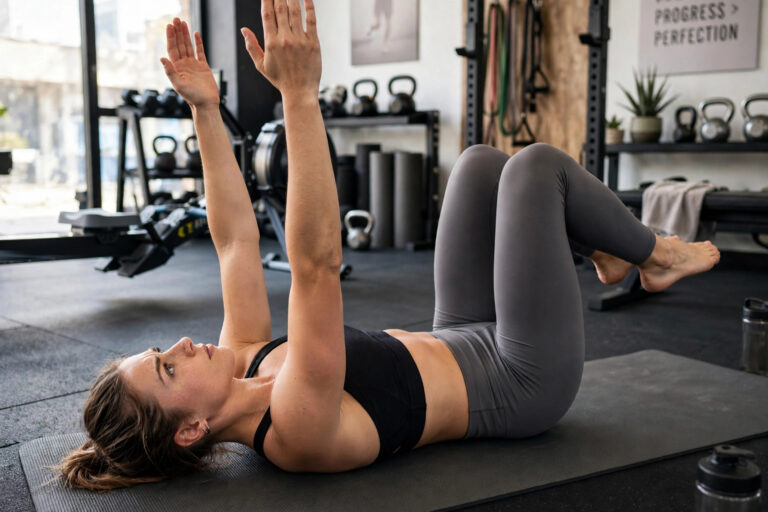
Beginners can start, with landing drills first — low box step-offs, squat jumps, sticking the landing before adding height or speed. You should be able to squat with good form, but you don’t need a big barbell squat first. Teenagers actually gain more from plyometrics than adults do, so starting young, with good coaching, is an advantage. And a strong core helps every landing — the dead bug is a good place to build it.
This article is for general information only and isn’t medical advice. Plyometric training involves high-impact jumping, so if you have a knee, ankle or back injury, are returning from surgery, or are pregnant, check with a doctor or physiotherapist before starting. Always learn landing technique from a qualified coach, and stop if you feel pain during a session.