


You train six days a week. You eat clean, you sleep seven hours, you do everything the podcasts tell you to do. And still, you’re flat. Your lifts have stalled. Easy runs feel hard. Your mood is somewhere between tired and irritable, and your libido has quietly gone missing. Then an ad for testosterone therapy pops up on your feed: a smiling clinic, a blood test, a promise. “Low T? We can fix that.”
You’re not the only one clicking. Searches for testosterone therapy hit around 110,000 a month in the United States this autumn. That makes it one of the fastest-rising health searches of November 2026. Clinics are opening on high streets. Influencers are posting their “before and after” bloodwork. The whole thing is starting to feel normal — like getting your iron checked or buying a new pair of shoes.
But here’s the thing nobody in those ads will tell you. For athletes, low testosterone is often a symptom of something else entirely. And therapy is a medical treatment with real trade-offs — not a performance upgrade. I went through the actual guidelines and the biggest trial ever run on this question. The honest picture is more complicated than either the clinics or the scare stories admit.
What “Low T” Actually Means (and What It Doesn’t)
First, let’s clear up the number, because it’s where most confusion starts.
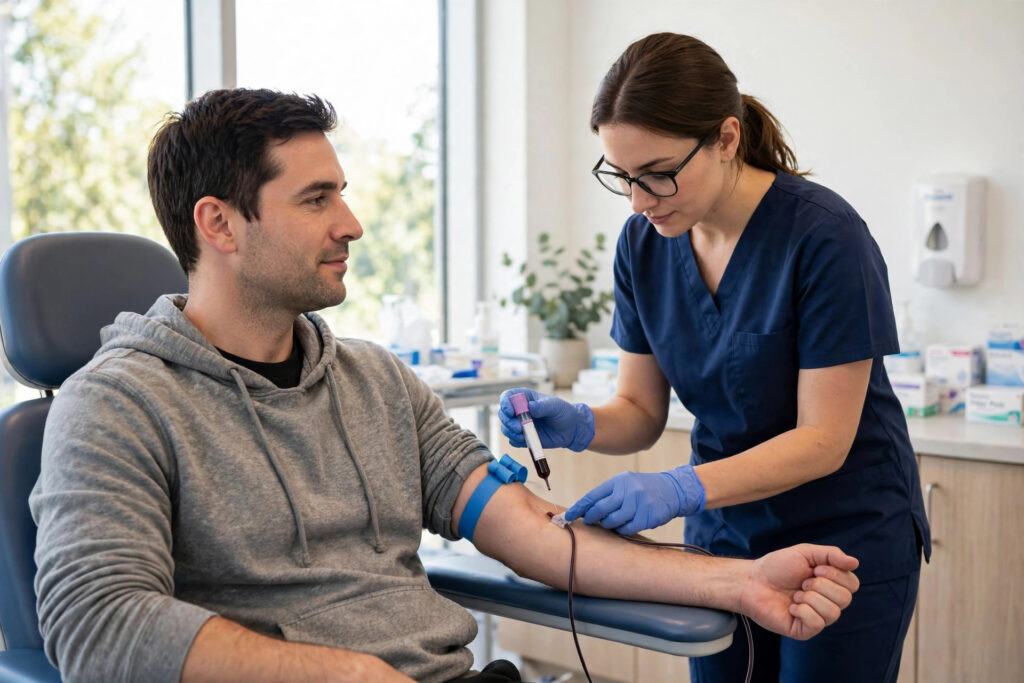
Testosterone is measured in nanograms per decilitre (ng/dL). For healthy, non-obese men aged 19 to 39, the harmonised reference range runs from 264 to 916 ng/dL. The American Urological Association treats a total testosterone below 300 ng/dL as a reasonable cut-off. That supports a diagnosis of low testosterone. So the line most doctors work with is somewhere around 300. But the number on its own is never the diagnosis.
That’s the position of the Endocrine Society, which restated its guidance in a statement in July 2026. A diagnosis of hypogonadism requires symptoms of low testosterone plus consistently low blood total and free testosterone. It has to be confirmed by at least two early-morning, fasting blood tests. Not one. Two. And both in the morning. Testosterone follows a daily rhythm and runs much higher in the morning than in the afternoon — in young men, roughly 50% higher.
So a single 2pm blood test that comes back at 280 ng/dL tells you almost nothing. You were tired and under-fuelled. You were possibly still recovering from yesterday’s session. And you tested at the lowest point of your daily cycle. A proper diagnosis needs the symptoms: low energy, low mood, low libido, loss of muscle, poor recovery. And it needs the repeated morning numbers to match. Anything less is a guess with a price tag.
The Athlete Twist: Your Training Might Be the Cause
Here’s where it gets interesting for anyone who trains seriously. Endurance athletes, in particular, often walk around with testosterone levels that look low on paper. And the training itself is a big reason why.

Across five studies of high-volume male runners, researchers found testosterone levels roughly 20–40% lower. That is lower than in sedentary men of the same age. The runners were logging 35 to 70-plus miles a week. Their levels typically sat in the 300–600 ng/dL range — a couple of hundred points below their non-running peers. Their luteinising hormone and follicle-stimulating hormone were usually normal. That points to the brain quietly resetting its thermostat rather than the testes failing. Sports medicine calls this the exercise hypogonadal male condition, and it’s a recognised pattern, not a broken body.
Why Training Pushes Testosterone Down
Three things drive it. The first is energy: when you burn far more than you eat, day after day, the body rations energy away from reproductive hormones. That’s the same low energy availability behind RED-S, and it hits men just as it hits women. The second is stress hormones — chronically elevated cortisol suppresses the signals that tell the testes to produce testosterone. The third is sleep, or the lack of it: short, broken sleep is one of the most reliable ways to drag testosterone down, and sleep efficiency is the first thing to collapse in a heavy training block.
Put numbers on it and the picture sharpens. Imagine two 30-year-old men. One is sedentary and tests at 700 ng/dL in the morning. The other runs 60 miles a week. He eats in a small deficit to stay lean and sleeps six and a half hours. And he tests at 450 ng/dL. Both are inside the normal range. But the runner’s number is 35% lower. If he tests once, in the afternoon, after a hard session, he might land at 290 — below the line, on a single reading, with a clinic ready to sell him a solution. The number was real. The conclusion would have been wrong.
That’s why the first move for a tired athlete is almost never therapy. It’s food, sleep, and a lighter training week — and then a retest.
What Testosterone Therapy Actually Is
If the diagnosis is genuine — real symptoms, two low morning tests, and a cause a doctor can identify — then testosterone therapy is a prescription medicine. It is not a supplement. It usually comes as a daily gel rubbed on the skin, or as injections every one to two weeks. The dose is designed to replace roughly what the body would make on its own. It is not the megadoses used for muscle building, and it’s not available over the counter anywhere legitimate.
What it does, in men who truly need it, is restore levels to the normal range. Energy, mood, libido, and muscle mass tend to improve over weeks to months. What it doesn’t do is turn a healthy athlete into a super-athlete. But it comes with a list of effects that anyone considering it should understand before signing anything.
The most common ones are thicker blood, acne and oily skin, and a rise in blood pressure. Thicker blood means a rise in red blood cells that needs monitoring. More seriously, therapy suppresses the body’s own sperm production while you’re on it. So fertility can drop sharply — a real consideration for younger men who might want children. And once you start, your body often stops making its own testosterone. That means stopping isn’t as simple as just quitting. Levels can crash below where you started.
What the Biggest Testosterone Therapy Trial Actually Found
The question that haunted testosterone therapy for years was the heart. Did replacing testosterone raise the risk of heart attacks and strokes? For a long time, the evidence was a mess of conflicting observational studies — until the trial designed to settle it arrived.
The TRAVERSE trial, published in the New England Journal of Medicine in 2023, enrolled 5,246 men aged 45 to 80 who had symptoms of low testosterone and either existing heart disease or a high risk of it. Half used a daily testosterone gel; half used a placebo gel. Over an average of about three years, major heart events — cardiovascular death, non-fatal heart attack, or non-fatal stroke — occurred in 7.0% of the testosterone group and 7.3% of the placebo group. Statistically, therapy was non-inferior: it did not increase heart attacks, strokes, or cardiovascular deaths.
But the trial was not a clean bill of health. Three problems showed up more often on testosterone: atrial fibrillation, an irregular heartbeat, in 3.5% versus 2.4% on placebo; blood clots in the lungs in 0.9% versus 0.5%; and acute kidney injury in 2.3% versus 1.5%. Small numbers, but real ones — and the researchers flagged them. In February 2025, the US Food and Drug Administration reviewed the trial and removed the language about increased cardiovascular risk from the boxed warning on testosterone products, while keeping warnings about blood pressure and other risks.
Two caveats matter for athletes. First, TRAVERSE studied middle-aged and older men with confirmed low testosterone and heart risk — not healthy 28-year-olds chasing a faster 10K. Its reassurance does not extend to performance use or to doses above replacement. Second, the trial lasted a few years. What happens over decades is still unknown.
The Part Athletes Forget: The Doping Rules
Here’s the part that gets left out of almost every clinic ad, and it’s the one that could end a competitive career.
Testosterone is on the World Anti-Doping Agency’s prohibited list as an anabolic agent (class S1), banned at all times — in competition and out of it. A prescription does not change that. If you compete in any sport that follows the anti-doping code, using testosterone without an approved Therapeutic Use Exemption (TUE) is a doping violation, and it can mean a multi-year ban.
And the exemption is far narrower than most athletes realise. WADA only grants a TUE for testosterone when there is an organic cause of hypogonadism — a genetic condition, testicular injury, a pituitary tumour, that kind of thing. Low testosterone caused by overtraining, under-fuelling, stress, or ageing does not qualify. If your numbers are low because you’re running 70 miles a week on too few calories, there is no exemption for that — the rules expect you to fix the training and the fuelling instead.
So the practical reality is blunt: if you compete, and your low testosterone is the functional, training-driven kind — which, for athletes, it usually is — therapy is not a legal option. That’s not a loophole to argue with. It’s the rule, and it’s enforced by drug testing.
Myth vs. Fact: Testosterone Therapy for Athletes
Myth: A low testosterone number means you need therapy.
Fact: Diagnosis needs symptoms plus two low early-morning fasting tests. One afternoon reading after a hard session is not a diagnosis — it’s a snapshot taken at the worst possible moment.
Myth: Testosterone therapy is a safe shortcut to more muscle.
Fact: In men with genuinely low testosterone, it restores normal function. In a healthy athlete with normal levels, it’s a banned substance, and the doses used for muscle building carry far greater risks than the replacement doses studied in trials.
Myth: Testosterone therapy will wreck your heart.
Fact: The largest trial found no excess of heart attacks, strokes, or cardiovascular deaths over about three years in men who truly needed treatment. But it did find more atrial fibrillation, lung clots, and kidney injury — so “not wrecking your heart” is not the same as “risk-free.”
Myth: If a doctor prescribes it, it’s fine for sport.
Fact: A prescription is not a TUE. Testosterone is banned at all times under anti-doping rules, and exemptions are only granted for organic causes — not for low levels caused by training, under-fuelling, or ageing.
Myth: Natural “testosterone boosters” do the same thing without the risks.
Fact: No supplement has been shown to raise testosterone into the therapeutic range in men with genuine deficiency. Sleep, food, and lighter training do more than any booster on the shelf.
Before You Call a Testosterone Therapy Clinic: The Four-Week Check
If your numbers came back low and you’re wondering what to do next, try this before you book anything. It’s the same order a good endocrinologist would work through — and it costs nothing.
- Eat enough for four weeks. Add back the calories your training actually burns. Most athletes in a low-testosterone hole are under-fuelling without realising it, and the fix starts on the plate, not in a clinic.
- Protect your sleep. Aim for eight hours in bed, same time every night, phone out of the room. Poor sleep efficiency alone can drag testosterone down, and it’s the cheapest variable to fix.
- Take a genuine deload week. Cut volume in half for seven days. If your fatigue is overtraining rather than a hormone problem, you’ll feel the difference fast — and your next blood test will tell a different story.
- Retest properly. Two early-morning, fasting tests, on separate days, after the deload. If both are still low and you still have symptoms, that’s when a doctor’s appointment — with an endocrinologist, not a sales clinic — makes sense.
If, after all that, the numbers are still low and the symptoms persist, therapy may genuinely be the right answer. That’s a medical decision, made with a specialist, with your blood pressure, blood counts, prostate, and fertility all part of the conversation. It just shouldn’t be the first answer.
Can hard training lower your testosterone?
Yes — and it’s common. High-volume endurance training, under-fuelling, and poor sleep can push testosterone 20–40% below sedentary levels. In most cases it’s the exercise hypogonadal pattern, which improves when you eat enough, sleep properly, and ease off the volume — no therapy needed.
Will testosterone therapy make me faster or stronger?
If you have genuine hypogonadism, therapy restores your levels to normal and can improve energy, mood, and muscle mass over time. If your levels are already normal, it won’t legally or safely make you faster — and in competitive sport, using it without a TUE is a doping violation.
How is low testosterone actually diagnosed?
With symptoms plus at least two early-morning, fasting blood tests showing consistently low total and free testosterone, using a standardised assay. A single test, or a test taken in the afternoon, is not enough to diagnose anything.
The Takeaway: Fix the Athlete First, Then the Hormone
Testosterone therapy is having a moment, and for men with a real diagnosis it’s a legitimate, useful treatment — the biggest trial we have says it doesn’t raise heart attack risk in the men who need it. But for athletes, the story usually starts somewhere else: too many miles, too few calories, too little sleep, and a blood test taken at the wrong time of day.
So before you believe the ad, do the boring work. Eat enough. Sleep properly. Take a deload week. Retest in the morning, twice. If the numbers are still low after that, see a specialist — and if you compete, sort out the anti-doping rules before you take a single dose. Your testosterone might not need replacing. It might just need you to stop running it into the ground.
This article is for general information only and isn’t medical advice. Testosterone therapy is a prescription treatment with real risks — talk to a qualified healthcare professional before making any decisions about testing or treatment.