
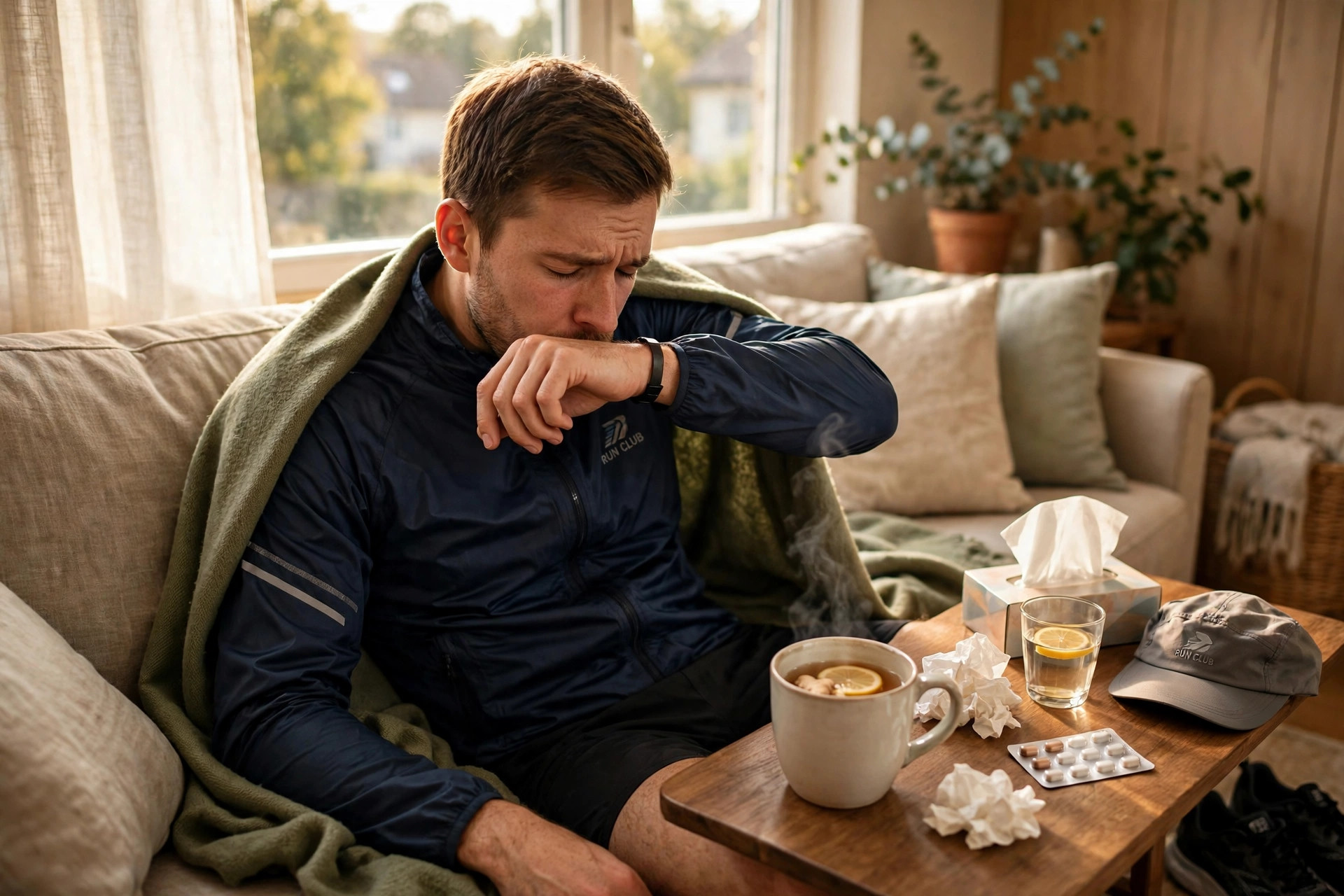

Is bronchitis contagious? Last month, a teammate of mine turned up to training with a cough he’d already had for two weeks. Don’t worry, he said, grinning between coughs, I’m not contagious anymore. It’s just the cough that’s left. Half the group believed him. The other half quietly moved their bags a little further away.
He was probably right, but probably is doing a lot of heavy lifting in that sentence, and it’s exactly where most people get bronchitis wrong. The cough and the contagiousness run on two very different clocks, and mixing them up is how gyms, teams, and households pass a chest cold around for weeks.
So let’s settle it properly: is bronchitis contagious, for how long, and when is it actually safe to train again?
The Short Answer First: Is Bronchitis Contagious?
Acute bronchitis, the common chest cold kind, usually is contagious, because it’s usually caused by a virus. Chronic bronchitis, the long-term lung condition, is not contagious at all. Same word, two completely different situations.
That distinction matters more than most articles admit, because it decides everything else: whether you should stay home, whether antibiotics will help (usually they won’t), and whether that three-week cough means you’re still spreading germs (usually it doesn’t).
It’s a question a lot of people are asking right now. In a September 2026 analysis of US search data, is bronchitis contagious? ranked as the second most-Googled respiratory health question in the country, at an estimated 103,000 searches a month, just behind pneumonia. Virus season is here, and everyone with a chesty cough wants to know where they stand.
What Bronchitis Actually Is
The CDC describes acute bronchitis plainly: it happens when the airways of the lungs swell and produce mucus, and that swelling is what makes you cough. Doctors often call it a chest cold, and that’s a useful name, because, like a cold, it’s usually a viral infection that your body clears on its own.
The symptoms are familiar to anyone who’s had one: a cough, with or without mucus, tiredness, congestion, a sore throat, and mild body aches. The CDC notes that symptoms of acute bronchitis last less than three weeks. That less than three weeks is doing quiet work, it tells you the illness itself is short, even when the cough feels endless.
Chronic bronchitis is a different beast entirely. It’s a form of chronic obstructive pulmonary disease (COPD), defined by a productive cough lasting at least three months a year for two consecutive years. It’s usually caused by long-term smoking, air pollution, or workplace irritants, not by catching something from a coworker. You cannot catch chronic bronchitis, and someone with it cannot give it to you. They can, however, catch a cold from you, and that cold can trigger a flare-up. That’s a different risk, and worth knowing if someone in your household lives with it.
The Contagiousness Table: Which Type Spreads?
Here’s the breakdown that actually answers the question, type by type:
| Type | Contagious | How long |
|---|---|---|
| Acute, viral (the common kind) | Yes | Usually a few days to a week, most contagious in the first 2-3 days. |
| Acute, bacterial (uncommon) | Yes, but less common | Usually stops about 24 hours after starting the right antibiotic. |
| Acute, from pertussis (whooping cough) | Yes | Can spread for up to 3 weeks without treatment; about 5 days after the right antibiotic. |
| Chronic bronchitis (COPD) | No | Not spread person to person at all. |
Notice the pattern: what spreads is never bronchitis itself. It’s the virus or bacterium behind it. You catch the germ, and whether it settles in your nose as a cold or travels down into your airways as bronchitis depends on the germ, your airways, and a bit of luck. Two people can catch the same virus at the same dinner and end up with two different illnesses.
The Two Clocks: Contagious Days vs. Coughing Weeks
This is the part my teammate got right, and the part most people get backwards. Picture the illness as two overlapping timelines:
Days 1-3: the contagious peak. You’re at your most infectious in the first few days, when symptoms are at their worst and a fever may be present. This is when staying home does the most good, for everyone else, and for your own recovery.
Days 4-7: still spreading, but fading. For most viral causes, contagiousness runs from about a day before symptoms start through roughly 5 to 7 days after they begin. If you still have cold-like symptoms, fever, sore throat, congestion, assume you can still spread it.
Weeks 2-3: the cough that won’t quit. By now, most of the active infection is gone. What remains is an airway lining that is still healing and stays irritable, firing off coughs at the slightest provocation, cold air, laughing, a hard training session. That lingering cough is a symptom of recovery, not a sign that you’re still shedding virus in any meaningful quantity. The CDC’s less than three weeks window covers exactly this tail.
So the rule of thumb I actually use: if you’ve still got fever or fresh cold symptoms, stay away from people. If the fever’s long gone, the other symptoms have cleared, and all that’s left is a dry, nagging cough, you’re almost certainly past the contagious stage, even though you still sound rough. Almost certainly isn’t a guarantee, though: if you live or train with infants, older relatives, or anyone with a weakened immune system, be more cautious and keep your distance a little longer.
Myth vs. Fact: What People Get Wrong
Myth: The cough means I’m still contagious. Fact: Not necessarily. A cough can linger for two to three weeks after the infection itself has cleared, because inflamed airways stay twitchy while they heal. Contagiousness tracks the active infection, roughly the first week, not the cough.
Myth: Green mucus means I need antibiotics. Fact: Mucus colour alone doesn’t prove a bacterial infection, and most acute bronchitis is viral. The CDC is blunt about this: a virus usually causes a chest cold, and even in the occasional bacterial case, antibiotics are not recommended and will not help you feel better. Taking antibiotics you don’t need doesn’t speed recovery, it just breeds resistance.
Myth: If I feel a bit better, I can train hard again. Fact: Feeling better and being ready for hard training are different things. Your airways are still inflamed, and a hard session in cold air can set the cough off for days. Easy movement first, hard sessions later, your lungs will tell you quickly if you’ve rushed it.
Myth: Chronic bronchitis in my dad means I’ll catch it from him. Fact: No. Chronic bronchitis comes from long-term irritation, smoke, pollution, workplace dust, not from germs. What you can catch from anyone, including him, is a cold or flu virus, which is worth avoiding around someone whose lungs are already compromised.
Myth: A cough that lasts three weeks must be something serious. Fact: Often it isn’t, a post-viral cough lasting up to three weeks is within the normal range for acute bronchitis. But often isn’t always: the CDC advises seeing a clinician if symptoms last more than three weeks, and sooner for the red flags below.
Athletes: When Can You Train Again?
Here’s the honest version, not the motivational-poster version. Bronchitis is not a cold you can push through, because it’s your airways themselves that are inflamed. Training hard while they’re swollen is like doing intervals while breathing through a straw, you won’t get the adaptation, and you’ll likely extend the cough by days.
What worked for me, and for most athletes I’ve talked to about this, is a simple ladder:
Step 1: Full rest while feverish or clearly unwell. No training, no just an easy session. Rest is the program.
Step 2: Easy walking once fever-free and symptoms are clearly improving. If a 20-minute walk leaves you coughing hard or breathless, you’re not ready for step 3 yet.
Step 3: Short, easy sessions. Think half your normal easy duration, indoors if the air is cold. Cold air is a classic cough trigger for healing airways, it’s not weakness, it’s physiology.
Step 4: Build back gradually. Add duration before intensity. If coughing, chest tightness, or breathlessness returns, drop back a step and give it another couple of days.
If you’ve been through a respiratory illness before, you know the comeback is slower than your ego wants. Our guide to training with a cold found that even ordinary colds took athletes a median of over a week to get back to full training, and bronchitis sits a step beyond a cold, so patience isn’t optional. And if you want the bigger virus-season picture, our flu-season training guide lays out how athletes should handle training when viruses are circulating, the same stay-home logic applies here.

How to Stop It Spreading (and How to Avoid Catching It)
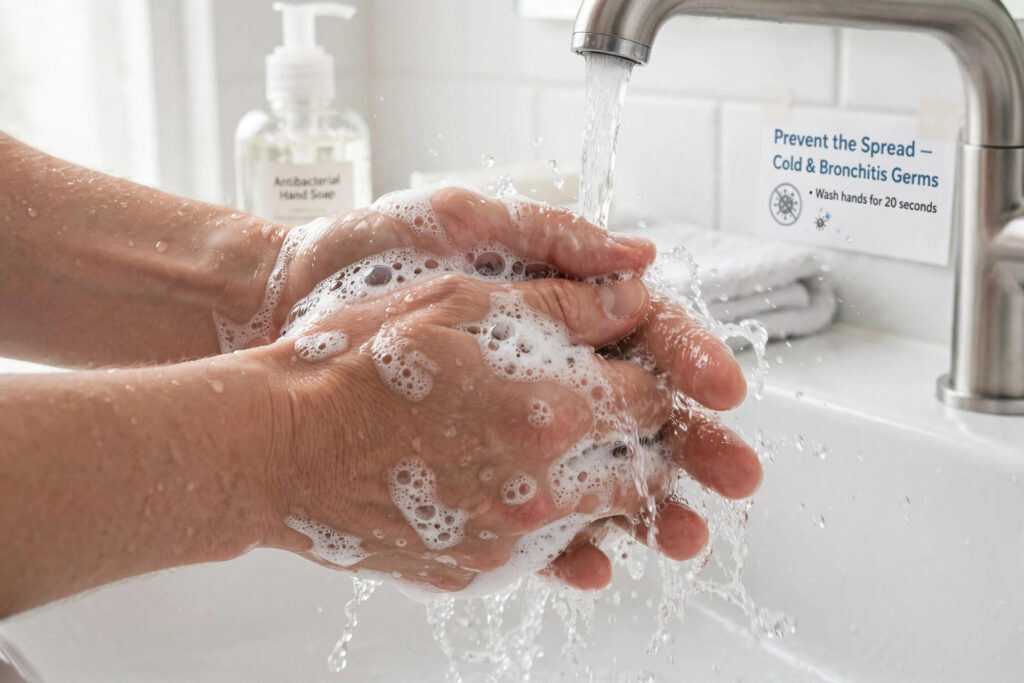
None of this is exotic. The CDC’s core prevention steps for respiratory viruses, the same viruses that cause most bronchitis, are the boring ones that actually work: stay up to date with recommended vaccines including the flu shot, cover coughs and sneezes, wash or sanitise your hands often, clean frequently touched surfaces, and bring in fresh air where you can.
In a household or a team, the practical version is even simpler. The sick person stays home while feverish. Everyone washes their hands after coughing, eating, and training. Don’t share water bottles, ever, but especially now. And if someone in the house has asthma, COPD, heart disease, or a weakened immune system, give them extra distance: for them, a simple chest cold can turn into something much worse.
When to Get Medical Help
Most acute bronchitis clears on its own. Get seen promptly if you have a fever lasting longer than five days or a fever of 104°F or higher, cough with bloody mucus, shortness of breath or trouble breathing, symptoms lasting more than three weeks, or repeated episodes of bronchitis. Those are the CDC’s own red flags, and they matter — because bronchitis can occasionally be pneumonia instead, or a sign of something else entirely, and only a clinician can tell the difference.
Get urgent help straight away for severe difficulty breathing, lips or face turning blue or grey, or new or worsening chest pain. Those are emergency signs, not wait and see signs.
Frequently Asked Questions: Is Bronchitis Contagious?
Is bronchitis contagious after a week?
Usually no, or only barely. For most viral acute bronchitis, you’re contagious for a few days to about a week. After that, a lingering cough is usually just healing airways, not active infection. If you still have fever or fresh cold symptoms after a week, though, assume you can still spread it and stay home.
Can you catch bronchitis from kissing or sharing a drink?
You can catch the virus that causes bronchitis through close contact like kissing, or by touching a contaminated surface and then your face. Sharing bottles or utensils with someone who’s sick raises that risk. The germ is the contagious part, whether it becomes bronchitis in you is a separate question.
Does bronchitis need antibiotics?
Almost never. About 95 percent of acute bronchitis is viral, according to Cleveland Clinic, and antibiotics don’t kill viruses. The CDC says antibiotics are not recommended even in the occasional bacterial case of a chest cold. Antibiotics do matter for specific diagnoses like pertussis or pneumonia, which is why a clinician’s diagnosis, not a guess, should decide.
The Bottom Line: Is Bronchitis Contagious?
So, is bronchitis contagious? Acute bronchitis usually is, for about a week, while the virus behind it is active. Chronic bronchitis never is. And the cough that hangs around for two or three weeks after you’ve recovered? That’s your airways finishing their repairs, not a sign you’re still infectious.
My teammate, it turned out, was right, his two-week cough wasn’t contagious anymore. But he was right by luck, not by knowledge, and luck is a terrible public health strategy. Now you know the two clocks: contagious for days, coughing for weeks. Keep them straight, stay home while it counts, and your team, and your lungs, will thank you.
This article is for general information only and is not medical advice. If you have breathing difficulty, persistent fever, chest pain, or symptoms that are worsening, seek medical care promptly and follow your clinician’s advice for your specific situation.