

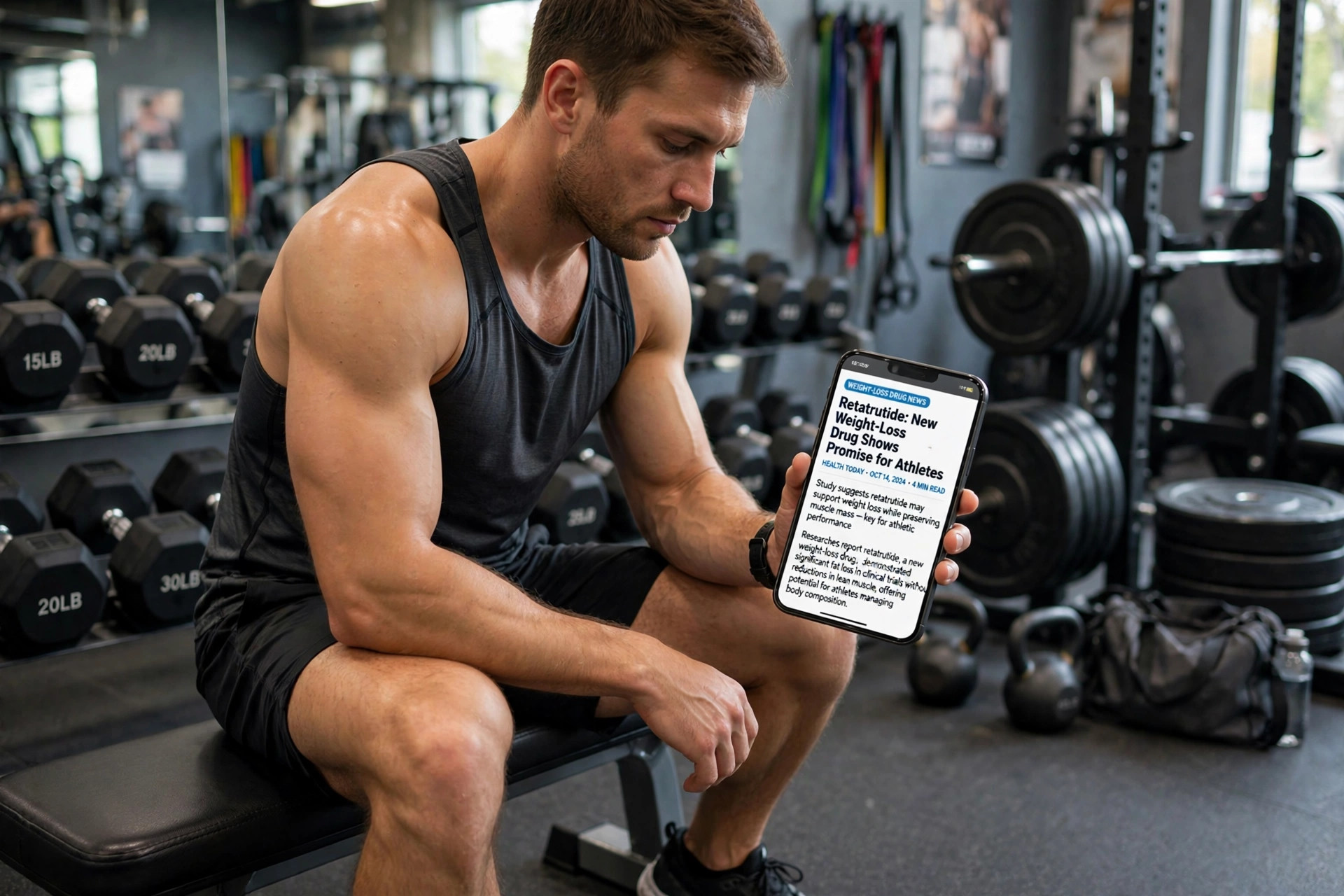
Spend five minutes in any gym group chat and you’ll hear it: someone’s talking about a new drug, “not Ozempic, the next one,” and the numbers sound almost too good to be true.
That next one is retatrutide: Eli Lilly’s once-a-week injection with trial numbers that made the medical world do a double-take this fall. It’s now one of the most-searched health terms in the US and UK — and if you train, it matters to you.
What Is Retatrutide, Actually?
You’ve heard of GLP-1 drugs — Ozempic, Wegovy, Mounjaro. They mimic one gut hormone to kill your appetite. Tirzepatide (Mounjaro/Zepbound) mimics two. Retatrutide mimics three: GIP, GLP-1, and glucagon. Think of it as a triple lock on your metabolism.
GLP-1 slows digestion and kills hunger. GIP helps insulin and fat-tissue signaling. And glucagon — the new piece — nudges your body to burn more energy and break down fat. So retatrutide doesn’t just make you eat less; it’s designed to make you burn more, too.
One crucial fact: retatrutide is not approved anywhere yet. It’s still investigational — no pharmacy sells it, and anything sold under that name online isn’t the real drug. The results below come from the published phase III trials themselves: the TRIUMPH-1 trial in the New England Journal of Medicine and the TRIUMPH-2 trial in The Lancet.
Retatrutide Weight Loss: The Trial Numbers Behind the Buzz
The hype didn’t come from marketing. It came from data.
TRIUMPH-1 (adults with obesity, no diabetes): a mean weight loss of 25.0% of body weight over 80 weeks on the highest 12 mg dose, versus 3.9% on placebo — numbers that start approaching bariatric surgery territory, without the surgery. That 25.0% is the trial’s headline intention-to-treat result. Among participants who stayed on treatment throughout, the figure reached 28.3% — but that is the efficacy estimand, a different calculation, not the headline number. Read the full results in the New England Journal of Medicine.
TRIUMPH-2 (adults with type 2 diabetes and obesity): 18.8% mean weight loss at 80 weeks on the 12 mg dose in the intention-to-treat analysis — 20.8% among those who stayed on treatment — with detailed results published in The Lancet on September 29, 2026. A third of top-dose patients lost at least 25% of their weight, and up to 40% reached normal blood sugar.
TRIUMPH-3 (severe obesity plus heart disease): up to 22.6%.
Lilly now has five positive phase III trials and plans to file for US approval in early 2027. US search interest peaked on October 13; the UK has been searching it actively for days. For context, the old heavyweight tirzepatide topped out around 22.5%. These retatrutide weight loss results are a genuine step-change.
Why Athletes Should Pay Attention
Most coverage frames this as an obesity story. But athletes live at the intersection of weight, muscle, and performance — and powerful weight-loss drugs don’t stay in doctors’ offices. GLP-1s showed up in locker rooms, cutting phases, and off-season transformations. Retatrutide will be no different, with sharper tradeoffs.
When someone loses 25% of their body weight in under two years, a real chunk of that is muscle. Rapid weight loss doesn’t discriminate between fat and lean tissue — and for an athlete, that’s your engine being quietly dismantled.
That’s the pattern that plays out again and again when a powerful appetite suppressant meets an aggressive cut: the weight drops fast, but so does the food. Protein intake collapses because eating feels like a chore, training carries on through a chronic calorie deficit, and recovery never gets fuel. The scale looks like a win — then the barbell tells a different story, with lifts sliding backwards even as body weight falls. The pounds lost weren’t all fat; a good share were muscle, lost for want of protein and energy to protect it.
Retatrutide’s appetite suppression is expected to be stronger, not weaker. Multiply that pattern and you see the problem.
The Muscle Problem Nobody’s Discussing
Every percentage point of rapid weight loss carries a quiet tax on lean mass — and the faster the drop, the heavier the tax. Research on GLP-1 weight loss has found a substantial share of what’s lost can be muscle, especially without resistance training and high protein. There are proven strategies for losing fat while keeping muscle — but they only work if you actually eat and train.
That matters for three groups of athletes in particular.
Lifters cutting weight classes. Dropping into a lower class on an appetite-killing drug sounds easy — until your total collapses. Severe appetite suppression makes eating 180+ grams of protein a day genuinely hard.
Endurance athletes. Your power-to-weight ratio might improve on paper, but chronic under-fueling raises injury risk, tanks recovery, and can trigger hormonal disruption and bone stress injuries.
Masters athletes. Muscle gets harder to build and easier to lose with age. Losing lean mass at 45 or 55 can take years to rebuild.
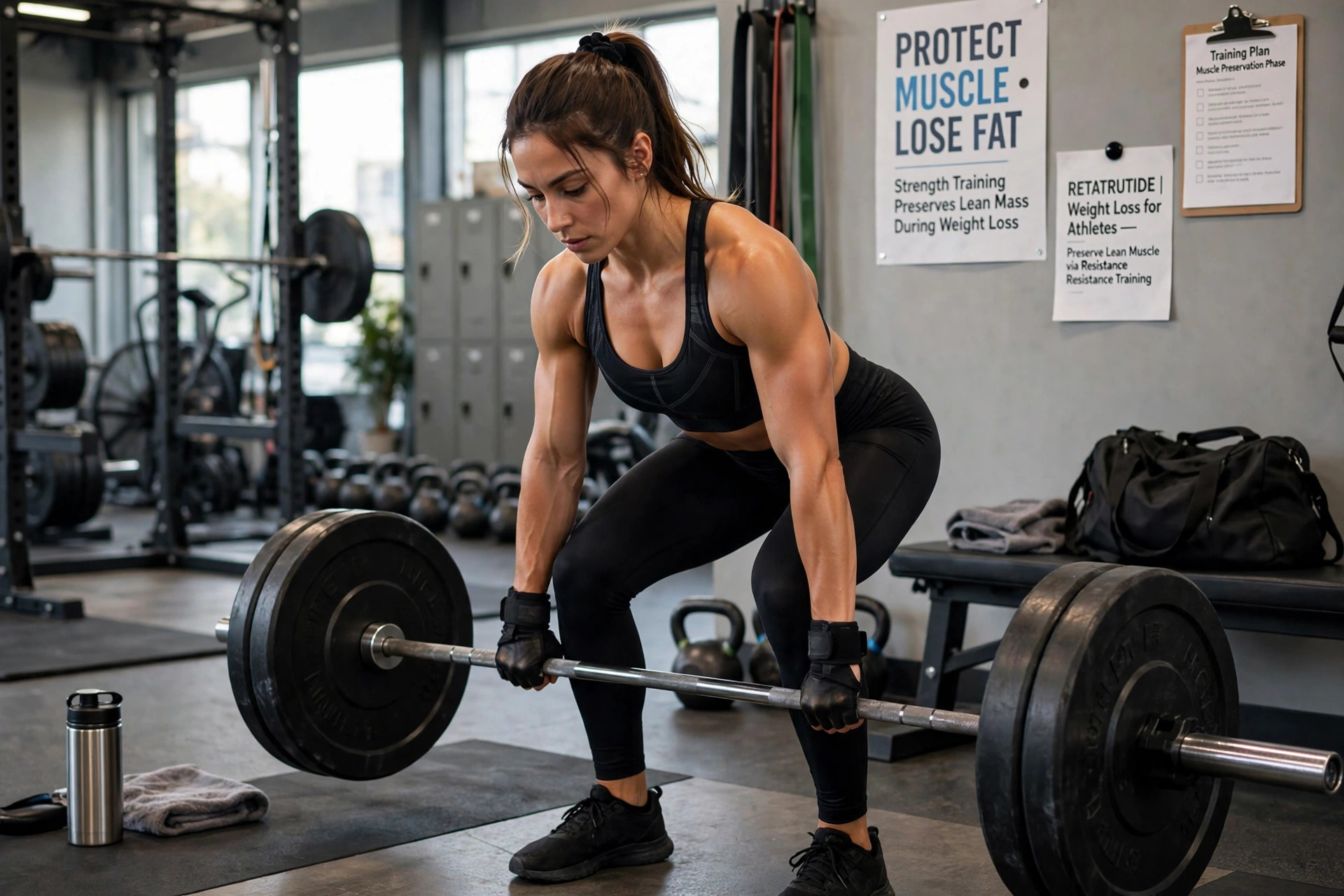
None of this means the drug is “bad.” It means the drug is powerful — and power without a plan is how athletes get hurt.
Training While Appetite-Suppressed: Five Practical Rules
Whether it’s retatrutide, a GLP-1, or any aggressive cut, these rules protect performance when food stops being appealing.
1. Protein is non-negotiable. Anchor every day around 1.6–2.2 grams of protein per kilogram of body weight. When you’re barely hungry, protein shakes, Greek yogurt, and eggs become strategic tools, not accessories. Eat the protein first.
2. Keep lifting heavy. Resistance training is the single strongest signal your body gets to keep muscle during weight loss. Two to three full-body sessions a week, compounds over isolation, weights that challenge you.
3. Shrink portions, not training fuel. Time your biggest meal around your hardest session. Learn how to fuel your workouts properly, and remember that sleep is the most underrated performance enhancer when you’re training in a calorie deficit.
4. Track what the scale won’t tell you. Measure your waist, take progress photos, and — most importantly — track your lifts. If strength is holding while weight falls, you’re losing the right tissue. If your numbers crater, the cut is eating your muscle.
5. Watch the side effects. The trials show mostly GI issues — nausea, diarrhea, vomiting — plus a dose-related skin-sensation quirk, dysesthesia, in about one in eight people at the top dose: 12.5% at 12 mg versus 0.9% on placebo. Mostly mild or moderate, but common enough to know about.
Retatrutide FAQs
Is retatrutide FDA-approved?
No. It’s investigational — five positive phase III trials, with Eli Lilly planning its US approval filing in early 2027. Anything sold online as retatrutide right now isn’t the real drug, and grey-market peptides are a gamble with your health.
How does retatrutide weight loss compare to Ozempic?
In trial numbers, it wins by a lot. Ozempic’s semaglutide averaged around 15–16% weight loss; retatrutide’s top-dose trial averaged 25.0% in the headline intention-to-treat analysis (28.3% among those who stayed on treatment throughout). But “better” depends on the person — stronger appetite suppression tends to mean stronger side effects, and long-term safety data are still being collected.
Can athletes use it to cut weight?
Medically, these drugs are being developed for obesity and related conditions — not for athletes trying to make weight or get lean. Any off-label use needs an honest conversation with a doctor who understands both the drug and your sport. The muscle-preservation rules above apply either way.
The Bottom Line: Respect the Power, Keep the Muscle
Retatrutide is the most potent weight-loss medication ever tested in trials — and it may be on pharmacy shelves by 2027. That means the conversation is happening now, in group chats and gyms, long before your doctor brings it up.
The drug changes the math of weight loss, but it doesn’t change the math of performance. Muscle still has to be earned and protected — with protein, heavy training, and honest tracking. A smaller number on the scale is worthless if it costs you the engine that got you there.
The hype will keep growing. Your training plan should get smarter, not smaller.
This article is for informational purposes only and is not medical advice. Retatrutide is an investigational drug and has not been approved by any regulator. Talk to a qualified healthcare professional before
considering any weight-loss medication or making changes to your training or diet.
Sources
- Jastreboff, A. M. et al. (2026). Retatrutide, a Triple Hormone Receptor Agonist, for Treatment of Obesity (TRIUMPH-1). New England Journal of Medicine, 395(18), 1781–1793. https://doi.org/10.1056/NEJMoa2604169
- Bellido, V., le Roux, C. W., Ekinci, E. I., et al. (2026). Retatrutide in adults with obesity and type 2 diabetes (TRIUMPH-2): a double-blind, parallel-group, randomised, placebo-controlled, phase 3 trial. The Lancet. Published online 29 September 2026. https://doi.org/10.1016/S0140-6736(26)01861-1