
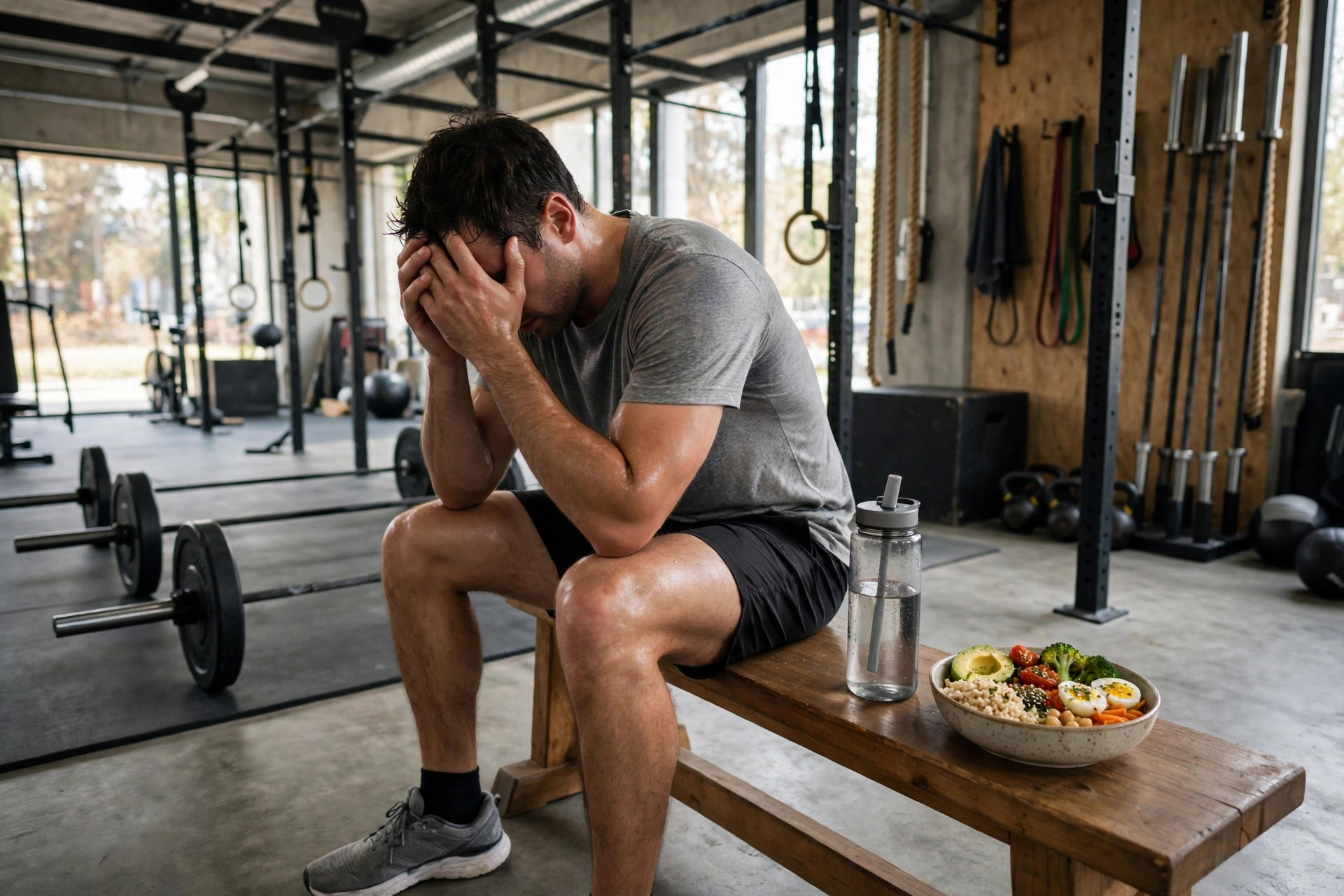

I know a guy — let’s call him Dan — who trains five mornings a week at a functional fitness gym, the kind with barbells, pull-up rigs, and a whiteboard full of workouts with girls’ names. He looks the part. He’s lean, he’s strong, and he never misses a session. Last month he told me, almost proudly, that he skips breakfast, grabs a black coffee, trains hard, and then eats “pretty clean” for the rest of the day. His story is a familiar one among low energy availability athletes.
He also told me, in the same conversation, that his lifts have stalled, he’s picking up little niggles that won’t heal, and he sleeps terribly. Age took the blame first. He blamed his programming. He never once blamed his plate.
A brand-new study suggests Dan might be looking in the wrong place — and that he’s far from alone. It shows that low energy availability athletes are easy to miss, because the problem is often silent at first.
What the New Study Actually Found
Researchers at the University of South Carolina followed 30 recreational high-intensity functional training athletes — 18 women and 12 men, average age about 31 — for two weeks. These weren’t elite competitors. They were ordinary gym-goers training five days a week on a supervised program, juggling jobs and life alongside their training, just like Dan.
The team tracked everything properly: detailed food logs on every training day, a multi-sensor armband estimating exercise energy expenditure, and DEXA scans to measure fat-free mass and bone density. They also measured resting metabolic rate, sleep, perceived exertion, and recovery.
The headline number stopped me cold: the group’s average energy availability was 24.9 kilocalories per kilogram of fat-free mass per day — well below the 30 kcal threshold researchers use to flag low energy availability. Twenty-four of the 30 athletes, 80 percent of them, fell below that line. Among the women it was 83 percent; among the men, 75 percent.
Here’s the twist, though — and it’s an important one. The low-energy group didn’t look any worse on the short-term measures. Their recovery ratings, sleep quality, perceived exertion, and bone density were no different from the six athletes who were eating enough. Their average resting metabolic rate ratio sat at 1.10, comfortably above the 0.90 value that signals metabolic suppression. Only four participants showed that suppressed signature.
In other words, under-fuelling was common — but in a two-week window, it was mostly silent.
What “Energy Availability” Actually Means
Energy availability isn’t the same as total calories eaten. It’s what’s left over for your body to run itself after you subtract the cost of training.
The formula is simple: Energy availability = (food energy eaten minus exercise energy burned) divided by fat-free mass in kilograms.
Fat-free mass is everything that isn’t fat — muscle, bone, organs, water. Researchers use it instead of total body weight because it’s a better proxy for the tissue your body actually has to maintain.
Below roughly 30 kcal per kilogram of fat-free mass per day, controlled studies show disruptions in hormones and metabolism. Stay there long enough, and you drift into the syndrome the International Olympic Committee calls RED-S — Relative Energy Deficiency in Sport. That’s the umbrella term for what happens when the body doesn’t have enough energy left to support health and performance: impaired recovery, more frequent illness and injury, hormonal disruption, and, over months and years, weaker bones.
RED-S isn’t a diagnosis you get from one bad week. It’s what chronic under-fuelling builds toward. And that’s exactly why this study matters: it shows how easily ordinary, committed recreational athletes can sit below the threshold without noticing.
Do the Math on Your Own Plate
This is the part most articles skip, so let’s not. Here’s a worked example with real numbers.
Take a recreational athlete weighing 78 kilograms with 62 kilograms of fat-free mass — a plausible profile for a regular functional fitness trainee. On a hard training day, she eats 2,400 kcal and burns roughly 900 kcal in her session and associated activity.
Energy availability = (2,400 minus 900) divided by 62 = 24.2 kcal per kilogram of fat-free mass per day.
That’s below the 30 threshold — and she ate what most people would call a decent amount of food. To reach 30, she’d need (30 times 62) plus 900 = 2,760 kcal on that training day. That’s 360 kcal more than she ate: roughly a large snack, a bigger dinner, or a proper post-workout meal she skipped.
Now run your own numbers honestly. Most people overestimate what they eat and underestimate what hard training costs. A food log for just three days — including one heavy training day — will tell you more than any guesswork. If your result lands under 30 consistently, that’s not a badge of discipline. It’s a warning light.

Why This Happens So Easily in Functional Fitness
Functional fitness culture makes under-fuelling almost the default setting, and it does it in three quiet ways.
First, the training load is enormous. Five sessions a week blending Olympic lifting, gymnastics, and metabolic conditioning burns far more energy than a casual gym routine. Yet most recreational athletes eat like casual gym-goers — or less.
Second, the culture rewards leanness. The aesthetic of the sport is visible abs and a lean frame, and social media amplifies it. Intentional restriction blends so smoothly into unintentional restriction that many athletes can’t tell which one they’re doing. The study authors flagged exactly this: a leanness-focused culture may encourage restriction, deliberate or not.
Third, there’s no support system. Elite athletes have dietitians. Recreational athletes have a whiteboard and a group chat. They train like athletes and fuel like people who sit at desks — because, most of the day, they do sit at desks, and nobody ever taught them that five hard sessions a week changes the maths entirely.
Why Nothing Looked Wrong (Yet)
If 80 percent of the group was under-fuelled, why did they all seem fine? The researchers offered several honest explanations, and they’re worth hearing before anyone dismisses the finding.
Food logs underestimate intake — people forget snacks, misjudge portions, and under-report, especially when they’re active. The men in the study reported eating only about 2,200 kcal a day despite resting metabolic rates near 2,300 kcal, which suggests under-reporting inflated the low-energy count. The armband estimating exercise burn is also less accurate during vigorous, stop-start exercise like functional training, and its errors grow at higher intensities.
Timing matters too. Bone density changes over months and years, not two weeks, so a short study can’t detect skeletal effects even if they exist. The study was also small — a 24-to-6 split between groups — and powered only to detect very large differences, so modest real effects could easily have been missed. And short-term performance can be propped up by glycogen stores, motivation, and pacing tricks.
None of that makes the finding meaningless. It makes it a snapshot of risk, not a verdict of damage. The authors’ own conclusion was careful: short-term low energy availability in recreational athletes may be common yet clinically silent, with consequences more likely to emerge over longer exposure. A single number below 30 shouldn’t be used as a stand-alone diagnosis — but it should never be ignored either.
One finding did stand out, even if it was exploratory: athletes who slept longer reported better overall recovery, with a moderate correlation (0.46) between sleep duration and total quality recovery scores. Sleep averaged just 6.8 hours a night across the group. In a sport obsessed with training variables, the cheapest recovery tool — an extra hour in bed — is the one most people skip.
Myth vs Fact: Under-Fuelling Edition
Myth: If I feel fine, I’m eating enough. Fact: This study found 80 percent of athletes below the energy threshold with no measurable difference in recovery, sleep, or exertion over two weeks. Feeling fine is not proof of adequate fuelling — it’s how under-fuelling hides.
Myth: Eating less keeps me lean, and leaner means faster. Fact: Chronic under-fuelling is linked to stalled performance, more injuries and illness, hormonal disruption, and bone loss over time. Leanness bought with an energy deficit eventually costs you the performance you were chasing.
Myth: Only elite or female athletes get RED-S. Fact: This was a recreational, mixed-sex group, and 75 percent of the men were below the threshold too. RED-S risk follows the energy maths, not the competitive level or the sex of the athlete.
Myth: One low day ruins everything. Fact: Energy availability is about the pattern over weeks, not a single day. An occasional light day is normal. A consistent deficit across training weeks is the problem worth fixing.
The Warning Signs Worth Watching
You don’t need a lab to spot the warning signs of overtraining early. Watch for the cluster, not a single symptom: performance that plateaus or slides despite consistent training; injuries or colds that keep recurring; constant fatigue that sleep doesn’t fix; loss of libido or disrupted menstrual cycles; irritability and preoccupation with food; and getting leaner while getting weaker. Any one of these has innocent explanations. Several together, in someone training five days a week on a modest diet, deserve attention — from a clinician or a sports dietitian, not just from a training partner.
How to Fix It Without Overhauling Your Life
Fixing an energy gap is usually simpler than people expect, because the gap itself is usually modest — a few hundred calories a day, not a thousand. For low energy availability athletes, that gap is often closed with one solid post-workout meal.
Eat a real post-workout meal. The session is the most expensive part of your day. A meal with protein and carbohydrates within a couple of hours afterwards — not just a shake and hope — closes much of the gap in one move.
Add energy where it doesn’t feel like a chore. An extra snack on training days, a bigger portion of rice or oats at dinner, a drizzle of olive oil, a handful of nuts. These are small additions that add up to the 300 to 500 kcal many under-fuelled athletes are missing, without falling into high-protein diet mistakes.
Log three honest days. Include one hard training day, weigh or estimate portions properly, and include the snacks you usually forget. Do the energy availability maths above. You can’t fix a number you’ve never calculated.
Prioritise sleep like a session, because sleep is an underrated performance enhancer. The study’s group averaged 6.8 hours. If your recovery feels flat, an extra hour of sleep is a better first move than a new supplement.

Get help if the pattern persists. If warning signs cluster, or if the thought of eating more feels genuinely difficult, talk to a sports dietitian or a clinician. That isn’t weakness — it’s exactly what the professional support system is for, and recreational athletes deserve it as much as elites do.
Conclusion
The uncomfortable lesson of this study isn’t that functional fitness is dangerous. It’s that hard training plus ordinary eating can quietly leave you short — and that “feeling fine” is a poor fuel gauge. Eight in ten recreational athletes in this study sat below the energy availability threshold, and none of them could tell from how they felt. The maths told the story their bodies hadn’t yet. For low energy availability athletes, that maths check is the simplest safeguard.
So steal the researchers’ method: log a few honest days, do the simple calculation, and see where you actually stand. If you’re below 30 on training days, add the food before you add the sessions. Your future self — stronger, healthier, and still training in five years — will be glad you did.
What is low energy availability in athletes?
Low energy availability means the energy left for your body’s basic functions, after subtracting exercise energy expenditure from food intake, falls below about 30 kilocalories per kilogram of fat-free mass per day. It is the primary driver of Relative Energy Deficiency in Sport (RED-S) and is linked to impaired recovery, hormonal disruption, and bone health problems over time.
Can you have low energy availability and feel fine?
Yes. In the 2026 Frontiers in Nutrition study of 30 recreational functional fitness athletes, 80 percent fell below the threshold yet showed no significant differences in recovery, sleep, exertion, or bone density over two weeks. Under-fuelling can be clinically silent in the short term, which is why tracking intake matters more than relying on how you feel.
How do I calculate my energy availability?
Subtract your exercise energy expenditure from your daily food intake, then divide by your fat-free mass in kilograms. For example, (2,400 kcal eaten minus 900 kcal burned) divided by 62 kg fat-free mass = 24.2 kcal per kilogram per day, which is below the 30 threshold. Track three honest days including a hard training day for a useful estimate.
This article is for general information only and isn’t medical advice. If you have warning signs such as recurring injuries, disrupted menstrual cycles, or persistent fatigue, talk to a qualified healthcare professional or sports dietitian before changing your diet or training.