
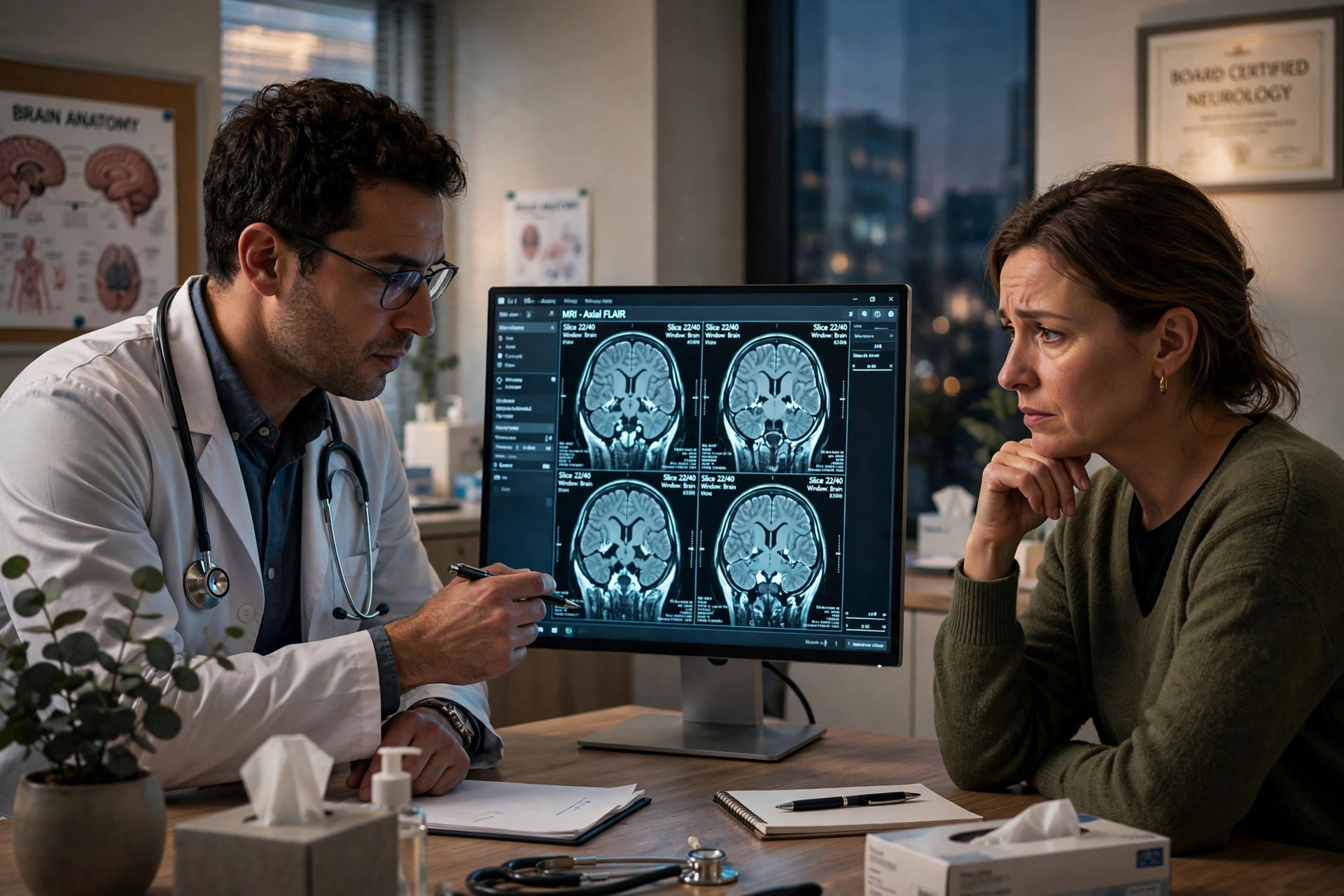

Imagine building your whole life around an illness for five years — the medications, the wheelchair, the identity — and then walking into your doctor’s office and hearing: “Congratulations, you don’t have MS.”
That’s exactly what happened to Christina Applegate this week. And honestly? Her reaction is the part I can’t stop thinking about. She didn’t feel relieved. She felt devastated.
On Tuesday, October 20, 2026, the 54-year-old actress returned to her MeSsy podcast after a seven-month hiatus and told co-host Jamie-Lynn Sigler, through tears, that doctors have now concluded they got her multiple sclerosis diagnosis wrong back in 2021. “You don’t get misdiagnosed and then all of a sudden I’m better,” she said. “I haven’t gotten better. If anything, I’ve gotten worse.”
She still relies on a wheelchair just to get from her car into the doctor’s office. The label is gone — but the symptoms never left.
Here’s the part that should make all of us pay attention: her doctor wasn’t an anomaly. Dr. Marwa Kaisey, an associate professor of neurology at Cedars-Sinai who joined that podcast episode, said MS misdiagnoses are “fairly common” — with roughly 20 percent of MS diagnoses eventually turning out to be wrong.
One in five. Let that sink in for a moment.
Why Getting an MS Diagnosis Right Is So Hard

For example, most diseases have a test. Flu? Swab. Diabetes? Blood sugar. Pregnancy? Well, you know the one.
MS has nothing like that. As Dr. Kaisey put it on the podcast: “We don’t have one single test for MS. It’s not like we have something like a pregnancy test that says, ‘Yes. You have it.’ ‘No. You don’t.’ It’s a list of criteria.”
Those criteria — called the McDonald criteria — require doctors to piece together symptoms, a neurological exam, MRI scans, spinal fluid analysis, and sometimes nerve-response tests called evoked potentials. It’s more detective work than lab work. And detective work leaves room for error.
The biggest trap? The MRI. White spots on a brain scan look dramatic, but scarring can show up on MRIs for all kinds of reasons that have nothing to do with MS — migraines, small vessel disease, plain old aging. Dr. Andrew Solomon, a neurologist at the University of Vermont who has studied this extensively, warns that an “overreliance on MRI abnormalities without thoughtful consideration of history, symptoms, and neurological exam” is a major driver of MS misdiagnosis.
In other words: a scary scan plus rushed interpretation can hand you a label that changes your entire life.
8 Conditions That Can Look Exactly Like MS
This is where it gets unsettling. A multicenter study of 110 misdiagnosed MS patients — the National Multiple Sclerosis Society funded it with Mayo Clinic researchers — found the wrong labels came from specialists and non-specialists alike. The culprits:
Migraine. The number-one mimic — 22% of the misdiagnosed cases in that study. Migraines can cause white-matter spots on MRI and visual symptoms that mimic MS relapses.
Fibromyalgia. Widespread pain, crushing fatigue, brain fog, tingling — sound familiar? About 15% of the misdiagnosed patients actually had fibromyalgia.
Vitamin B12 deficiency. Here’s one that stings: B12 deficiency causes fatigue, numbness and tingling in the hands and feet, and mental confusion — because B12 helps maintain the myelin sheath MS attacks. A blood test could catch this. Sometimes it just… doesn’t get ordered.
Lupus and Sjögren’s syndrome. These autoimmune conditions can produce white-matter abnormalities on MRI that fool even experienced readers.
Lyme disease. The National MS Society notes Lyme can cause weakness, blurred vision from optic neuritis, “pins and needles” sensations, cognitive trouble, and fatigue — plus a relapsing-remitting pattern and similar MRI findings. It’s one of the hardest calls in neurology.
Neuromyelitis optica (NMO) attacks the optic nerves and spinal cord. Doctors used to lump it in with MS, but it needs completely different treatment.
Functional neurological disorder. Real, disabling symptoms — weakness and movement problems — without structural nerve damage. It made up about 11% of misdiagnoses in the study.
Small vessel disease. Tiny blood-vessel damage in the brain — common with aging, hypertension, or diabetes — shows up as white spots doctors can mistake for MS lesions, especially after 50.
Notice something? Every single one of these is treatable in a completely different way. That’s why the right label matters so much.
How Doctors Actually Diagnose MS (When They Get It Right)
By contrast, a proper MS workup is a slow, layered process — and that slowness is a feature, not a bug. Here’s what a thorough evaluation typically includes:
1. A detailed neurological exam — testing reflexes, coordination, vision, and strength across multiple visits, looking for a pattern of damage “separated in space and time.”
2. Brain and spinal cord MRI — interpreted carefully, in the context of your symptoms, not in isolation.
3. Lumbar puncture (spinal tap) — checking for oligoclonal bands, abnormal proteins that suggest immune activity in the central nervous system.
4. Evoked potentials — measuring how fast your nerves respond to stimulation.
5. Ruling everything else out — B12 levels, Lyme testing, autoimmune panels. Doctors skip this step more often than they should.
The National MS Society’s own diagnosing-MS guidelines emphasize that in people 50 and older — or with vascular risk factors like hypertension or diabetes — neurologists strongly recommend extra confirmation steps, precisely because the misdiagnosis risk climbs with age.
What To Do If You Doubt Your Own Diagnosis

First, I’m not a doctor, and neither is a blog post. But if Applegate’s story has you side-eyeing your chart, here’s what neurologists say helps:
Get a second opinion from an MS specialist — not just any neurologist, but someone at an MS center who sees hundreds of MS patients yearly. Mayo Clinic researchers behind the study put it bluntly: “Premature diagnosis of MS should be avoided… Physicians should request a second opinion when they are unsure.”
Bring your full records, not just your story. Old MRIs, blood work, the actual images — not just summaries. A specialist re-reading the original scan often unravels the misdiagnosis.
Also, keep a symptom journal. Dates, triggers, what got better, what got worse. Patterns matter in neurology, and human memory is a terrible filing cabinet.
Don’t stop your medication on your own. MS therapies carry real side effects and real stopping risks. In the multicenter study, doctors had put 70% of misdiagnosed patients on MS drugs they never needed. Untangling that requires a doctor’s supervision, not a DIY purge.
Protect your mental health. Applegate said losing her diagnosis sent her into “a great depression” — because even a wrong diagnosis gave her suffering a name and a community. Grief over a retracted diagnosis is real grief. Building mental resilience through a health identity crisis is brutally hard — and it’s worth getting support instead of white-knuckling it alone.
Meanwhile, if fatigue is part of your picture — and it’s part of nearly every MS and MS-mimic picture — it’s worth learning how chronic fatigue recovery works, since pacing and energy management help regardless. And don’t underestimate the basics: sleep quality affects everything neurological, and poor sleep amplifies every symptom on this list.
Frequently Asked Questions
Can MS be misdiagnosed from an MRI alone?
Yes — and this is one of the most common ways it happens. White-matter lesions on MRI are not unique to MS; migraines, small vessel disease, and normal aging can all produce similar spots. That’s why neurology training says never to diagnose from imaging alone. If your diagnosis rested mostly on a scan, that’s a strong reason to seek a second opinion from an MS specialist.
What percentage of MS diagnoses are wrong?
Research consistently lands around 15–20%. A Cedars-Sinai neurologist cited roughly 20% on Christina Applegate’s podcast this week. A multicenter study of 110 misdiagnosed patients found that errors took an average of four years to catch — and a third of patients carried the wrong diagnosis for over a decade.
If I’m misdiagnosed, should I stop my MS medication?
No — not without your doctor’s direct guidance. MS therapies suppress the immune system, and stopping abruptly can cause rebound disease activity or other complications. The correct move is to raise your doubts with your neurologist, get a specialist second opinion, and let the medical team design a safe transition plan if the diagnosis changes.
The Takeaway
Christina Applegate spent five years as one of the most visible MS advocates in the world — and now she’s “back at square one,” as she put it, with worsening symptoms and no name for them. Nobody would choose that trade.
But there’s something useful buried in this painful story for the rest of us: a diagnosis is a working theory, not a tattoo. Good medicine expects to be questioned. The best neurologists in the world get this wrong one time in five — which means patients who ask “are we sure?” aren’t being difficult. They’re being smart.
If you take one thing from Applegate’s week, let it be this: your symptoms are real whether or not the label is right. Chase the label, yes — get the second opinion, ask the hard questions. But don’t let anyone, including a doctor, make you feel like losing a diagnosis means losing the right to be taken seriously.
Medical disclaimer: This article is for informational purposes only and is not a substitute for professional medical advice, diagnosis, or treatment. Always seek the advice of your physician or another qualified health provider with any questions you have regarding a medical condition.