
Last month, my uncle tried to lift a suitcase into the overhead rack on a flight and couldn’t. Not because it was heavy — it was the same bag he’d carried for years. His arms just… gave up halfway. He laughed it off at the time. But that moment stuck with me, because it wasn’t about one suitcase. It was about muscle quietly disappearing, year after year, while nobody notices — until a staircase, a jar lid, or a grandchild on the floor makes it impossible to ignore.
That slow disappearance has a name: sarcopenia muscle loss. And here’s the part most people miss — it doesn’t start at 70. It starts in your 30s and 40s, and by the time most of us pay attention, we’ve already lost a serious chunk of the strength we’ll need for the rest of our lives. The good news? A brand-new 2026 review of 25 clinical trials has worked out exactly how much training it takes to fight back. Not vague advice. An actual dose. Let’s get into it.
What Is Sarcopenia Muscle Loss, Really?
Sarcopenia muscle loss is the age-related loss of muscle mass, strength, and physical performance. Doctors define it in three parts: low muscle strength comes first, then low muscle mass confirms the diagnosis, and poor physical performance — like walking slowly — marks it as severe. It’s not just “getting old.” It’s a recognised muscle disease, and it raises your risk of falls, fractures, frailty, and losing your independence.
How common is it? Roughly 10 to 16 out of every 100 older adults live with it, according to a 2026 review in the European Review of Aging and Physical Activity — and that number climbs to as many as 50 in 100 once you pass 80. That’s not a rare condition. That’s half the people in the room.
And it starts earlier than you’d think. Most adults begin losing muscle in their 30s, and the slide speeds up after 60. If you’re an athlete in your 40s who’s noticed your sprint times slipping or your recovery dragging, you’re not imagining it — and the research on losing strength in your 30s and 40s backs up exactly what you’re feeling.
5 Warning Signs You’re Losing Muscle Faster Than You Should
You don’t need a lab to spot the early signs. Your daily life is already running the tests for you — you just have to pay attention to the results.
1. The jar test
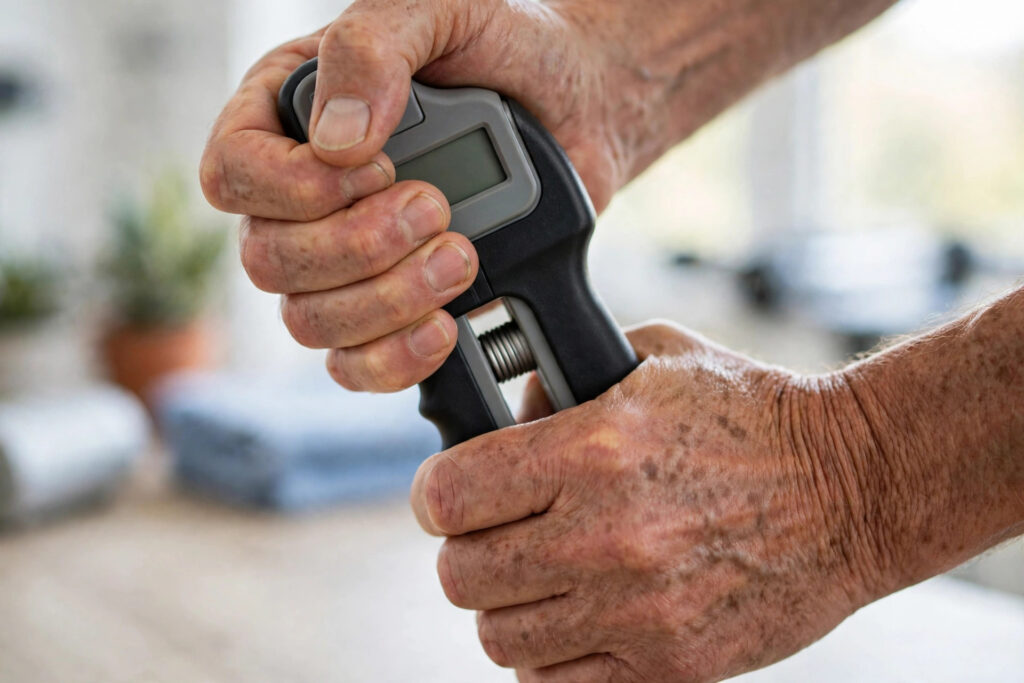
If lids that used to pop open now need a towel, a tool, or someone else’s hands, your grip is fading. Grip strength is one of the best early warning signs doctors use — below 27 kg for men or 16 kg for women is the line where sarcopenia becomes “probable.” A simple grip strength test takes thirty seconds and tells you more about your future health than most blood tests.
2. The chair test
Can you stand up from a chair five times in a row without using your hands, and do it quickly? If you need to push off the armrests or rock forward for momentum, your leg strength is slipping. This is the same test clinics use, just without the stopwatch.
3. The stairs test
Climbing a flight of stairs used to be nothing. Now your thighs burn halfway up, or you catch yourself holding the rail every single time. That’s your body telling you your leg muscles can’t produce the power they used to.
4. Your walking speed has dropped
If friends and family keep walking ahead of you, or you notice you’re the slow one in the group now, take note. A walking speed of 0.8 metres per second or less is the clinical cut-off for low physical performance. You don’t need to measure it precisely — if you’ve slowed down noticeably, it counts.
5. Recovery takes forever
That workout soreness that used to fade in a day now hangs around for three. Bruises linger. A minor strain turns into a two-week saga. Weaker muscles recover slower, and slower recovery is itself a warning sign.
If two or more of these sound familiar, don’t panic — but don’t shrug it off either. Every single one of them is reversible with the right training
What the New 2026 Research Actually Found
Here’s where it gets exciting. A systematic review published in 2026 pulled together 25 randomised controlled trials covering 1,302 older adults with sarcopenia muscle loss, all testing resistance training. This wasn’t one small study — it was the combined weight of the best evidence we have.
The results were clear. Resistance training significantly improved muscle strength (a solid, moderate effect), grip strength, walking ability, and lean muscle mass. And the numbers behind those words are genuinely encouraging: across the research, strength training typically delivers 30 to 60% gains in strength and 5 to 10% more lean mass. Separate research has also shown it cuts falls by 23% — which, for anyone over 60, might be the single most important number in this whole article.
But the review went further than “lifting weights helps.” It worked out the dose. For maximum strength gains, the sweet spot was around 1,043 minutes of total training time. For walking ability, it was around 2,716 minutes. And the intensity that worked best was 60 to 80% of your one-rep max — in plain English, weights that feel challenging but manageable, not feather-light and not maximal.
Let me translate those minutes into something you can actually plan around. If you train three times a week for 45 minutes, you hit 1,043 minutes in about 8 weeks — and 2,716 minutes in about 20 weeks. That’s it. Two months to rebuild meaningful strength, five months to transform how you move. For something that took decades to lose, that’s a remarkably good deal.
The Exact Training Dose That Works
So what does a sarcopenia-fighting programme actually look like? Based on the 2026 review and the guidelines built on it, here’s the prescription:
- Frequency: 2 to 3 sessions per week, with at least one rest day between them. Your muscles rebuild between sessions, not during them — the rest day is part of the medicine.
- Intensity: 60 to 80% of your one-rep max. If you can lift a weight 8 to 12 times with good form but the last two reps feel hard, you’re in the zone.
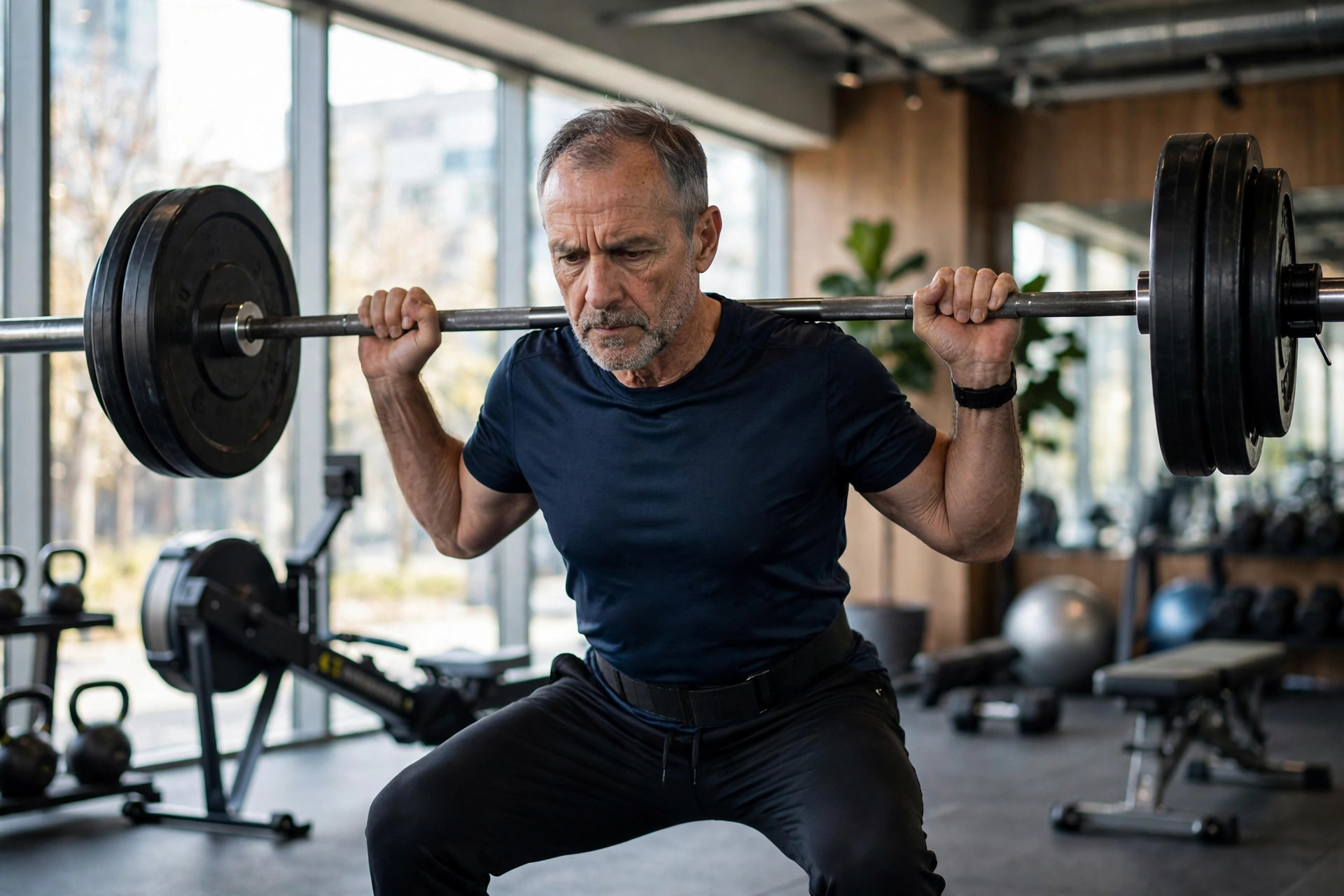
- Exercises: focus on the big moves — squats or leg press, deadlifts or hip hinges, chest press, rows, and overhead press. These work the most muscle at once, which is exactly what you want.
- Sets and reps: 2 to 3 sets of 8 to 12 reps per exercise. Start at the lighter end and add a little weight every week or two.
- Progression: this is the part most people skip, and it’s the part that matters most. Your muscles only adapt when the challenge grows. Add a rep, add a kilo, add a set — small steps, every week.
A word of honesty here: if you’ve never lifted weights, don’t walk into a gym and grab the heaviest dumbbell you can find. Book one session with a qualified trainer or physiotherapist to learn the movements safely. One good coaching session is worth more than six months of guessing.
Protein: The Other Half of the Equation
Training is the signal. Protein is the building material. You can send the signal all you like, but if the bricks never arrive, nothing gets built.
Older adults need more protein than the standard guidelines suggest. The PROT-AGE study group — a panel of nutrition and muscle experts — recommends 1.0 to 1.2 grams of protein per kilogram of body weight per day for healthy older adults, rising to 1.2 to 1.5 grams during illness or recovery. That’s noticeably more than the 0.8 grams per kilo that younger adults get by on.
Here’s a worked example. Take a 70 kg person. At 1.2 grams per kilo, that’s 84 grams of protein a day. Spread across three meals, that’s roughly 25 to 30 grams per meal — a palm-sized piece of chicken or fish, or two eggs with a bowl of Greek yogurt, or a cup of lentils with cheese. Nothing exotic. But here’s the catch: most older adults eat almost all their protein at dinner and barely any at breakfast. Your muscles don’t care about your daily total as much as they care about each meal hitting that 25-to-30-gram threshold, because that’s what switches muscle-building on. So the fix isn’t eating more protein — it’s spreading the protein you already eat more evenly. And if you’re not sure where you’re going wrong, the protein mistakes athletes make are the same ones most of us make at home.
Myth vs Fact
Myth: “Muscle loss is just part of aging — nothing you can do about it.”
Fact: The 2026 review of 25 trials found strength gains of 30 to 60% in people who already had sarcopenia — including people in their 70s and 80s. Your muscles don’t know your age. They know the stimulus you give them.
Myth: “Walking is enough exercise as you get older.”
Fact: Walking is wonderful for your heart, your mood, and your joints — but it doesn’t load your muscles hard enough to rebuild them. The research is blunt on this: resistance exercise beats aerobic exercise for muscle mass and strength in sarcopenia. Walk every day, yes. But lift too.
Myth: “Protein shakes will fix it.”
Fact: Protein only helps when it’s paired with training. Without the training signal, extra protein mostly just becomes expensive calories. Shakes are a convenient way to hit your daily target — they’re not a substitute for the work.
Myth: “You need a gym and heavy barbells.”
Fact: The trials in the 2026 review used everything from machines and free weights to resistance bands and bodyweight. What matters is progressive overload — making it a little harder over time — not where you do it or what brand of equipment you use.
A Simple 4-Week Starter Plan
Week 1: Learn the moves. Two sessions, bodyweight only or very light weights. Squats to a chair, wall push-ups, dumbbell rows, glute bridges. Focus entirely on form. Soreness is normal; sharp pain is not.
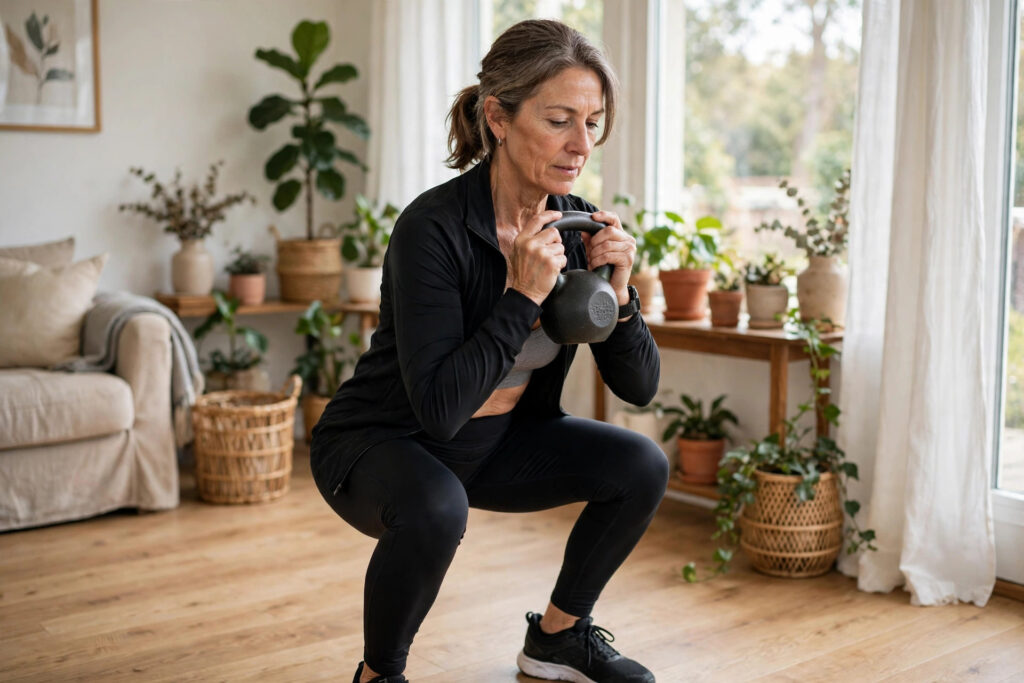
Week 2: Add load. Three sessions now. Pick weights where 10 reps feel challenging. Add a goblet squat and a chest press with dumbbells. Write down every weight you use — you’ll want that record later.
Week 3: Push the last reps. Same exercises, but now the final two reps of each set should feel genuinely hard. Add a third set to your two favourite exercises. Check your protein: are you hitting 25 to 30 grams at breakfast, not just dinner?
Week 4: Test yourself. Time your five chair stands. Squeeze a grip trainer or just notice the jars. Compare with week one. Most people are surprised — the change in four weeks is real, and it’s only the beginning. From here, keep adding a little weight every week or two, and remember the 8-week and 20-week milestones from the research: that’s when the biggest gains land.
Frequently Asked Questions
Can sarcopenia be reversed, or only slowed down?
It can genuinely be improved — and in many cases, reversed. The 2026 review found significant gains in strength, grip, walking speed, and lean mass in people who already had sarcopenia. You may not get back the muscle of your 25-year-old self, but you can absolutely get back the strength to live the way you want. The earlier you start, the better the result.
How fast will I see results?
Strength improves first — most people feel a difference within 4 to 6 weeks, because your nervous system learns to use the muscle you already have. Visible muscle growth takes longer, typically 8 to 12 weeks. The research suggests the biggest strength gains cluster around 8 weeks of consistent training, and walking ability keeps improving out to about 20 weeks. Stick with it past the first month and the results compound.
Is it safe to lift weights if I already have sarcopenia?
For most people, yes — with the right starting point. The trials in the 2026 review included adults in their 70s and 80s with diagnosed sarcopenia, and resistance training was safe and effective. But “safe” assumes sensible progression and decent technique. If you have heart disease, severe osteoporosis, joint replacements, or any condition that affects balance, get clearance from your doctor and a first session with a qualified trainer before you start.
The Bottom Line
Sarcopenia muscle loss isn’t a verdict — it’s a warning. Your muscles start slipping in your 30s, the slide speeds up after 60, and by 80 it affects as many as half of us. But the same research that spells out the problem also hands you the solution: two to three sessions of resistance training a week at a challenging weight, about 8 weeks to rebuild real strength and 20 weeks to transform how you move, plus enough protein spread across every meal.
The suitcase my uncle couldn’t lift? Six months from now, I want him carrying two. And if you’ve recognised yourself anywhere in this article — the jars, the stairs, the slow recovery — the best day to start was ten years ago. The second-best day is today.
This article is for general information only and is not medical advice. If you have a medical condition, take medication, or have been diagnosed with sarcopenia, talk to your doctor or a qualified physiotherapist before starting a new exercise programme.