
You did everything right. You got into bed early, you put the phone down, you even hit that magic eight hours. Then you woke up feeling like you’d been run over by your own training session. Sound familiar? I’ve been there, staring at my watch in the morning, wondering how eight hours in bed could possibly feel like five. Sleep efficiency athletes know that gap well.
Here’s the uncomfortable answer a brand-new study just put numbers on: it’s not how long you slept. It’s how much of your time in bed you actually spent asleep. And for athletes, that difference might matter more than the total hours on your tracker.
The Study That Split Sleep in Two
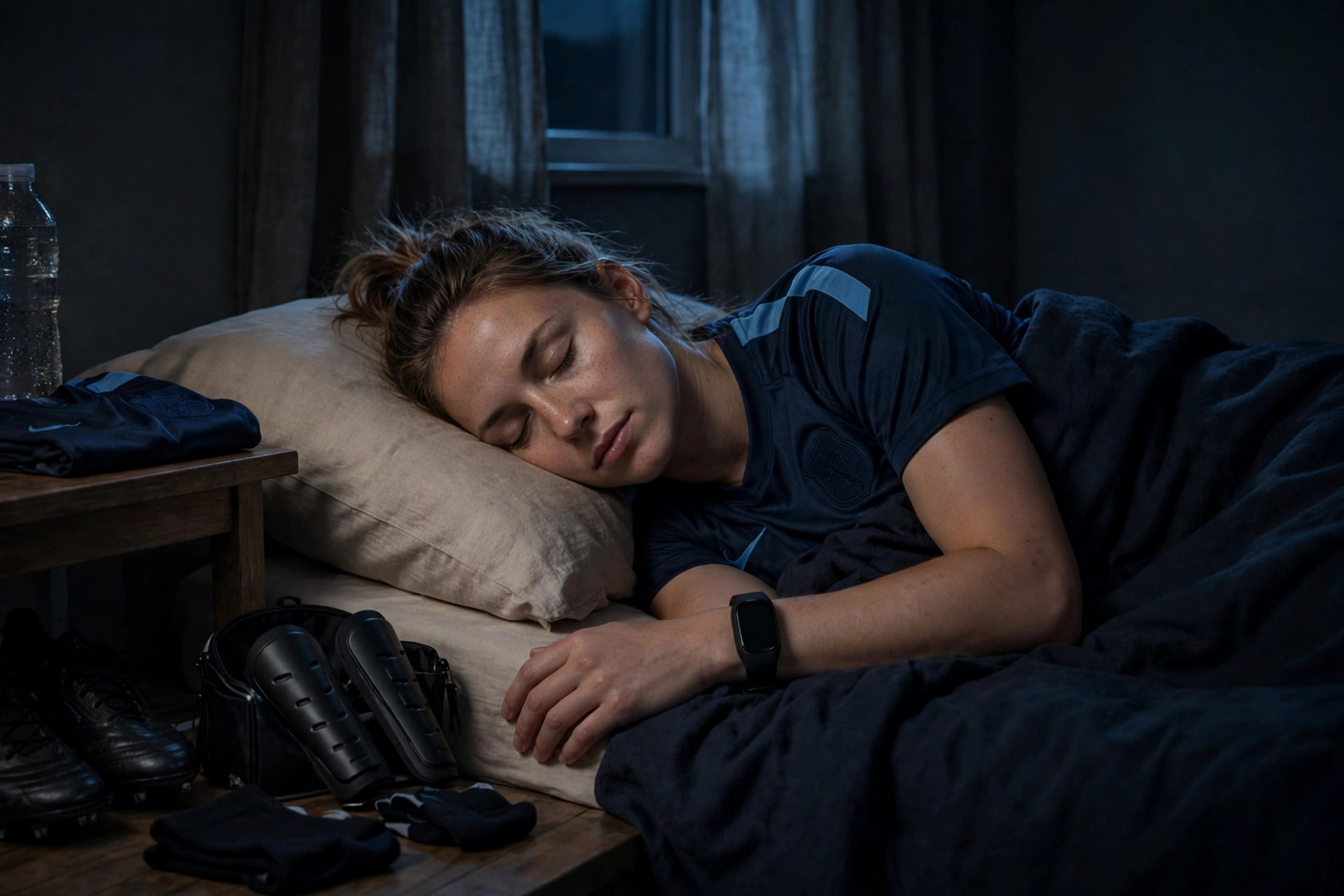
A study published in Scientific Reports in October 2026 followed fifteen elite women’s footballers from an Italian Serie A club for fourteen weeks of a competitive season. Every day, the players wore wrist actigraphs that tracked their sleep, took a one-minute seated heart rate variability (HRV) recording each morning, and filled in short questionnaires about how recovered they felt.
That’s a lot of mornings. And it produced a beautifully clear split.
Sleep efficiency — the percentage of time in bed actually spent asleep — predicted the players’ morning autonomic recovery, measured as LnRMSSD, a standard HRV marker. The association was statistically significant (coefficient 0.008, p = 0.014). Total sleep time, on the other hand, showed no significant independent association with that same recovery marker in the same model (coefficient −0.051, p = 0.158).
Read that again slowly, because it flips the usual advice on its head. In this group, sleeping longer didn’t move the body’s recovery signal. Sleeping more continuously did.
But Wait — Longer Sleep Still Felt Better
Before you throw your alarm clock out of the window, here’s the second half of the finding, and it’s just as important. When players slept longer than their own usual amount, they reported higher subjective sleep quality (coefficient 0.199, p < 0.001) and greater perceived recovery (coefficient 0.305, p = 0.003).
So we have two different recovery stories running at the same time. The body’s autonomic signal tracked sleep efficiency. The athlete’s own feeling of readiness tracked sleep duration. Neither one is lying. They’re just measuring different things.
This is why a single number on your watch will mislead you. You can feel refreshed after a long, broken night and still show a flat HRV. You can also have a night of tight, efficient sleep, wake up a bit groggy, and still be physiologically recovered. If you only watch one dial, you’ll misread your own body half the time.
Match days made the split even sharper. Compared with training and rest days, players reported lower sleep quality on match days (coefficient −0.314, p = 0.007) and substantially lower perceived recovery (coefficient −1.583, p < 0.001). If you’ve ever wondered why the night after a big game feels awful even when you slept in, you’re not imagining it.
Do the Maths on Your Own Night
Sleep efficiency is simple arithmetic, and doing it once will change how you look at your tracker forever. Do this maths once, then stop obsessing. That is how sleep efficiency athletes keep it simple.
Sleep efficiency = total sleep time ÷ time in bed × 100.
Here’s a worked example with real numbers. Say you climb into bed at 10:30pm and get up at 6:30am. That’s eight hours in bed. But you took 25 minutes to fall asleep, woke up twice for a total of 20 minutes, and lay awake for 15 minutes before the alarm. Your actual sleep is 7 hours. Your efficiency is 7 ÷ 8 × 100 = 87.5%.
Now take a different night. Bed at 11:00pm, up at 6:30am — seven and a half hours in bed. You fall asleep in 10 minutes, wake once briefly, and sleep 7 hours. Efficiency: 7 ÷ 7.5 × 100 = 93.3%.
The second night is shorter. By the study’s logic, it’s the night more likely to show up as better autonomic recovery the next morning. The first night looks better on a “hours slept” leaderboard and feels longer — and yet it contains a full hour of lying awake, which is exactly the fragmentation that seems to blunt the recovery signal.
Most sleep researchers treat efficiency above 85% as normal and above 90% as good. If your tracker
regularly shows you below 85%, that’s a stronger warning sign than a single short night.
Myth vs. Fact: Athlete Sleep
Myth: Eight hours in bed guarantees recovery. Fact: Eight hours in bed with an hour of wakefulness is seven hours of fragmented sleep. The study found efficiency, not duration, tracked the morning HRV recovery marker.
Myth: If you feel fine, your body has recovered. Fact: Feeling recovered tracked sleep duration in this study, while the autonomic marker tracked efficiency. Both matter, and they can disagree. Check both before a hard session, not just one.
Myth: A bad HRV morning means you need to sleep longer tonight. Fact: It might mean you need to sleep more continuously — fewer awakenings, a more consistent sleep window — rather than simply adding an hour in bed, which can actually lower efficiency if you spend it tossing and turning.
Myth: Match-day sleep problems are just in your head. Fact: Players in the study genuinely reported worse sleep quality and much lower perceived recovery on match days. Late kick-offs, adrenaline, travel, and post-match soreness are real disruptors, not excuses.
How to Raise Your Efficiency Without Obsessing: A Guide for Sleep efficiency athletes
I don’t want you lying in bed doing mental arithmetic at 2am. That defeats the whole point. These are practical, boring, effective habits — the kind that actually move the number. Sleep efficiency athletes use them to protect unbroken sleep.
Keep your sleep window consistent, even on weekends. Going to bed and waking up within the same hour most days stabilises your body clock, which shortens the time it takes to fall asleep. A wildly shifting weekend schedule is one of the fastest ways to wreck efficiency.
Only go to bed when you’re sleepy. If you’re wide awake, staying in bed trains your brain to associate the bed with wakefulness. Get up, do something dull in dim light, and return when your eyes feel heavy. This is the core idea of sleep restriction therapy, and it’s powerful — but if you have a diagnosed sleep disorder, work through it with a clinician, not alone.
Cool, dark, and quiet beats fancy. A cool room, blackout curtains, and earplugs or white noise will do more
for unbroken sleep than any supplement. Late-night training is a known disruptor, so if you train at night,
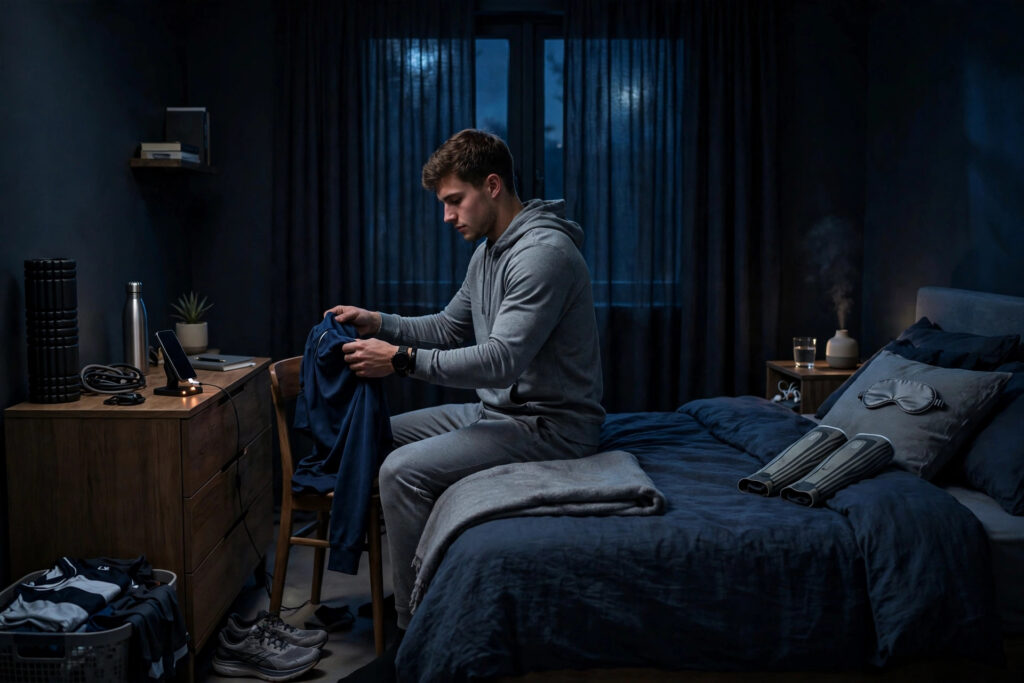
build in a proper wind-down: dim lights, no screens in bed, and no caffeine within six hours of bedtime.
Don’t add bed hours to fix broken sleep. This is the counterintuitive one. If you sleep 6.5 hours out of 9 hours in bed, your efficiency is 72% — poor. Lying in bed longer usually adds wake time, not sleep time. Tighten the window first, get the efficiency up, then expand it slowly as your sleep consolidates.
Read HRV as a trend, not a verdict. One low morning means very little. A week of falling efficiency paired with a falling HRV trend, plus feeling flat in training, is a real signal to ease off. A single red morning after a match day is expected — the study showed exactly that pattern. That trend is what sleep efficiency athletes watch.
The Honest Caveats
I like this study, but I’m not going to pretend it’s the final word. Fifteen players from one club in one league is a small, specific sample. The associations are observational, not causal — the study shows efficiency and recovery moving together, not that changing one will definitely change the other. And a one-minute morning HRV recording is a brief snapshot of a system that shifts all day.
None of that makes the finding useless. Fourteen weeks of daily, real-world data from elite athletes in season is a serious dataset, and the split between what the body showed and what the players felt is too clean to ignore. It just means the right response is to track both signals and test what works for you — not to declare that duration doesn’t matter. It clearly does, for how you feel, and feeling ready matters for performance too.
Conclusion
The next time your tracker says eight hours but your body says otherwise, don’t argue with either of them. Check your sleep efficiency. If you’re spending a big chunk of your night awake, that’s the number to fix first — with a consistent sleep window, a proper wind-down, and a bedroom that actually lets you stay asleep.
Long sleep makes you feel recovered. Unbroken sleep helps your nervous system actually recover. Athletes need both, but if you’ve been chasing hours and ignoring continuity, you’ve been training only half the system. That is why sleep efficiency athletes chase continuity first.
Start tonight: same bedtime as last night, phone charging outside the bedroom, and a cool, dark room. Your morning HRV might just thank you before your alarm finishes snoozing.
Related reading: sleep as a performance enhancer and post-workout recovery routines.
What is athlete sleep efficiency?
Athlete sleep efficiency is the percentage of time in bed actually spent asleep, calculated as total sleep time divided by time in bed, multiplied by 100. Above 85% is generally considered normal and above 90% is good. In the 2026 Scientific Reports study, efficiency — not total sleep time — predicted morning autonomic recovery in elite female footballers. For sleep efficiency athletes, that percentage is the number to watch.
Does sleeping longer help athletic recovery at all?
Yes, but in a different way. In the study, sleeping longer than usual improved players’ subjective sleep quality and perceived recovery, even though it did not independently predict their HRV recovery marker. Duration shapes how recovered you feel; efficiency shapes what your nervous system shows.
How can I improve my sleep efficiency?
Keep a consistent sleep and wake time, go to bed only when sleepy, keep your room cool, dark and quiet, avoid caffeine late in the day, and don’t extend your time in bed to compensate for broken sleep — tighten the window first and expand it as sleep consolidates.
This article is for general information only and isn’t medical advice. If you have persistent sleep problems, low mood, or symptoms like chest pain or unexplained breathlessness, talk to a qualified healthcare professional before changing your training or sleep routine.