


I fell for the gummy version of everything first. Vitamin D gummies, magnesium gummies, the ones that taste like dessert and sit next to my keys so I actually remember them. So when creatine gummies started showing up all over my feed — same promise as the powder, none of the gritty shaker bottle — I did what most lifters do. I bought a tub, chewed two a day, and felt very modern about it.
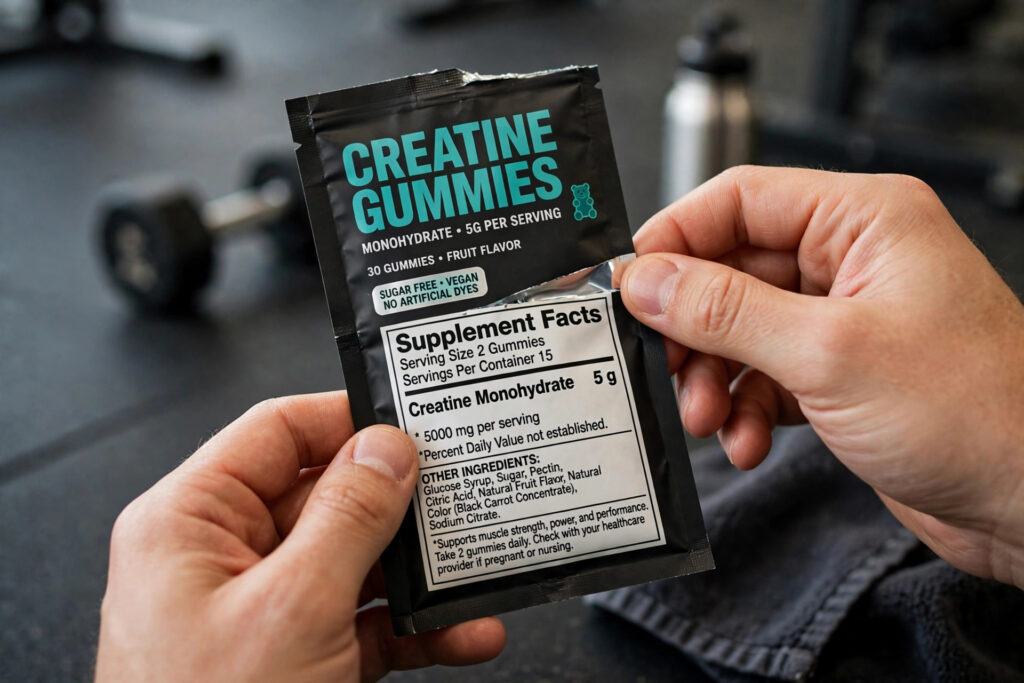
Three weeks later, a friend who actually reads labels asked me one question that ruined the whole thing: “How many grams are in those two gummies?” I checked. Then I checked again, because I assumed I’d misread. I hadn’t. My daily “dose” was barely a third of what the research says you need.
That’s the story of creatine gummies in a nutshell. The creatine inside them is real. The problem is how much of it actually survives the gummy — and how much you’re really getting per serving.

Why Creatine Gummies Exploded in the First Place
Creatine powder is one of the least glamorous supplements on earth. It doesn’t dissolve well, it tastes like chalky nothing, and it comes in a tub that looks like it belongs in a lab. Gummies fixed all of that in one move: chewable, flavoured, portable, no shaker required.
The timing helped too. Creatine search interest has surged through 2026, with monthly searches for creatine powder alone climbing past 165,000, and October’s trend roundups flagged dose-measured creatine gummy snacks as one of the month’s breakout formats. Supplement brands noticed. Shelves filled up fast.
But here’s the thing nobody puts on the front of the pack: a gummy is a terrible home for creatine. And the testing data keeps proving it.
The Chemistry Problem: Creatine Hates Being Wet and Warm
Creatine monohydrate is rock-stable as a dry powder. That’s why the tub on your shelf can sit there for years and still work. But drop creatine into water and it slowly converts into creatinine — an inactive breakdown product your body just gets rid of.
Now think about how a gummy is made. Water, heat, acidity, and a long shelf life in a soft, moist chew. It’s basically the worst possible environment for creatine, and it’s exactly the environment every gummy provides.
Independent lab testing has caught this again and again. In 2024, NOW Foods tested 12 gummy brands using high-performance liquid chromatography. Six met their label claims and six didn’t — a 46 percent failure rate — and several of the failures also contained notable creatinine, the fingerprint of degraded creatine. In 2025, the testing platform SuppCo analysed six best-selling gummy brands: two contained essentially no creatine, two had only trace amounts, and the two that did meet their claims showed high creatinine levels, suggesting the creatine was already breaking down.
Small samples, single lots, and manufacturers have disputed some of these results. Fair enough. But when two separate rounds of independent testing land on the same pattern, “just a bad batch” stops being a convincing defence.
The Dose Problem: Do the Gummy Math Before You Buy
The International Society of Sports Nutrition’s position stand — the most-cited creatine paper in sports science — puts the daily maintenance dose at 3 to 5 grams of creatine monohydrate, after an optional loading phase of around 0.3 grams per kilogram of body weight per day for 5 to 7 days. Smaller daily doses of 2 to 3 grams will eventually top up your stores over 3 to 4 weeks, but the performance effects of that slower route are less well supported.
Now look at real gummy labels. Per-gummy creatine content typically ranges from 0.5 to 1.5 grams, and a “serving” is often 2 to 5 gummies. Let’s do the honest math on a common example:
One serving: 2 gummies, 1 gram of creatine each = 2 grams total. Daily target: 5 grams. Servings needed: 2.5 servings, or 5 gummies a day. Extra sugar along the way: roughly 5 to 10 grams per serving, so 12 to 25 grams of added sugar daily.
And that’s a decent product. Some gummies deliver as little as 750 milligrams per serving, which means you’d need around seven gummies to approach a 5-gram dose. At that point, the “convenient” format has you eating a handful of sweets every day, paying several times more per gram, and still wondering whether the creatine survived manufacturing.
The Cost Problem: What a Year of Gummies Actually Costs
This is the part that made me switch back to powder, and it’s worth doing with real numbers.
A basic creatine monohydrate powder costs roughly $0.05 to $0.15 per 5-gram serving. Gummies run about $0.80 to $2.00 for the same 5 grams. Take the midpoints — $0.10 versus $1.40 — and stretch it over a year:
Powder: $0.10 × 365 = about $36.50 a year. Gummies: $1.40 × 365 = about $511 a year.
That’s a difference of roughly $474 a year for the same active ingredient, before you count the extra sugar. Some estimates put gummies at 10 to 20 times the cost per gram of powder. Either way, you’re not paying for better creatine. You’re paying for the shape.
Creatine Gummies vs Powder: The Honest Comparison
Powder wins on research behind the format (hundreds of trials vs almost none), dose per serving (usually a full 3–5 g vs often 1–2 g), label reliability (generally solid vs variable, with independent tests finding frequent failures), stability (very stable when dry vs degrades in moisture and heat), cost per 5 g (about $0.05–$0.15 vs about $0.80–$2.00), and added sugar (usually none vs often 5–10 g per serving). Gummies win only on convenience: chew and go, no mixing.
Powder wins on every measure except the fun one. And fun matters — the best supplement is the one you actually take. If gummies are genuinely the only format you’ll stick with, they’re not useless. But they only work if they pass three checks.
How to Buy Creatine Gummies Without Getting Ripped Off
- Check the grams, not the marketing. The label should say “creatine monohydrate” and state the grams per serving clearly. If it hides behind a “creatine blend” or a proprietary blend with no gram amount, walk away. You need a product where one serving — the number of gummies you’ll actually eat — gets you to at least 3 grams, ideally 5.
- Demand a recent third-party test. Look for brands that publish current, batch-specific, third-party lab results — not a single certificate from two years ago. NSF Sport or Informed Sport certification is a strong signal. Given the failure rates independent labs keep finding, “trust us” is not a quality-control strategy.
- Count the sugar and the cost. Multiply the sugar per serving by the servings you actually need for 5 grams, then multiply the price per serving the same way. If the real daily numbers surprise you, they were designed to.
Myth vs Fact: Creatine Gummies Edition
Myth: Gummies absorb better than powder. Fact: Creatine monohydrate is absorbed essentially completely from powder. No study shows a gummy absorbing better — the chemical form matters, not the shape.
Myth: A gummy a day is enough. Fact: One gummy typically delivers 0.5 to 1.5 grams. You need 3 to 5 grams daily. One gummy is a garnish, not a dose.
Myth: Creatine damages your kidneys. Fact: The ISSN position stand found no scientific evidence that short- or long-term creatine monohydrate use harms otherwise healthy individuals. People with kidney disease, or anyone on regular medication, should still talk to a clinician first — that’s caution, not a proven danger.
Myth: Expensive creatine works better. Fact: Systematic reviews keep finding no superiority for alternative creatine forms over plain monohydrate. Some, like creatine ethyl ester, actually perform worse.
Who Should Skip Gummies Entirely?
If you’re chasing a specific performance goal on a budget, powder is the obvious answer. If you’re diabetic or watching sugar intake, the added sugar in a multi-gummy daily dose is a real downside. And if you’re buying gummies for a teenager, be extra careful — supplement quality control is looser than most parents assume, and a failed label claim means you’re paying for flavoured sweets.
On the flip side, if you travel constantly, hate the taste of powder, and find a third-party-tested gummy that genuinely delivers 5 grams per serving at a price you accept, there’s nothing wrong with that choice. Consistency beats perfection. Just make sure the consistency is real — measured in grams, not in good intentions.
So, Do Creatine Gummies Actually Work?
Yes — with a catch big enough to matter. Creatine gummies can match powder, but only when they deliver a full, stable 3 to 5 gram dose of intact creatine monohydrate. The molecule doesn’t care about the format. The problem is that many gummies don’t deliver that dose, and independent testing keeps catching them short.
I still keep a bag of gummies in my gym bag for travel days. But my daily driver is back to the unglamorous tub of powder, because the math is stubborn: same ingredient, a fraction of the price, no sugar, and no question about whether it survived the factory.
Before you buy either format, do the one thing I didn’t do for three weeks: flip the pack over, find the grams per serving, and multiply. That thirty-second habit is worth more than any supplement ad you’ll see this year.
Conclusion
Creatine gummies aren’t a scam, but they’re a format that makes a simple supplement complicated. The creatine science is settled — 3 to 5 grams of monohydrate daily works — and the gummy question comes down to dose, stability, and price. Check the grams per serving, demand a current third-party test, and run the yearly cost before you commit. If a gummy passes all three, enjoy the convenience. If it doesn’t, the powder tub is still the smartest money in sports nutrition.
Do creatine gummies work as well as powder?
They can, but only if they deliver a full 3 to 5 gram dose of stable creatine monohydrate. Many brands fall short on dose or lose creatine to degradation during manufacturing, which is why independent lab tests keep finding gummies with little or no creatine.
How many creatine gummies should I take per day?
Enough to reach 3 to 5 grams of creatine daily — typically 3 to 10 gummies depending on the brand, since per-gummy content ranges from 0.5 to 1.5 grams. Always count the grams per serving on your specific label, not the marketing claim.
Are creatine gummies safe?
Creatine monohydrate is one of the most studied supplements available, and the ISSN position stand found no evidence of harm in healthy adults at recommended doses. The bigger risks with gummies are underdosing, added sugar, and unreliable label claims — not the creatine itself.
This article is for general information only and isn’t medical advice. Talk to a qualified healthcare professional before starting any supplement, especially if you have kidney disease, are pregnant or breastfeeding, or take regular medication.