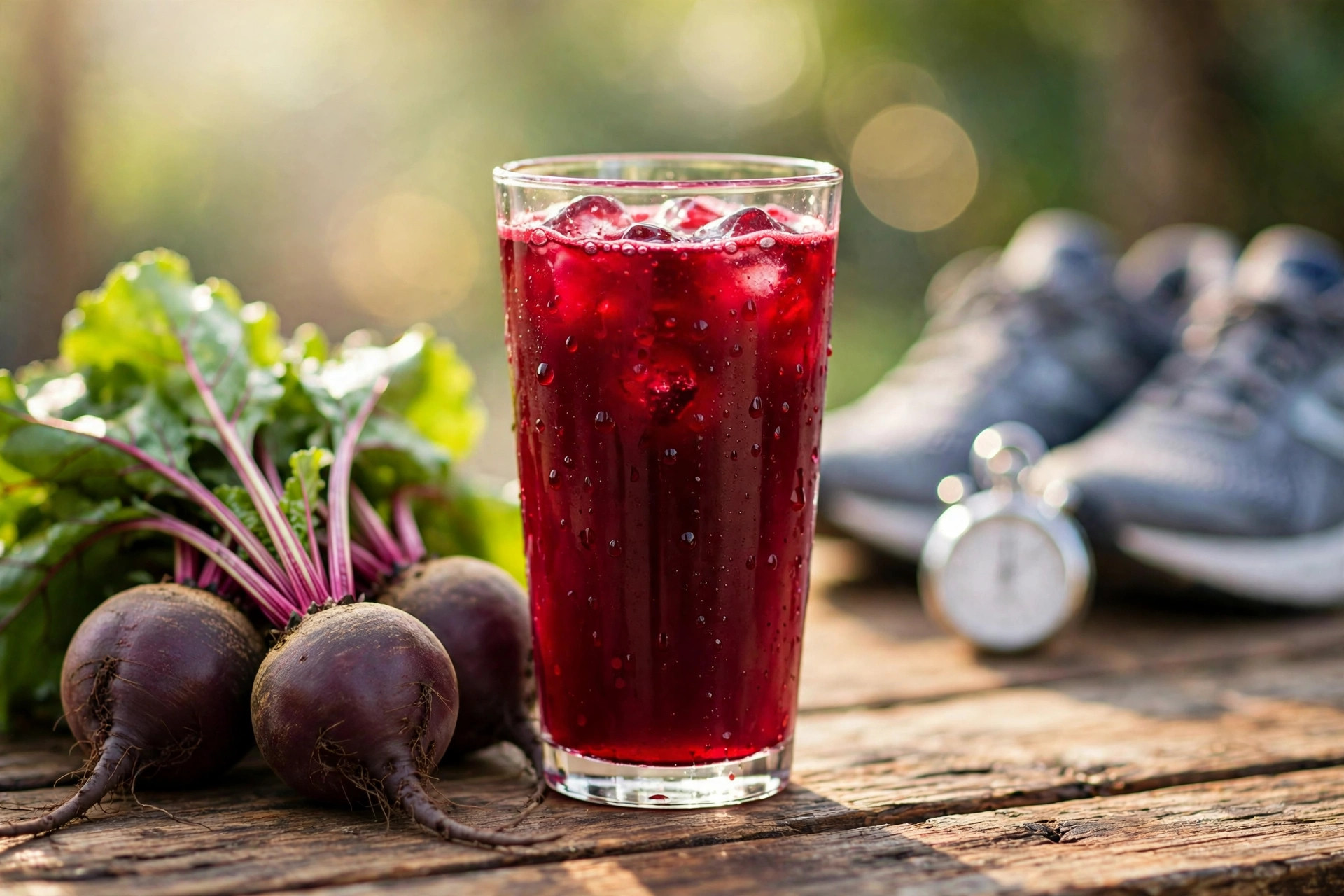

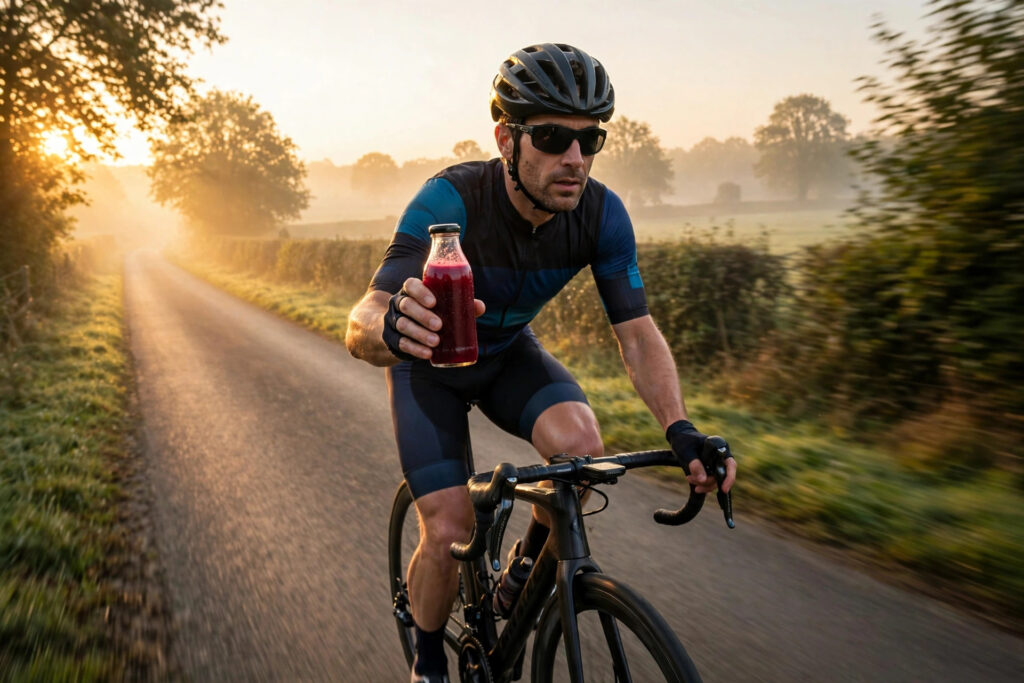
I first noticed it at a local 10K last spring. Not the fancy carbon shoes, not the compression sleeves — the little purple bottles. Three runners in the start corral, all sipping something that belonged in a smoothie bar, not a race. One of them caught me staring and grinned: “Beetroot juice. Two hours before the gun. Trust me.”
I’d heard the whispers for years — beetroot juice for athletes was the endurance world’s worst-kept secret, and the journals kept publishing numbers that sounded too good for a vegetable. But a good story and a good result aren’t the same thing, so I read the actual research, not the supplement ads. Here’s what it really says — including the parts the hype leaves out.
What’s Actually in the Glass?
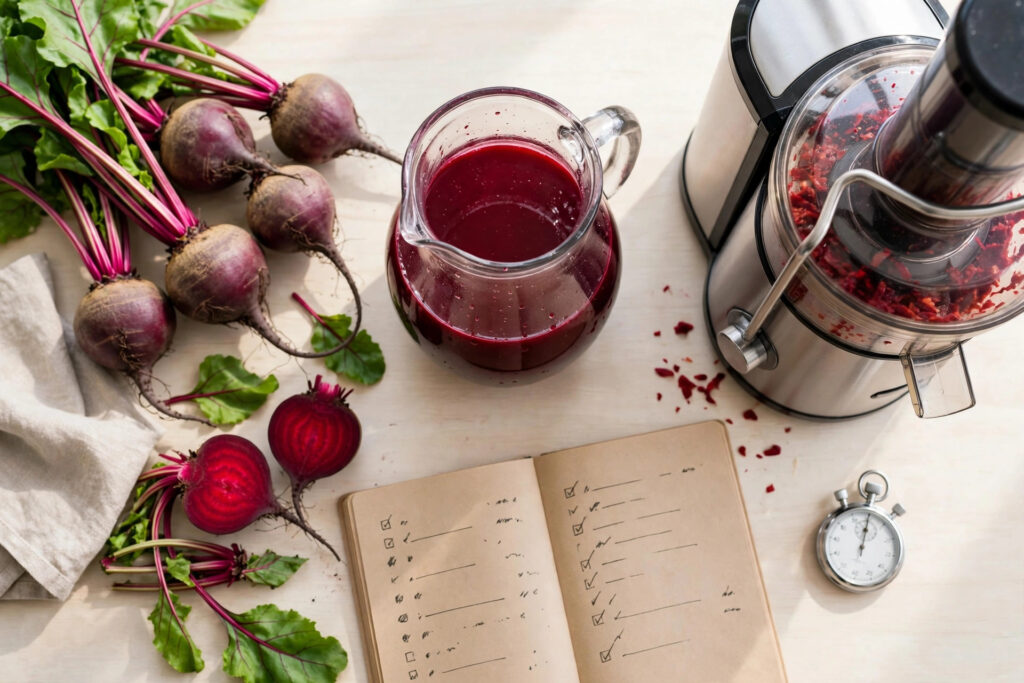
Beetroots are unusually rich in inorganic nitrate — a hundred grams carries roughly 250 to 500 mg, far more than almost any other vegetable. Bacteria on your tongue convert that nitrate into nitrite, and your stomach and bloodstream turn the nitrite into nitric oxide, a molecule that tells blood vessels to relax and widen.
Wider vessels mean more blood flow to working muscles, and nitric oxide also helps your muscle fibres use oxygen more efficiently — the same power for slightly less oxygen. Think better mileage from the same tank of fuel. That’s the whole mechanism behind beetroot juice for athletes: not a stimulant or a hormone, just a food nudging a system your body already runs.
What the Research Really Shows
Let’s start with the study that put beetroot on the map. In 2009, Stephen Bailey’s team at Exeter gave eight healthy men 500 ml of beetroot juice a day for six days — about 5.6 mmol of nitrate daily — against a similar-tasting placebo cordial. During moderate cycling the oxygen cost of exercise fell by about 19%, and during severe-intensity cycling the riders lasted 675 seconds versus 583 on placebo — roughly 16% longer. Systolic blood pressure fell too, from 132 to 124 mmHg.
It was a small study — eight men — but it launched fifteen years of follow-up work. So what does that work add up to in 2025?
A June 2025 umbrella review in Nutrients pulled together fifteen meta-analyses to answer that. Its verdict is honest: beetroot juice improves performance, but the effect is small. In recreationally active people, aerobic endurance improved (effect size 0.26) — real and consistent, but modest. Time to exhaustion improved too (0.25), as did Yo-Yo intermittent recovery test performance (0.27). In professional athletes, endurance didn’t improve significantly, but muscular strength did (0.27).
In cycling time trials, acute nitrate made riders about 2 to 3% faster over 16.1 kilometres in Lansley’s 2011 study.
Two to three percent doesn’t sound like much until you do the maths — we’ll do that in a minute. But first, the honest part: if you’re already an elite endurance athlete with a VO2max above 65, the research consistently shows smaller or no benefits. Your engine is already so efficient there’s less room for nitric oxide to help. Beetroot juice helps the rest of us far more than the pros — the opposite of what the ads imply.
How to Use Beetroot Juice for Athletes: Dose and Timing That Work
This is where most people get it wrong, because the protocol in the studies is surprisingly specific.
The dose. The 2025 umbrella review found that benefits show up at 8.3 to 16.4 mmol of nitrate per day — roughly 515 to 1,017 mg. A standard 500 ml glass lands in that range, as does a concentrated 70 ml shot from brands that label their nitrate content. Dose-response work by Wylie and colleagues found the benefit plateaus at around 8.4 mmol: going higher didn’t buy extra performance, just more trips to the bathroom.
The timing. Two options work. Take it 2 to 3 hours before exercise, when blood nitrite levels peak. Or load it for 3 to 6 days before a big event. The umbrella review found both approaches work, with the single acute dose showing the slightly stronger effect. Don’t do both at full dose unless you’ve tested it in training — your gut will have opinions.
The worked example. Say you run 10K in 45 minutes. A 2% improvement — the low end of the time-trial studies — is 54 seconds: 44:06 instead of 45:00. At 3%, it’s 81 seconds: 43:39. That’s the difference between a personal best and another ordinary Saturday. It won’t turn a 50-minute runner into a 40-minute one, but for a PB attempt it’s the cheapest 54 seconds in sport — a bottle of juice costs less than a pair of socks.
One practical note: check the label. Nitrate content varies wildly between brands, and many “beetroot” drinks are mostly apple juice with a splash of beet for colour. If the label doesn’t state the nitrate in mmol or mg, you don’t know what you’re drinking. Research shots typically state around 400 mg (about 6.4 mmol) per 70 ml.
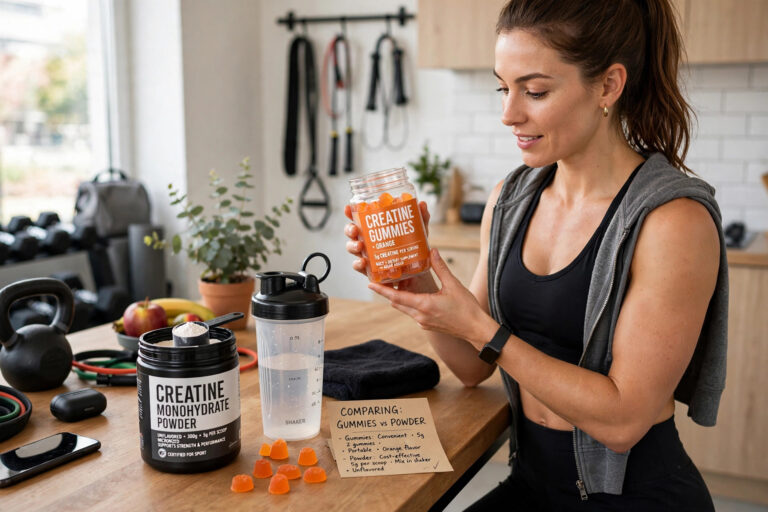
And remember, beetroot juice works best as one piece of a bigger picture — it can’t rescue poor hydration for athletes, and it pairs with the same honest approach to recovery behind astaxanthin for athletes and the question of whether do creatine gummies actually work.
Three Mistakes That Waste the Whole Bottle
Mistake one: the mouthwash. Antibacterial mouthwash kills the oral bacteria that convert nitrate to nitrite — researchers who had volunteers use it saw the benefit vanish. On race morning, skip the mouthwash. Brush your teeth, sure — just don’t rinse with the antibacterial stuff for a few hours either side of your beetroot juice.
Mistake two: too little, too late. A small glass with breakfast an hour before the race won’t cut it — the nitrate needs time to convert, and the dose needs to match the studies. Either take a proper dose 2 to 3 hours beforehand or load for several days. A casual sip on race morning is a placebo with a purple moustache.
Mistake three: expecting elite gains as a beginner — or expecting any gains as an elite. The evidence is clearest for recreational and well-trained-but-not-elite athletes. If your VO2max is already sky-high, beetroot juice probably won’t move your numbers. And if you’re new to training, no juice replaces the enormous gains from just showing up consistently. Keep expectations honest and you’ll never be disappointed.
Myth vs. Fact: Beetroot Juice for Athletes
Myth: “It works for everyone equally.”
Fact: Recreational athletes see the clearest endurance benefit; elites see little to none. The fitter you are, the smaller the edge.
Myth: “More beetroot means more speed.”
Fact: The benefit plateaus at around 8.4 mmol. Double the dose and you mostly double the stomach discomfort, not the speed.
Myth: “Any beetroot product works.”
Fact: Nitrate content varies enormously. A labelled shot with 400 mg of nitrate is a different product from a “beetroot blend” that’s 90% apple juice. Read the label or don’t bother.
Myth: “It’s basically doping.”
Fact: Nitrate is a food component, not a banned substance — it’s not on the WADA prohibited list, and the Australian Institute of Sport classifies beetroot juice as a Group A supplement, meaning the evidence supports its use in specific situations.
Is Beetroot Juice for Athletes Safe?
For most healthy adults, yes. The side effects are mostly harmless and slightly embarrassing: your urine and stools can turn pink or red for a day — a phenomenon called beeturia. It’s pigment, not blood, and it fades on its own. Some people get mild stomach upset, especially with large volumes, which is another reason the small concentrated shots beat half a litre of juice.
Two cautions are worth taking seriously. First, beetroot juice lowers blood pressure — a meta-analysis of 16 trials found an average drop of about 4.4 mmHg in systolic pressure. Good news if your pressure runs high, but if you take blood pressure medication, talk to your doctor first. Second, beetroots are high in oxalates, so if you have a history of kidney stones, check with a clinician before making it a daily habit.
It also contains natural sugars, so athletes managing blood sugar should count it like any other juice. And if you’re pregnant, on medication, or managing a medical condition, a quick word with your doctor beats a supplement advert every time.
The Takeaway
Beetroot juice for athletes is one of the rare sports-nutrition stories where the hype and the science mostly agree — just at a lower volume than the ads suggest. It’s not a miracle. It’s a small, real, well-documented edge: roughly 2 to 3% in time trials, a little more time before exhaustion, and slightly better oxygen economy, all from a vegetable.
The protocol is simple: a product that states its nitrate content, roughly 8 mmol two to three hours before your event or a three-to-six-day load, no antibacterial mouthwash, and test it in training before race day. Do that, and a 45-minute 10K runner might find 54 seconds they didn’t know they had.
I’ll keep drinking mine before the big sessions. Not because it makes me superhuman — because in a sport measured in seconds, a legal, cheap, evidence-backed 2% is worth a purple moustache.
How much beetroot juice should I drink before a race?
Aim for roughly 8 mmol of nitrate — about 500 ml of regular beetroot juice or one 70 ml concentrated shot labelled with its nitrate content. Take it 2 to 3 hours before your event, or drink a daily dose for 3 to 6 days beforehand. Higher doses don’t add performance, just stomach trouble.
Does beetroot juice work for elite athletes?
Much less. A 2025 umbrella review of fifteen meta-analyses found no significant endurance improvement in professional athletes, though strength did improve slightly. Recreational and well-trained athletes see the clearest benefit. If your VO2max is above 65 ml/kg/min, expect little from it.
Will beetroot juice turn my pee pink?
Probably, and it’s harmless. The red pigment in beetroots, betanin, passes through your body and can colour urine or stools pink or red for up to a day. It’s called beeturia, it’s common, and it fades on its own. If the colour persists for days or comes with pain, see a doctor — but one pink wee after beetroot juice is normal.
This article is for general information only and isn’t medical advice. Beetroot juice can lower blood pressure and may interact with medication, so if you take blood pressure medicine, have kidney stones, or manage a medical condition, talk to your doctor before using it regularly.