
I spent years believing the same rules most lifters do. Eight to twelve reps for muscle. Train to failure or don’t bother. Machines are for beginners, free weights are for serious people. Periodise everything or plateau forever. I thought those were the ACSM strength training guidelines.
In March 2026, the American College of Sports Medicine tore most of that up: its first major update to the resistance training guidelines since 2009, built on 137 systematic reviews covering more than 30,000 participants. The headline finding isn’t a new secret technique — it’s that the best programme is the one you’ll actually stick with, because consistency and effort matter far more than getting every variable perfect. Here’s what the new ACSM strength training guidelines actually say, what changed from 2009, and what it means for your next session.
What the New ACSM Strength Training Guidelines Are (and Why This One Is Different)
The 2009 guidelines were a landmark in their day, but they were written before the modern explosion of training research. The 2026 update — formally titled “Resistance Training Prescription for Muscle Function, Hypertrophy, and Physical Performance in Healthy Adults” and published in Medicine & Science in Sports & Exercise — isn’t a single new study. It’s an overview of overviews: the authors, led by Brad Currier at McMaster University and chaired by Stuart Phillips, gathered every systematic review on resistance training prescription, graded each one for quality, and synthesised the results. You can read the ACSM’s own announcement of the new Position Stand for the full summary.
That matters because single studies contradict each other all the time. An overview of 137 reviews washes out the noise and leaves the patterns that keep showing up. As McMaster put it: consistency over perfection.
For Strength: Go Heavy, But Not Complicated
If your main goal is getting stronger, the new ACSM strength training guidelines are refreshingly simple:
- Load: at least 80% of your one-rep max
- Volume: 2 to 3 sets per exercise
- Frequency: at least 2 sessions per week
- Technique: full range of motion on every rep
- Exercise order: put your key lifts first in the session, while you’re fresh
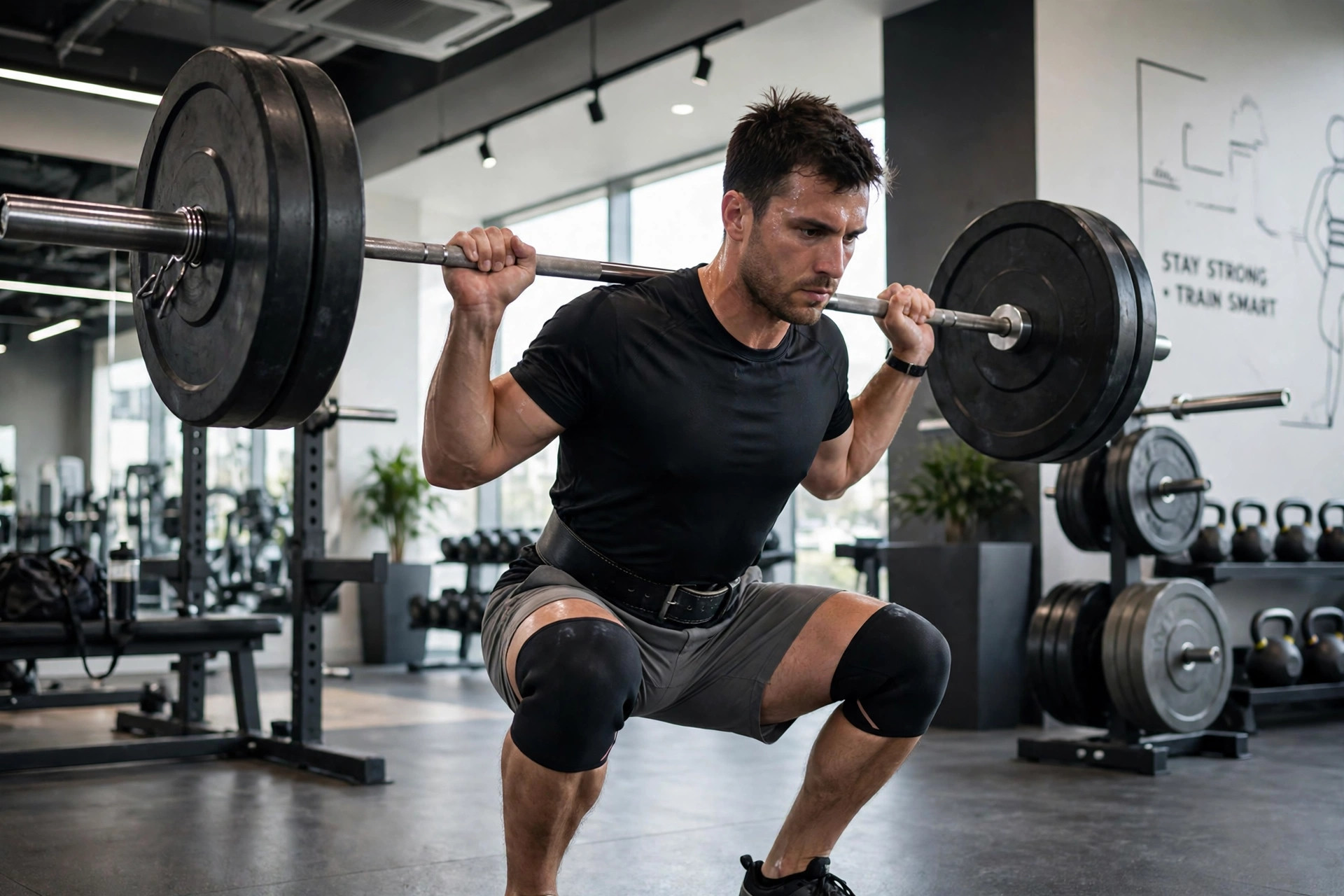
That’s it. No magic rep scheme, no mandatory rest interval, no special equipment. A squat at 80% of your max for 3 sets of 5, done twice a week with full depth, checks every box the evidence supports.
Two things the guidelines explicitly did not find important for strength: training to failure, and whether you use free weights or machines. Both produce similar gains when load and effort are matched. So if your knees prefer the leg press to the barbell squat on a given day, you’re not leaving gains on the table.
For Muscle Size: The 8–12 Rep Rule Is Dead
This is the change that will surprise the most people. For decades, gym wisdom said muscle grows in the 8–12 rep range, and anything outside it was wasted effort. The 2026 guidelines say otherwise: loads from 30% to 100% of your one-rep max all build muscle, provided each set is taken close to failure. The muscle doesn’t know the number on the plate. It knows tension and fatigue.
What does matter for size is volume — and, once the training stimulus is in place, eating enough protein to support it. The usual high-protein diet mistakes are easy to fix once you spot them.
- At least 10 sets per muscle group per week as a starting point, with a dose-response relationship — more sets generally mean more growth, up to a point
- Eccentric overload — emphasising the lowering phase of a lift — was singled out as favourable for hypertrophy
So the number to remember for muscle growth isn’t a rep range. It’s 10 sets a week per muscle, done with real effort. How you split those sets — heavy or light, barbell or bands — is largely up to you.
For Power: Lighter, Faster, Fewer Reps
Power is different from strength, and the guidelines treat it that way. For explosive performance — the kind a sprinter, jumper or thrower needs — the prescription is lighter weights moved as fast as possible: roughly 30–70% of your one-rep max, low to moderate volume (around 24 total reps or fewer per exercise), with Olympic-style lifts and power-focused training helping most.
The logic is simple. Power is force times speed, and you can’t move maximally fast with a maximal load. A jump squat at 40% of your max, moved explosively, trains power in a way a grinding 95% squat never will.

Your Week in Numbers: A Worked Example
Let’s make this concrete. Say you train twice a week and want to build muscle while getting stronger. Here’s how the guideline numbers add up for your chest:
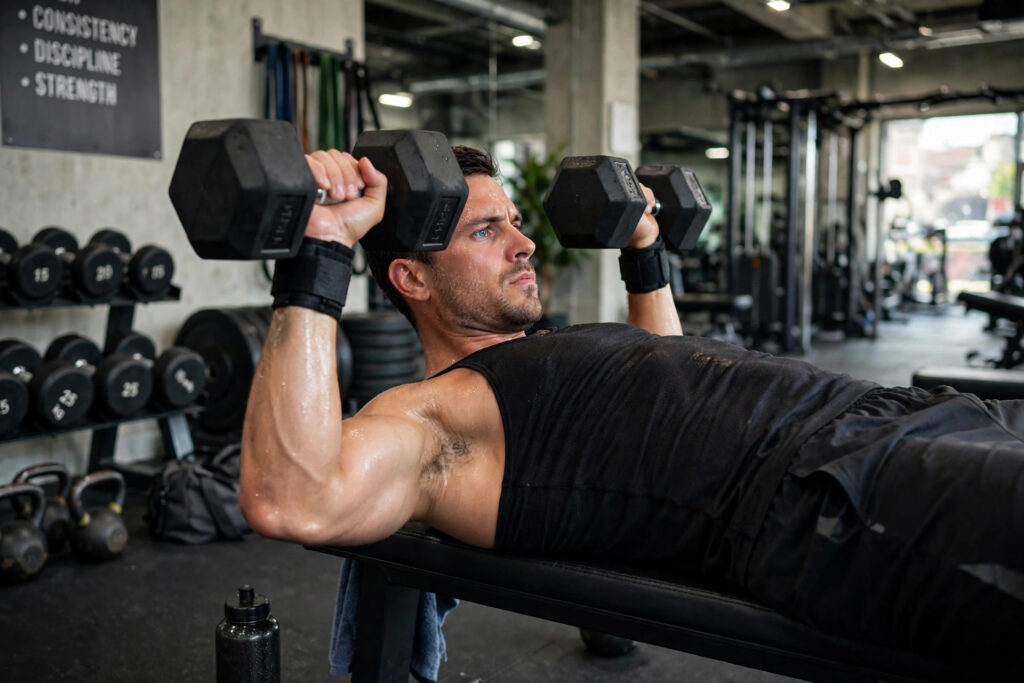
- Session 1 (Monday): bench press, 3 sets of 6 at 80% of your max (strength prescription) + incline dumbbell press, 2 sets of 12 at 60%
- Session 2 (Thursday): bench press, 3 sets of 8 at 75% + push-ups, 2 sets to 2 reps in reserve
Total for the week: 10 sets for chest — exactly the hypertrophy threshold — with two heavy strength exposures and real effort on every set. No session runs longer than an hour, no set goes to absolute failure, and every guideline box is ticked. The same maths works for every muscle group: two sessions a week, roughly 10 sets per muscle, effort high, failure optional. That’s the whole system.
Myth vs Fact: What the ACSM Strength Training Guidelines Actually Settled
Myth: You must train to failure to grow.
Fact: The guidelines are clear — training to momentary failure does not enhance strength, hypertrophy or power compared with stopping 2 to 3 reps short. You get the same results with less fatigue and better recovery. That margin matters: constantly grinding to failure is one of the warning signs of overtraining most lifters ignore until it costs them weeks. Failure is a tool, not a requirement.
Myth: Free weights beat machines, always.
Fact: Equipment type did not consistently change outcomes across the 137 reviews. Bands, bodyweight, machines and free weights all count. Use what fits your body and your access — and if you’re coming back from injury, machines are a legitimate way to load heavy safely.
Myth: You need a complicated periodised programme.
Fact: The 2009 guidelines treated periodisation as a core principle. The 2026 update found periodised programmes were not significantly superior to non-periodised ones when total volume was matched. Structure helps, but the fancy spreadsheet isn’t what makes you stronger — the work is.
Myth: If you can’t train hard, don’t bother.
Fact: Even minimal doses — as little as one set per exercise, twice a week — produce real, meaningful gains in strength, muscle size and function. The biggest jump in benefit comes from going from nothing to something.
What Didn’t Change (and Still Matters)
For all the updates, some fundamentals survived the evidence review intact. Train all major muscle groups at least twice a week. Prioritise compound movements. Use progressive overload — gradually add weight, reps or sets over time. These were true in 2009 and they’re true now.
What changed is everything around those fundamentals: the rigidity is gone. The guidelines stopped prescribing one exact recipe and started describing the range of recipes that work. That’s good news for athletes with busy schedules, home gyms or injuries. The science now says: pick the version you’ll do consistently, hit the minimums, and stop worrying about the rest.
How to Apply the ACSM Strength Training Guidelines This Week
You don’t need to overhaul your programme. Three small checks:
- Frequency: Are you hitting each muscle group at least twice a week? If not, split your sessions rather than adding a third day.
- Volume: Are you reaching roughly 10 sets per muscle per week if growth is the goal? Warm-up sets don’t count.
- Effort: Are your working sets stopping 2 to 3 reps short of failure? If you’re breezing through with 5 reps left in the tank, add weight. If you’re grinding every set to failure, back off — you’re paying a recovery cost for nothing.
FAQs
Do the new ACSM guidelines apply to older adults?
Yes — the evidence covers adults across the lifespan, and resistance training improves strength, muscle size, power and function at every age. The minimal-dose finding matters most here: even one set per exercise, twice a week, produces meaningful gains. Older adults should still get medical clearance before starting, particularly with existing health conditions.
Is training to failure ever useful?
It can be, in small doses — for example, on a final isolation set where the fatigue cost is low. But the guidelines found it isn’t necessary for strength, size or power, and it increases fatigue and recovery demands. For most lifters, stopping 2 to 3 reps short on most sets is the better default.
Can bodyweight training really build muscle?
Yes. The guidelines count bodyweight work as resistance training, and loads as low as 30% of maximum build muscle when effort is sufficient. The challenge is progression — you need harder variations or added load over time. Push-ups become archer push-ups, then weighted push-ups. Same principle as a barbell.
The Bottom Line on the ACSM Strength Training Guidelines
Seventeen years of research distilled into one sentence: lift at least twice a week, work hard enough that your last reps feel like something, and stop obsessing over the perfect programme. Strength wants heavy loads and full range of motion. Muscle wants about 10 sets a week. Power wants lighter weights moved fast. None of it requires failure, fancy equipment or a periodisation spreadsheet.
The old rules weren’t wrong so much as too narrow. The new ACSM strength training guidelines give you a wider road to the same destination — and the evidence says the people who arrive are the ones who keep showing up.
This article is for general information only and isn’t medical advice. If you have a health condition or are returning from injury, talk to a qualified healthcare professional before starting a new training programme.