
You finish a brutal leg session, legs shaking, shirt soaked through. Half the gym is already heading for the sauna, towels over their shoulders, looking like they’ve cracked some secret code. You stand there wondering: should I be in there too — or is that just twenty minutes of sitting in a hot wooden box for nothing?
I asked the same question last winter, after a training partner swore his sauna habit was the reason he never got sore anymore. So I went looking for actual evidence instead of gym-floor wisdom. And the honest answer is more interesting — and more mixed — than either side admits.
What Actually Happens to Your Body in a Sauna
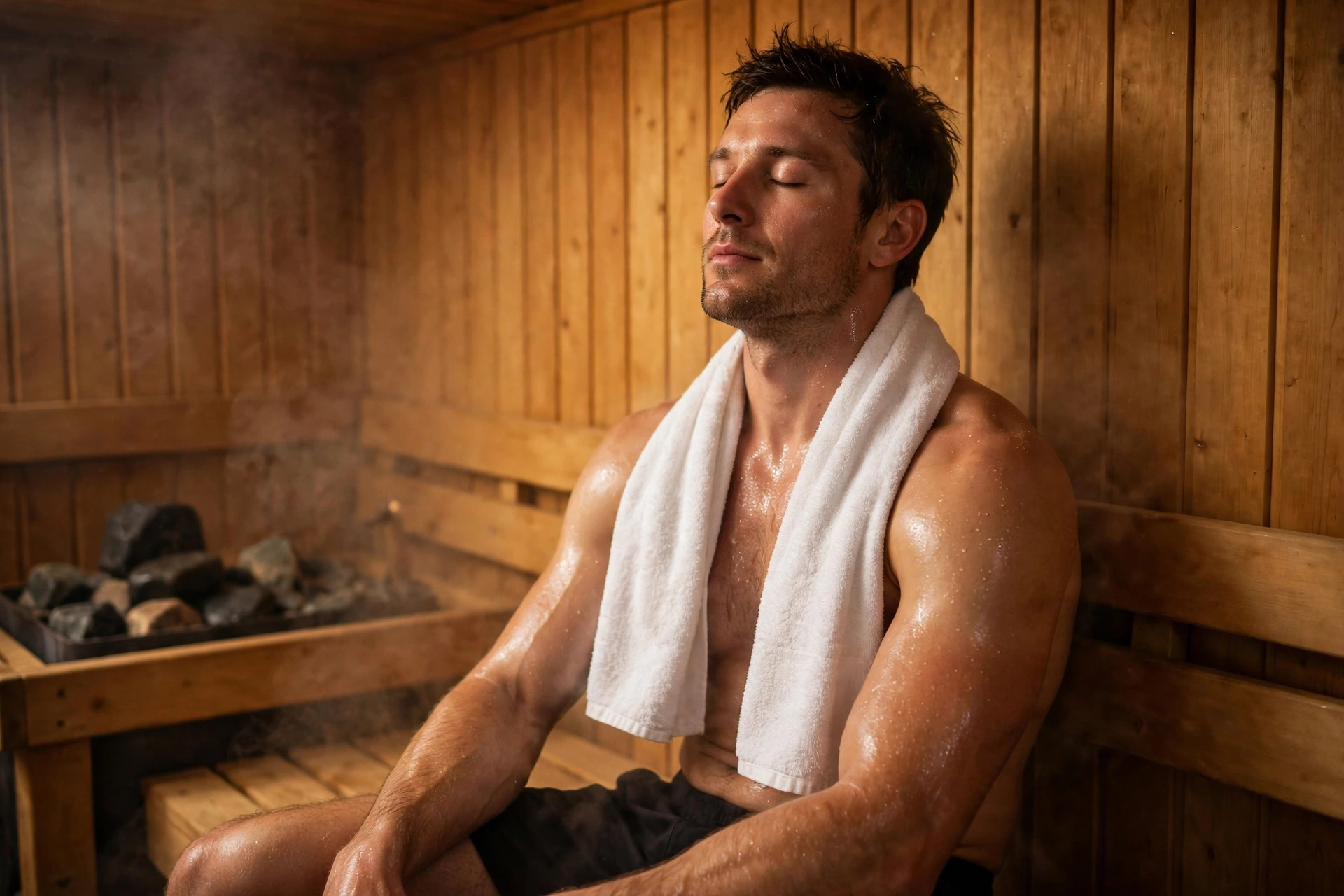
A traditional Finnish sauna runs at roughly 80–90°C (176–194°F). Within minutes your skin temperature climbs, blood vessels widen, and your heart starts working harder to push blood to the surface so you can sweat it off. Your heart rate can rise to around 100 beats per minute in a moderate session and up to 150 in a hotter one — that’s the workload of a light jog, while you’re sitting perfectly still.
You also sweat. A lot. A typical 15–20 minute session can cost you half a litre to a litre of fluid, along with salt. That sweat is the whole point and also the whole risk: everything useful a sauna does rides on blood flow and heat, and everything dangerous about it rides on dehydration and overheating.
What the Big Finnish Study Really Found
The most famous sauna study of all comes from Finland, where researchers followed 2,315 middle-aged men for more than 20 years. The results, published in JAMA Internal Medicine in 2015, were striking: men who used a sauna four to seven times a week had a 63% lower risk of sudden cardiac death than men who went once a week. Fatal heart disease was 48% lower, fatal cardiovascular disease 50% lower, and deaths from all causes 40% lower. Longer sessions helped too — men who stayed in for more than 19 minutes fared better than men who left before 11.
Before you book a sauna membership on the strength of that, here’s the catch the headlines usually skip. It was an observational study. Nobody was assigned a sauna schedule; the researchers just watched men who already lived that way. The men in the four-to-seven-times-a-week group numbered only about 201 out of 2,315, and people who sauna that often tend to be healthier and more active in other ways too. The study shows a strong association, not proof that the sauna itself caused the difference. Still, the dose-response pattern — more frequent and longer sessions tracking with better outcomes — is hard to ignore, and later reviews have found the same direction of effect.
Does a Sauna After Training Actually Help You Recover Faster?
This is the question athletes really care about, and the evidence here is newer and messier than the heart-health data. A 2025 systematic review from the University of Jyväskylä in Finland pulled together 14 trials of post-exercise heat — sauna or hot-water immersion — covering 194 people in total. Of the nine trials that measured short-term recovery, four found a benefit, four found no effect, and one found heat actually made recovery worse. The authors rated the evidence low to moderate and concluded it was “not possible to draw definitive conclusions.”
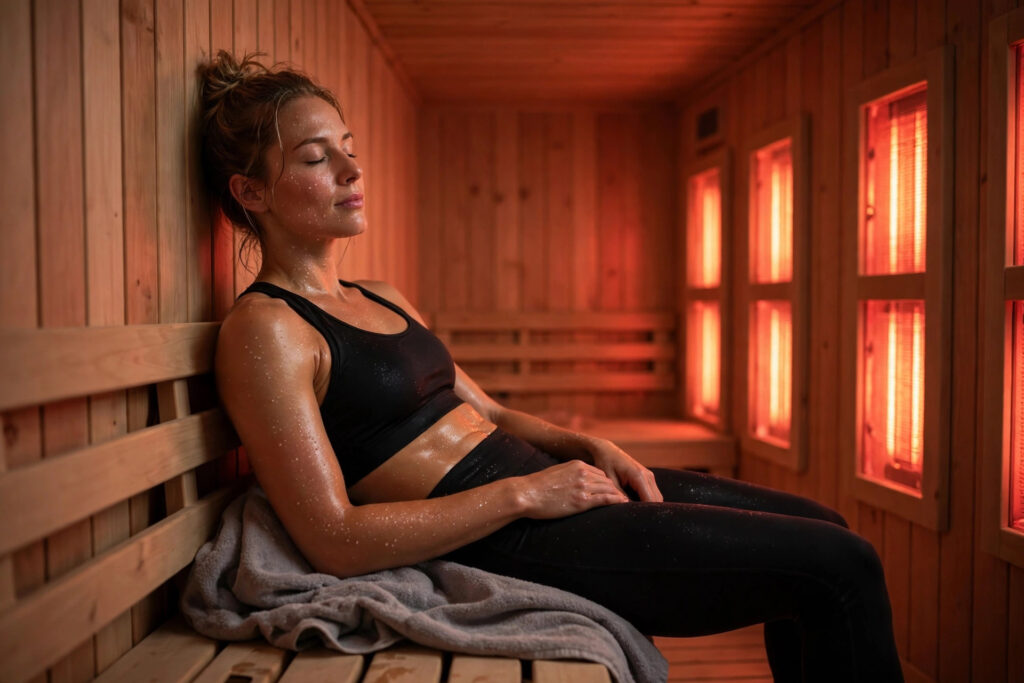
But zoom into the individual trials and a pattern emerges. The best-designed ones used infrared saunas, where radiant panels heat your body directly while the air stays much cooler — around 43–50°C instead of 80–90°C.
In 2023, Finnish researchers tested 16 young male basketball players. Each did a hard strength-and-jump session twice, a week apart. Once they followed it with 20 minutes in an infrared sauna; the other time they just rested. Fourteen hours later, the sauna group’s jump height had dropped less, they reported less muscle soreness, and they felt better recovered. Sprint times and strength didn’t differ — the benefit was in how banged-up they felt, not in raw power.
Then came the longer test. In 2025, the same research group pair-matched 40 female team-sport athletes into two groups for six weeks of training. One group used a 10-minute infrared sauna at 50°C after training three times a week; the other recovered passively. The sauna group recovered neuromuscular performance faster between sessions and reported less soreness — and crucially, their muscle growth was no different. DXA scans and ultrasound measurements of thigh muscle showed the same gains in both groups.
That last detail matters more than it sounds, because it answers the worry every lifter has about recovery tools. Ice baths are known to blunt muscle growth when used right after lifting. Sauna, at least in this trial, didn’t. It’s a different mechanism from red light therapy, which targets tissues with light rather than heat — but the practical question is the same: does the tool help you recover without costing you adaptation?
The Endurance Bonus Nobody Talks About
There’s a second, separate reason endurance athletes love the sauna, and it has nothing to do with soreness. Repeated heat exposure trains your body to handle heat: blood plasma volume expands, you start sweating earlier and more efficiently, and your heart rate stays lower at a given pace.
The classic study is tiny — just six male distance runners in 2007 — but its result is famous: after three weeks of sitting in a sauna for 30 minutes after training, the runners could run roughly a third longer before exhaustion. Six runners is barely a study, so treat the size of that effect with suspicion. But the mechanism is real, and it’s the same reason athletes deliberately train in the heat before a hot-weather race. A sauna is simply the most convenient heat chamber most of us will ever have access to.
Sauna vs Ice Bath: Which One After Training?
Here’s where it gets practical. Cold and heat do opposite jobs, and picking the wrong one at the wrong time is the most common recovery mistake I see.
An ice bath shrinks blood vessels, numbs soreness fast, and feels fantastic after a brutal session. But that same blunting effect also dampens the inflammation signal your muscles use to grow. Used after every lifting session, cold can quietly cost you gains. A 2021 systematic review of 32 trials on hot and cold therapy for muscle soreness found heat — including sauna — helped soreness without the growth trade-off.
So the rule of thumb I use now: sauna after regular training and lifting, when the goal is feeling fresh for tomorrow. Ice bath when you’re genuinely wrecked — a tournament with two games in one day, or a race the next morning — and soreness right now matters more than adaptation next month.
How to Use a Sauna After Your Workout (The Protocol That Actually Makes Sense)
Don’t just wander in straight off the squat rack. The studies that showed benefits all used a version of this pattern:
Cool down first. Give yourself 10–15 minutes after training. Let your heart rate come down, walk around, stretch. Stepping into 85°C heat while your core temperature is already at its peak is how people feel faint.
Hydrate before you sit down. Drink 300–500 ml of water before entering, and keep a bottle with you. You’ll sweat out roughly half a litre in a 15-minute session, and starting dehydrated is the fastest way to turn recovery into extra strain.

Time it right. For a traditional sauna, 15–20 minutes at 80–90°C matches the sessions in the Finnish research. For an infrared sauna, 10 minutes at around 50°C is what the athlete trials used. New to saunas? Start with 5–10 minutes and build up over two weeks. More is not better — the men in the Finnish study topped out around 20 minutes, and nobody in any trial benefited from heroic 40-minute sessions.
Two to four times a week is the sweet spot. The big health associations showed up at two to three sessions a week, with more benefit at four to seven. For recovery purposes, using it after your two or three hardest sessions covers nearly all of it.
Here’s what a realistic week looks like for someone training four days a week. Monday: heavy leg day, 15 minutes in the sauna after cooling down. Wednesday: upper body, 10 minutes. Friday: interval run, 15 minutes. Saturday: long slow run, 20 minutes — this is your heat-acclimation session. That’s four sessions, about an hour total, and it costs you nothing but time and water.
Myth vs Fact: Sauna Edition
Myth: A sauna melts fat and detoxes you. Fact: The weight you lose in a sauna is water, and it comes back with your next drink. Your sweat is about 99% water and salt. Actual detoxification is done by your liver and kidneys, not your skin.
Myth: The hotter the sauna, the better it works. Fact: The studied range is 80–90°C for traditional saunas. Cranking it past 100°C doesn’t add benefit; it adds dizziness, a racing heart, and risk.
Myth: You should sauna after every single workout. Fact: After a session where you’re already dehydrated — a long run in summer heat, a heavy sparring day — adding a sauna can push you past the line. Skip it that day. Recovery tools should reduce strain, not add to it.
Myth: Sauna before a workout warms you up properly. Fact: A pre-workout sauna can sap your strength and leave you dehydrated before you lift a single weight. Heat after training; a proper dynamic warm-up before it.
Who Should Skip the Sauna
Saunas are safe for most healthy adults, but not for everyone. Skip it — or ask your doctor first — if you have unstable heart disease, very low blood pressure, or a recent heart attack or stroke. Don’t sauna if you’re pregnant, if you’ve been drinking alcohol, or if you feel dizzy, nauseous, or unwell. And never, ever fall asleep in one. If you feel light-headed, get out immediately, sit down, and drink water. The heat will still be there tomorrow.
FAQs
How long should you sit in a sauna after a workout?
Fifteen to twenty minutes in a traditional sauna at 80–90°C, or about 10 minutes in an infrared sauna at 50°C. If you’re new, start with 5–10 minutes and build up. Sessions longer than 20 minutes don’t add benefit in any study I found.
Should you use a sauna before or after a workout?
After. Every athlete trial that showed a recovery benefit used the sauna post-exercise. A sauna before training can reduce strength and leave you dehydrated before you start.
Is a sauna good for muscle growth?
It doesn’t build muscle directly, but unlike ice baths, it doesn’t appear to blunt growth either. A six-week trial in 40 female athletes found identical muscle gains with and without post-training sauna, while the sauna group recovered faster between sessions.
The Bottom Line
A sauna after your workout is not magic, and it’s not a waste of time either. The heart-health evidence from Finland is genuinely impressive but observational — an association, not a prescription. The recovery evidence is real but modest: less soreness, faster bounce-back between sessions, and no cost to muscle growth. And for endurance athletes, regular post-training heat is one of the cheapest ways to build heat tolerance.
If you already have access to a sauna, using it for 15–20 minutes after your two or three hardest sessions each week is one of the lowest-effort recovery habits you can add. Just hydrate first, cool down before you go in, and remember that the sauna is a complement to sleep, food, and smart training — not a substitute for any of them. A good place to start is pairing it with the other recovery techniques that actually work, and keeping the rest of your routine honest.
This article is for general information only and is not medical advice. Talk to your doctor before starting sauna use if you have a heart condition, low blood pressure, or any other medical concern.