

Nicotine pouches athletes are using in record numbers — but do they help performance?
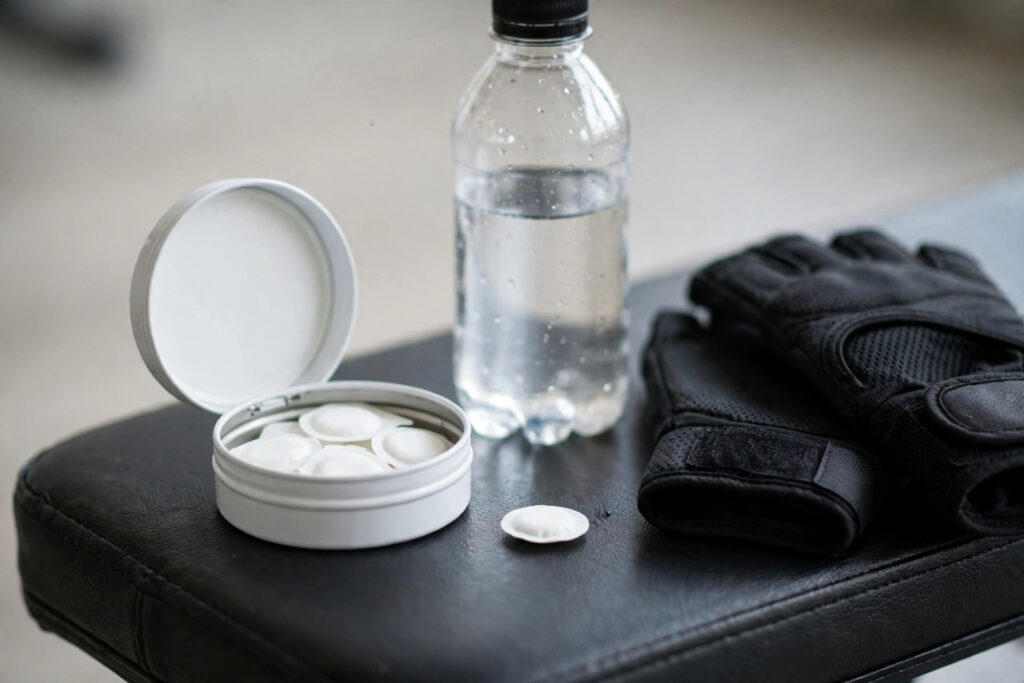
You’ve probably seen it by now. A teammate reaches into a small round tin, tucks a tiny white pouch under their top lip, and carries on as if nothing happened. No smoke, no smell, no lighter, no vape cloud. It looks almost innocent — like a mint.
It’s not a mint. It’s nicotine, and it’s spreading through sport faster than almost any habit in years. Searches for nicotine pouches have jumped to more than 90,000 a month in the US, and the dressing-room version of the story is spreading even faster than the numbers. Players say it sharpens their focus. Cyclists say it steadies their nerves before a big race. And because there’s no smoke involved, a lot of athletes have quietly decided it doesn’t count.
It counts. Here’s what the research actually says — and the numbers are not what the tin promises.
What’s Actually in That Little Pouch?
A nicotine pouch is a small white sachet that sits between your gum and your lip. Inside is nicotine — usually extracted from tobacco, but with no tobacco leaf — plus flavourings and plant-based fibres. That’s the whole trick: no smoke, no vapour, no spit. You pop one in, it dissolves slowly through the lining of your mouth, and you feel it within minutes.
The best-known brand, ZYN, comes in 3 mg and 6 mg strengths, with newer “Ultra” versions at 9 and 11 mg. For comparison, nicotine gum — the stuff pharmacies sell to people quitting smoking — is 2 or 4 mg. So a single 6 mg pouch is already stronger than a piece of quit-smoking gum.
The US Food and Drug Administration authorised 20 ZYN products for sale in January 2025, then added 11 Ultra products in August 2026. That authorisation gets misunderstood a lot, so let’s be clear: the FDA said these products can be marketed as lower-risk than cigarettes for adult smokers who switch completely. It did not say they are safe, and it did not approve them as a way to quit smoking. Lower risk than cigarettes is a very low bar — cigarettes are the most dangerous nicotine product that exists.
Nicotine Pouches Athletes: How Widespread Is It, Really?
This isn’t a fringe habit anymore. The nicotine pouches athletes use are now common in professional dressing rooms. In May 2024, the Professional Footballers’ Association and Loughborough University published a joint study of professional footballers in England. The numbers were startling: 18% of the men and 22% of the women surveyed were currently using snus or nicotine pouches, and 42% of men and 39% of women had tried them at some point. That’s roughly one in five professional footballers — in a sport where players obsess over every gram of body fat and every hour of sleep.
Cycling tells the same story. A study funded by the World Anti-Doping Agency found nicotine in 15% of the athlete anti-doping samples it tested. Fifteen percent. In a population that treats a protein shake like a chemistry experiment, one in seven samples contained nicotine.
Why? Ask around a dressing room and you’ll hear the same three reasons: focus, calm, and routine. A pouch before a match feels like it sharpens attention. It takes the edge off pre-match nerves. And for players who used to smoke or vape, it’s a way to keep the nicotine without the lung damage. Those reasons feel real — nicotine genuinely does affect alertness in the short term. The question is whether any of it helps you actually perform better. That’s where the story falls apart.
Nicotine Pouches Athletes: Does It Actually Help Performance?
Here’s the honest answer: no — at least, not in any way a controlled trial has been able to find for the nicotine pouches athletes use.
The cleanest test so far was a 2019 randomised, double-blind crossover study published in a peer-reviewed journal. Ten well-trained male cyclists — serious riders, average VO2max of 71 — each did three one-hour time trials a week apart. Once with a 2 mg nicotine gum, once with a 7 mg nicotine patch, once with a placebo. Nobody knew which was which.
The results were almost comically flat. Placebo: 63.3 minutes. Gum: 62.9 minutes. Patch: 62.6 minutes. No statistical difference at all (p = 0.73). Average power was 263, 264 and 265 watts — basically identical. Heart rate, perceived effort, everything: the same. The nicotine changed nothing that mattered on the bike.
And a 2026 review that pulled together everything published on snus and nicotine pouches in sport — called “The Paradox of the Pouch” — reached an even blunter conclusion: nicotine does not improve physical performance, and it may actually worsen cardiovascular readiness, anaerobic performance and endurance. The focus feeling is real. The performance gain is not.
Think of it like the peptides craze or the testosterone therapy shortcut: the promise is always bigger than the evidence, and the costs are always in the fine print.

The Pouch Math: A Worked Example
Let’s do the arithmetic, because the numbers on the tin hide how much nicotine is actually involved.
A 2020 pharmacokinetic study measured what really happens with a ZYN 6 mg pouch: over an hour, it released about 3.5 mg of its nicotine into the user — 59% of the pouch’s content — and blood nicotine peaked at roughly 14.7 ng/mL. A cigarette, for comparison, delivers about 1 mg of nicotine into the bloodstream. So one 6 mg pouch is roughly the nicotine of three and a half cigarettes, absorbed slowly through your gum.
Now scale that up. Imagine an athlete using ten 6 mg pouches a day — not unusual for a regular user, and the kind of habit that builds quietly. That’s 60 mg of nicotine in the tin, and about 35 mg actually absorbed. At roughly 1 mg per cigarette, that’s the nicotine equivalent of about 35 cigarettes a day — more than a pack and a half — delivered in a format that never once touches your lungs.
That’s an arithmetic example, not a real person’s habit. But it shows the trap clearly: because there’s no smoke, no cough, and no smell, the dose creeps up without any of the warning signs smoking gives you. Your lungs feel fine. Your nicotine intake is that of a heavy smoker. The nicotine pouches athletes use can add up fast, even when each pouch feels small.
Nicotine Pouches Athletes: What It Costs You
Nicotine is a stimulant, and stimulants always send a bill. Here’s what the research has actually documented about the nicotine pouches athletes use.
Your heart works harder for nothing. Nicotine raises heart rate and blood pressure — temporarily, but measurably. A small 2024 study found a 6 mg pouch caused only a slight rise, but very strong 30 mg pouches pushed heart rate up by about 25 beats a minute, close to a cigarette. During sustained aerobic effort, that’s extra cardiac load buying you nothing, and over time the same effect that makes heart damage a concern with other shortcuts applies here too.
Your sleep and recovery take the hit. Nicotine is a stimulant that disrupts sleep quality, and for athletes, sleep is where the training actually lands. A pouch late in the day can quietly shave off the deep sleep your muscles need to rebuild. You won’t feel it the next morning — you’ll feel it three weeks later, when your sessions start feeling flat for no obvious reason.
Your mouth pays first. A 2024 systematic review in BMC Oral Health looked at what pouches do to the mouth. Among users, 48% reported mouth lesions and 37% reported a sore mouth, with white lesions common right where the pouch sits. The review only had three small studies, so long-term effects like gum recession are still unclear — but “unclear” is not the same as “fine.” It’s the same tissue that has to last you a lifetime of eating, talking, and breathing hard.
And it’s addictive — properly addictive. The CDC calls nicotine highly addictive, and pouches deliver it efficiently through the gum lining. The PFA/Loughborough study found notable signs of nicotine dependence among professional players. Once a pouch becomes part of your pre-match routine, stopping feels like losing a piece of your preparation. That’s not focus. That’s dependence wearing a tracksuit.
Myth vs Fact: What Players Get Wrong
Myth: “It’s tobacco-free, so it’s harmless.” Fact: tobacco-free is not nicotine-free, and nicotine is the addictive, heart-rate-raising, sleep-disrupting part. Removing the leaf removes the smoke — it doesn’t remove the drug.
Myth: “It sharpens my focus, so it must help my game.” Fact: nicotine can briefly sharpen alertness, but the controlled trials show no improvement in actual performance — and the 2026 review suggests it may worsen endurance. Feeling focused and being faster are two different things.
Myth: “If it were a problem, it would be banned.” Fact: nicotine is on WADA’s Monitoring Program, where it has sat since 2012 — the agency tracks how often it shows up in athletes. Monitoring is not prohibition, and it is definitely not an endorsement. Plenty of harmful things in sport are legal.
Myth: “One pouch is nothing — it’s weaker than a cigarette.” Fact: a 6 mg pouch delivers about 3.5 mg of nicotine into your system. A cigarette delivers about 1 mg. The pouch is the stronger dose. It just doesn’t feel like it, because there’s no smoke to warn you.
Is It Banned in Sport?
No — not yet. Nicotine is not on WADA’s Prohibited List, and no major football governing body bans nicotine pouches. That’s the legal position, and it’s why the tins are everywhere.
But “not banned” is doing a lot of heavy lifting in that sentence. WADA put nicotine on its Monitoring Program in 2012 precisely because use across professional sport was so widespread — and a WADA-funded study found it in 15% of athlete samples. Monitoring means the agency is watching the numbers, and if use keeps climbing, the conversation about prohibition will keep getting louder. Athletes who build their routine around a substance on a watchlist are betting that the rules won’t change. That’s a bet with a bad history.
If You Already Use Them
No lectures — if pouches are already part of your routine, here’s the practical side. First, count honestly: how many a day, what strength, and what time of day. Most users underestimate by half, and the worked example above shows why the real number matters. Second, move them away from training and bedtime: a stimulant before a hard session adds cardiac load, and one in the evening steals sleep. Third, don’t stack them with caffeine and pre-workout — that’s two stimulants pushing your heart rate in the same direction.
And if you want to stop, treat it like the addiction it is, not a willpower test. Nicotine replacement therapy (gum, lozenges, patches) exists precisely for this, and a doctor or pharmacist can help you taper properly. The PFA itself now runs education programmes for players for exactly this reason — because dependence in a dressing room is a health issue, not a character flaw.
FAQs
Do nicotine pouches improve athletic performance?
No controlled trial has shown a performance benefit from the nicotine pouches athletes use. In the best study available — ten trained cyclists doing one-hour time trials with nicotine gum, a nicotine patch, or a placebo — times and power output were identical. A 2026 review concluded nicotine does not improve physical performance and may worsen endurance. The focus feeling is real; the speed gain is not.
Are nicotine pouches safer than smoking or vaping?
They avoid smoke and inhaled aerosol, so they spare your lungs the damage that comes with cigarettes and vapes. But they still deliver addictive nicotine that raises heart rate and blood pressure, disrupts sleep, and irritates the mouth and gums — nearly half of users in one review reported mouth lesions. Safer than smoking is not the same as safe.
Are nicotine pouches banned by WADA?
No. Nicotine is not on WADA’s Prohibited List, but it has been on the Monitoring Program since 2012, meaning the agency tracks its use in athletes. It is legal in competition for now, but monitored — and the rules could change as use keeps rising.
The Takeaway
The nicotine pouches athletes use are the perfect modern sports habit: invisible, odourless, legal, and wrapped in a story about focus. But strip away the packaging and the numbers tell a different story — one in five professional footballers using them, nicotine in 15% of athlete samples, zero performance benefit in controlled trials, and a daily dose that can quietly match a pack and a half of cigarettes.
The focus you feel is real, and it’s the only thing the pouch actually delivers. Everything else — the extra heart rate, the worse sleep, the sore gums, the dependence — is a cost with no performance return. If you’re reaching for a pouch before a match, ask yourself what it’s actually buying you. The science says: nothing you can measure, and quite a lot you can’t see yet.
This article is for general information only and isn’t medical advice. Nicotine is highly addictive and affects heart rate, blood pressure, and sleep. If you use nicotine pouches and want to stop, or if you have a heart condition, high blood pressure, or are pregnant, speak to a qualified healthcare professional before changing anything. If you experience chest pain, palpitations, or severe breathlessness, seek medical care promptly.