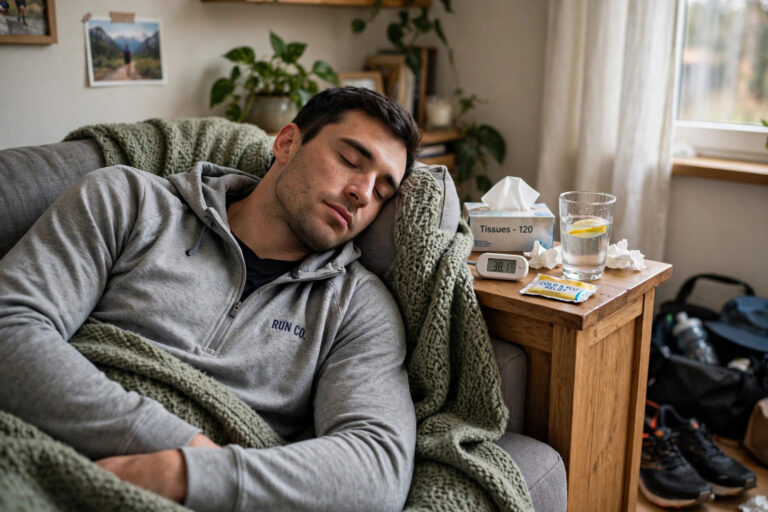
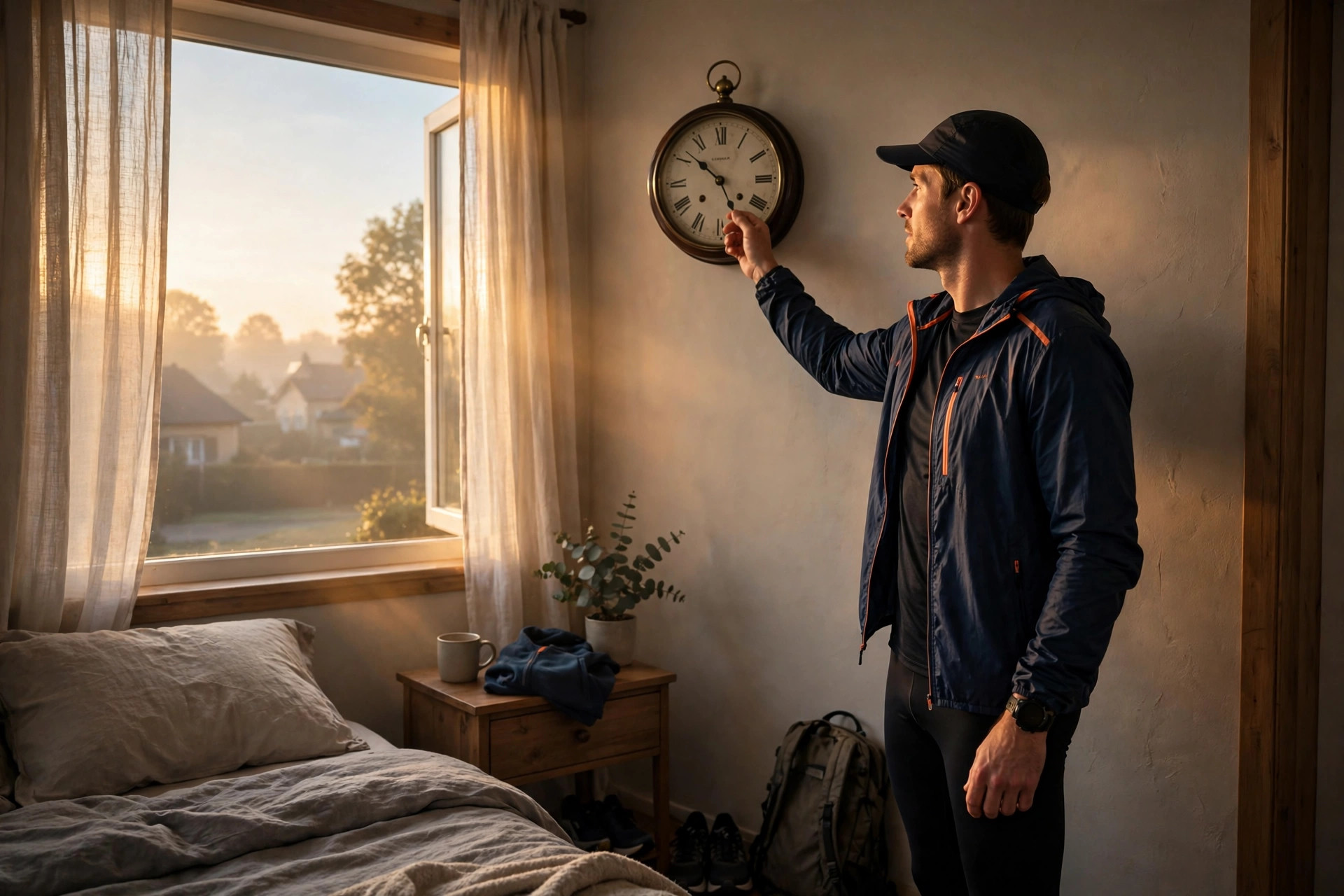

I woke up this morning feeling oddly cheated. The clocks went back overnight, so technically I gained an hour — and yet my body woke me at what felt like the same old time, my morning run felt heavier than it should have, and by mid-afternoon I was already yawning. If you’ve ever felt worse after “gaining” an hour, you’re not imagining it.
Here’s what most people get wrong about the fall clock change: your body doesn’t care what the clock on the wall says. It runs on light, habit, and a stubborn internal rhythm built over weeks. When the clocks jump, that rhythm doesn’t jump with them — it drags its feet for days. And if you train hard, that drag shows up exactly where you don’t want it: in your sleep quality, your morning energy, and your recovery.
What the clock change actually does to your body
Your circadian rhythm is roughly a 24-hour internal clock that tells your body when to feel sleepy, when to wake up, when to release hormones, and even when your muscles perform best. Its main cue is light — bright morning light says “daytime, be alert,” and darkness in the evening says “wind down.”
When daylight saving time ends — at 2 a.m. on Sunday, November 1, 2026, in most of the United States, when clocks fall back to 1 a.m. — the light pattern around your routine shifts by a full hour overnight. Your body, which had tuned itself to the old pattern, suddenly finds sunrise arriving an hour “earlier” on the clock and sunset arriving an hour earlier too.
The result is a few days of mild circadian misalignment. You might fall asleep fine but wake up too early. You might feel groggy in the morning and strangely alert late at night. Your appetite and digestion might feel slightly off-schedule. None of this is dramatic on its own — but stacked on top of training stress, it adds up to the flat, foggy feeling a lot of athletes report in the first week of November.
There’s a second, slower effect that matters even more: the earlier sunset. Once the clocks go back, darkness arrives in the late afternoon instead of the early evening, which means less natural light exposure overall — and for some people that drags mood and motivation down through the winter months.
The extra hour that mostly doesn’t arrive
This is the part that surprised me most when I dug into the research. The fall change is the one people look forward to, but the sleep science is much less generous than the folk wisdom.
A 2013 review in Sleep Medicine Reviews by researcher Yvonne Harrison put it bluntly: the general public assumes the clock changes are easy to adjust to, but the scientific data challenge that assumption. On the autumn night itself, the review found “little evidence of extra sleep.” What happens instead is that your body keeps waking at its old time — which on the new clock is an hour early — and the cumulative effect of five consecutive days of earlier rising after the autumn change suggests a net loss of sleep across the week, not a gain.
Let me make that concrete with a worked example, because the maths is what convinced me:
A worked example: the missing hour
Say you normally sleep from 10:30 p.m. to 6 a.m. — 7.5 hours. On Sunday morning the clocks go back, but your body still wakes after roughly 7.5 hours of sleep, which is now 5 a.m. on the new clock. You lie there, maybe doze, maybe don’t. If you get up at 5 a.m. each morning that week instead of 6 a.m. — and go to bed at your usual new-clock time of 10:30 p.m. — you’re effectively sleeping 7 hours a night instead of 7.5. That’s 30 minutes lost per night, or 2.5 hours across five nights. The “extra hour” you were promised has quietly turned into a sleep debt.
One small actigraphy study often cited in this area tracked healthy adults through the fall change with wrist monitors and found sleep efficiency dropped from 86 to 80 percent, with nighttime restlessness rising by about half — but treat that one with care, because it involved only nine people. Small studies can mislead. The broader point, though, is consistent across the literature: the fall change is gentler than the spring change, but it is not free.
The spring comparison shows the pattern clearly: the Sleep Foundation notes that the average person gets about 40 minutes less sleep on the Monday after “springing forward.” The fall change is easier — but easier is not the same as harmless.
Why athletes feel the clock change more than most
You might wonder why a one-hour shift deserves an article aimed at athletes specifically. Three reasons.
First, sleep is where you actually recover. Muscle repair, glycogen replenishment, hormone release, and memory consolidation for motor skills all lean heavily on good sleep. Our guide to sleep as the most underrated performance enhancer makes the case in detail, but the short version is this: a week of slightly worse sleep is a week of slightly worse recovery, and that compounds across a training block.
Second, athletes live by precise timing. Your hard Tuesday session, your Saturday long run — they all sit at fixed clock times. When your body clock is an hour out of sync with your training clock, your warm-up feels stiffer, your perceived effort climbs, and your coordination can feel a fraction off. That’s not a fitness problem. It’s a timing problem, and it resolves as your rhythm catches up.
Third, the earlier darkness steals your evening training light. If you train after work, your evening run or ride suddenly happens in the dark. That changes safety, surface visibility, and frankly motivation. Plenty of athletes quietly cut sessions short in November — not because they’re lazy, but because training in the dark after a long day feels like a different sport.
The heart angle: what the research actually says
Here’s where I want to be careful, because the headlines around clock changes and heart attacks get overstated every year. A cardiovascular researcher at the University of Alabama at Birmingham, Martin Young, explained in an October 2026 report that the body’s internal clocks coordinate far more than bedtime — and that different organs may adjust to the new schedule at different speeds, creating a brief period of biological misalignment. That misalignment, he cautions, can affect blood pressure, inflammation, blood glucose, and clotting.
The same report noted that gaining an hour in November is associated with approximately 10 percent fewer heart attacks the following Monday, compared with roughly 10 percent more after the spring transition. Note the word “associated.” That is a population-level pattern, not a guarantee for any individual, and it certainly isn’t a reason for a healthy athlete to panic — or to celebrate. If you have existing cardiovascular disease, though, this is exactly the kind of week to be a bit more careful: keep sleep regular, don’t stack a brutal session on top of a bad night, and pay attention to warning symptoms rather than pushing through them.
The American Academy of Sleep Medicine continues to recommend permanent standard time as the healthier long-term option, because it better aligns with the body’s natural circadian rhythm. That policy debate is a question for another day — including a July 2026 U.S. House vote for permanent daylight saving time that still needs Senate approval. For this week, your job is simpler: help your body settle into standard time as smoothly as possible.
Your 7-day clock-change reset plan
Enough theory. Here’s the practical plan, and it starts before you think it does — ideally you began shifting a few days ago, but starting today still helps enormously.
Days 1–2 (Sunday–Monday): anchor the morning. Get bright light within 30 minutes of waking — step outside, even if it’s grey. Morning light is the single strongest signal you can give your body clock, and it’s free. Keep your wake time consistent on the new clock, even if you woke early. Don’t lie in trying to “use” the extra hour; a consistent wake time resets you faster than a lie-in does. Keep hard training moderate today; save the brutal session for midweek.

Days 3–4 (Tuesday–Wednesday): shift the evenings. Move your last meal a little earlier if you can, dim the lights at home an hour before bed, and put the phone down in that last hour. If you train in the evening, add reflective gear and a headlamp now, before the dark catches you out on a run. Most people feel the fog lifting around now; if it hasn’t, that’s normal too — give it the full week.
Locking in the new rhythm
Days 5–7 (Thursday–Sunday): lock it in. By now your wake time should feel natural on the new clock. Re-establish your full training rhythm — including your normal post-workout recovery routine — rather than improvising around tiredness. If you track sleep, check your numbers against your pre-change baseline; our guide to sleep efficiency shows how to read that number properly. A return to your usual efficiency is the best sign you’ve adjusted.
Three rules run through the whole week: caffeine only in the morning (a late coffee now costs you more than it did last week, because your sleep is already fragile); no heroic catch-up naps longer than 20 minutes, and none after mid-afternoon; and alcohol kept to a minimum in the evenings, because it fragments exactly the deep sleep your body is trying to rebuild.
Myth vs. fact: the clock change edition
Myth: “Falling back is pure gain — a free hour of sleep.” Fact: as Harrison’s review shows, there’s little evidence of extra sleep on the night itself, and five days of earlier waking can add up to a net loss across the week. The free hour is a clock fact, not a sleep fact.
Myth: “One bad night and you’re adjusted.” Fact: most people need several days to a week, and the earlier sunset keeps nudging your rhythm even after the hour itself feels settled. Judge adjustment by a full week of normal sleep, not one good night.
Myth: “Athletes don’t need to worry — it’s only an hour.” Fact: it’s only an hour on the clock, but sleep, hormones, and performance timing all run on that clock. An hour of misalignment is enough to make a hard session feel harder and recovery feel slower — especially when it lands on top of a heavy training week.
Myth: “Staying up late on Saturday ‘banks’ the extra hour.” Fact: staying up late just moves the disruption later. The evidence-backed move is the boring one: shift bedtime and wake time gradually, keep wake time consistent, and get morning light.

Will the clock change ruin my race if it’s next weekend?
Probably not — but don’t schedule your hardest session for Monday or Tuesday if you can avoid it. By the weekend, most people have largely adjusted. Keep the early part of the week moderate and save the sharp work for Thursday onwards.
Should I nap to catch up?
A short nap of 20 minutes or less, before mid-afternoon, can take the edge off without wrecking that night’s sleep. A long late-afternoon nap feels great in the moment and then steals your night — exactly what you don’t need this week.
Does the fall change affect children or older athletes differently?
Yes. Children and teenagers need more sleep than adults, so a disrupted week hits them harder, and older adults often find schedule shifts take a little longer to settle. If you coach or parent young athletes, keep their wake times consistent too — and expect a few groggy mornings before it clicks.
The takeaway
You didn’t gain an hour of sleep today — you gained an hour on the clock, and your body needs about a week to believe it. That’s not a failure of discipline or fitness; it’s how circadian rhythms work. Anchor your mornings with light, keep your wake time boringly consistent, train a little more gently for the first few days, and sort your dark-evening gear before the darkness sorts you out. Do that, and by next weekend the clock change will be a footnote — while everyone else is still wondering why they feel so tired.
This article is for general information only and isn’t medical advice. If you have a heart condition, a sleep disorder, or symptoms like chest pain, severe daytime sleepiness, or loud snoring with pauses in breathing, talk to a qualified healthcare professional rather than treating this as a clock-change problem.
Read more: the Sleep Foundation’s guide to daylight saving time and sleep.