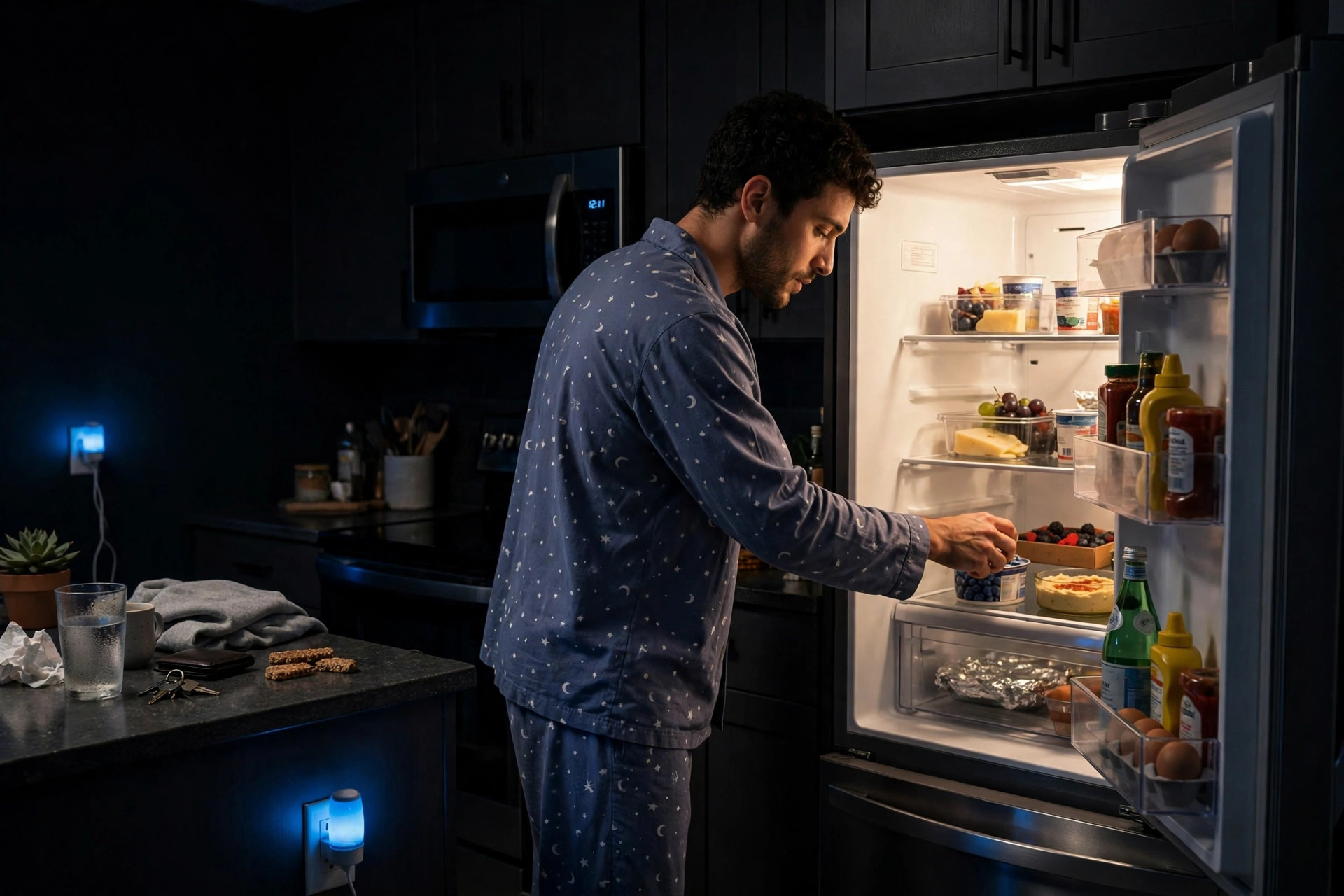

You know that 12:47 AM fridge raid? You’re standing there in your boxers, bathed in fridge light, telling yourself it’s just a little bowl of cereal. No big deal.
Turns out it might be a bigger deal than you think.
A brand-new study — one of the largest of its kind — just linked late night eating to a significantly higher risk of liver disease. And I’m not talking about a tiny statistical blip. We’re talking about a 36% higher risk of fatty liver disease. That bowl of cereal suddenly doesn’t feel so innocent, does it?
Here’s the good news: nobody’s asking you to starve yourself. You just might need to give your food a bedtime.
What the New Study Actually Found
Researchers at Oregon Health & Science University (OHSU), led by hepatologist Dr. Robert Wilechansky, dug into diet and lifestyle data from nearly 200,000 people tracked over roughly 16 years. The data came from three massive long-running health studies, including the Nurses’ Health Study and the Health Professionals Follow-up Study. The findings were published this month in the journal Clinical Gastroenterology and Hepatology.
Their definition of late night eating was simple: eating after dinner, or after bedtime. That’s it. Not binge-eating. Not junk food specifically. Just eating during hours when your body expected to be done for the day.
And the numbers were striking. People who regularly ate late had:
- A 36% higher risk of developing non-alcoholic fatty liver disease (now called MASLD — metabolic dysfunction-associated steatotic liver disease)
- A 28% higher risk of cirrhosis, the severe scarring of the liver
These results held up even after the researchers adjusted for age, body weight, diabetes, physical activity, alcohol, and overall diet quality. In other words, it wasn’t just that late-night eaters happened to be less healthy overall. The timing itself seemed to matter.
Dr. Wilechansky’s takeaway was refreshingly practical: “Confining your calorie intake to several hours before bedtime might be beneficial.”
One honest caveat: this was an observational study based on self-reported habits, so it can’t prove that late eating causes liver disease. But with nearly 200,000 people followed for 16 years, it’s the kind of signal you don’t just shrug off. The research team is already recruiting for a follow-up study that will monitor eating habits directly. You can read more about the research in this summary of the OHSU study.

Why Your Liver Hates a Midnight Snack
To understand why timing matters, it helps to know what your liver actually does at night.
Your Liver Runs on a Clock
Your liver isn’t just sitting there waiting for food to arrive — it follows a daily rhythm, just like your sleep. During the day, it’s in processing mode: breaking down sugars and fats from your meals, storing energy, doing the metabolic heavy lifting. At night, it shifts into repair and reset mode.
“When you eat late, you’re asking your liver to work the night shift,” a dietitian friend of mine put it. She’s right. Food arriving during hours meant for rest disrupts that rhythm, and fats and sugars end up lingering longer in your bloodstream — eventually building up in the liver itself.
It’s Not Just About the Calories
Here’s the part that surprised me. Late night eating has also been tied to higher obesity risk and worse insulin sensitivity — the exact two drivers that fuel fatty liver disease. And get this: as much as 30% of the U.S. population is estimated to have some form of fatty liver disease. Many have no idea.
Night shift workers have known a version of this story for years. Their disrupted schedules come with elevated rates of obesity and heart disease — the same circadian misalignment, just on a bigger scale. The rest of us are apparently running a smaller, nightly version of that experiment every time we eat at midnight.
“But I Train at Night” — What About Athletes?
Okay, let’s address the elephant in the locker room. If you train at 8 PM, you can’t exactly finish dinner at 6. Are you doomed?
No. And here’s why the distinction matters: the study flagged habitual late eating — the everyday pattern of snacking after dinner or after bedtime, night after night. A planned post-workout meal eaten right after training is a different animal from mindlessly grazing through a bag of chips at 11:30 PM while scrolling your phone.
I know a guy — let’s call him Dan — who finishes his gym sessions around 9:30 PM and used to follow them with a “recovery meal” that somehow stretched into two bowls of ice cream at midnight. When he tightened things up — real dinner within an hour of training, then kitchen closed — his sleep improved within two weeks. He wasn’t eating less. He was just eating on a schedule his body understood.
The practical approach for evening trainers: keep your post-workout nutrition, but make it deliberate and finish it within about an hour of your session. That way you’re fueling recovery — which matters, since what you eat around your training directly affects performance — without turning the whole evening into open kitchen hours. And if your bigger goal is to lose fat and build muscle, meal timing is one more lever you can pull without eating a single calorie less.

5 Simple Rules to Give Your Liver Its Nights Off
1. Set a Kitchen Curfew — 2 to 3 Hours Before Bed
This is the study’s headline advice, and it’s the one that matters most. If you sleep at 11, aim to be done eating by 8 or 8:30. No complicated math, no app required. Just a cutoff.
2. Front-Load Your Calories
Shift more of your eating earlier: a solid breakfast, a real lunch, and a lighter dinner. Most late-night snacking happens because dinner was tiny at 6 PM and by 10 PM your stomach is filing a formal complaint. Eat enough at dinner and the midnight cravings lose their power.
3. Plan the Post-Workout Meal — Don’t Improvise It
Decide before training what you’ll eat after. A protein-rich meal or shake within an hour of your session covers recovery, and then you’re done. The danger zone is the unstructured hour between “workout’s over” and bed, when ultra-processed snacks start calling your name from the pantry.
4. Brush Your Teeth
Sounds silly. Works anyway. That minty-fresh signal tells your brain the kitchen is closed, and food genuinely tastes worse right after toothpaste — which is exactly the point. It’s a two-minute ritual that draws a line under the day’s eating.
5. Eat in the Light, Sleep in the Dark
Align your eating with daylight as much as your schedule allows. Regular meal times, a consistent sleep schedule, and a dark bedroom all support the circadian rhythm your liver depends on. Think of it as teamwork: your sleep protects your liver, and your liver returns the favor.
FAQs
Does a protein shake before bed count as late night eating?
Technically, yes — if it’s after dinner or close to bedtime, it falls into the pattern the study flagged. That said, a small planned protein shake right after an evening workout is very different from nightly recreational snacking. If you’re a late trainer, keep the shake modest, finish it within an hour of training, and don’t stack extra snacks on top of it.
I only snack late on weekends. Does that still matter?
The study measured habitual patterns, so occasional late nights are unlikely to carry the same risk as a nightly habit. But weekend snacking has a way of becoming “most nights” snacking. If Friday pizza at 11 PM is genuinely the exception, don’t lose sleep over it — ironically, good sleep is part of the prescription.
Can I undo the damage if I’ve been a late-night eater for years?
Your liver is remarkably forgiving — it’s one of the few organs that can regenerate. The study didn’t test whether changing habits reverses risk, but everything we know about fatty liver disease says lifestyle changes (meal timing, weight, activity) can improve liver health significantly. Starting the curfew tonight is better than starting it next year.
The Bottom Line
We’ve spent years obsessing over what to eat — keto, high-protein, low-carb, you name it. This research is a reminder that when you eat matters too, maybe more than we thought.
You don’t need a new diet. You don’t need to give up your favorite foods. You just need to give your food a bedtime — a couple of hours before yours — and let your liver do its night shift in peace. Your midnight self might protest for a week. Your liver will thank you for years.
This article is for informational purposes only and is not medical advice. If you have liver concerns or a diagnosed liver condition, talk to your doctor or a registered dietitian before changing your eating patterns.