
Your legs feel heavy at kilometre 30. You’ve done everything right — gels every 20 minutes, sports drink on schedule, the same fuel plan that carried you through your last marathon. But today it’s 40 degrees, the sun is bouncing off the tarmac, and your body feels like it’s running on empty anyway.
You’re not imagining it. A brand-new study on carbs in extreme heat has found that in extreme heat, your muscles simply can’t use a big chunk of the carbs you eat and drink. And here’s the twist nobody expected: getting used to the heat doesn’t fix it.
The Study: 17 Cyclists, 40 Degrees, One Surprising Result
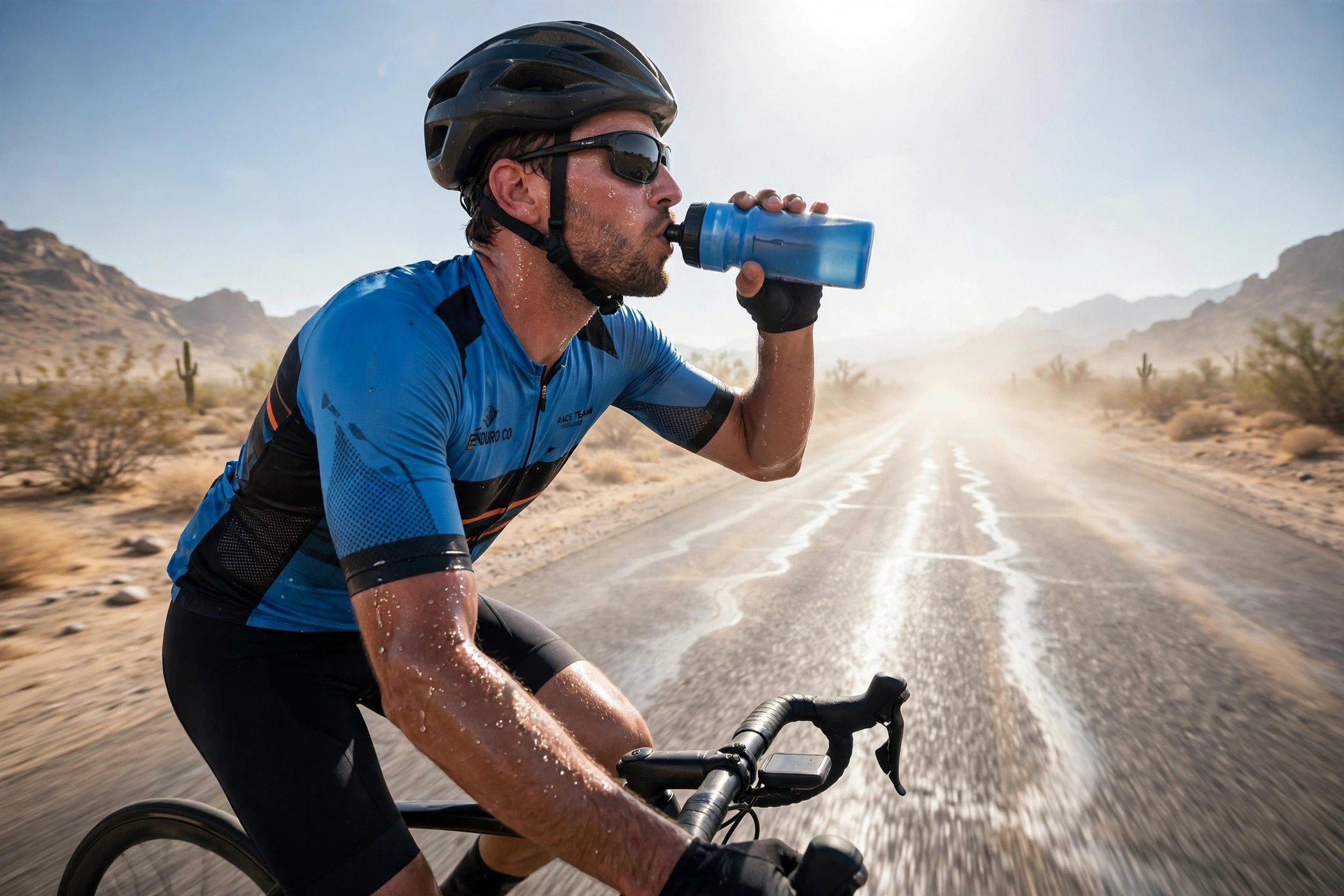
Researchers from the University of Birmingham and the University of Exeter put 17 trained cyclists through 90-minute rides on stationary bikes, drinking glucose at 90 grams per hour — a solid endurance fuelling rate. The paper was published in The Journal of Physiology on 11 November 2026.
Each rider did the same ride three times. Once in comfortable 20°C conditions. Once in brutal 40°C heat with 20% humidity. And once more in the heat after nine days of heat acclimation — training in the heat every day to adapt.
The team used stable-isotope tracers and muscle biopsies to track exactly where each gram of glucose went. That’s what makes this study different from the usual “drink this, feel better” advice. They didn’t guess. They measured.
The result? In the heat, the riders burned about 27% less of the carbohydrate they’d drunk compared to the cool ride. Their ingested carb oxidation dropped from 0.51 grams per minute at 20°C to 0.37 grams per minute at 40°C. And after nine days of heat acclimation, it barely budged — 0.38 grams per minute.
In other words, nearly a third of your race fuel just… doesn’t get used.
What Actually Happens Inside Your Body
For years, sports scientists assumed the problem was the gut. The thinking went like this: in the heat, blood gets diverted to your skin to cool you down, your stomach gets less blood flow, and digestion slows to a crawl. Makes sense, right?
Wrong — at least not the way everyone thought.
The tracer data showed the riders’ guts were still absorbing glucose into the bloodstream at a normal rate. The carbs were getting in. The problem was what happened next. The glucose was sitting in the blood, but the muscles weren’t pulling it out and burning it at the usual rate.
Professor Gareth Wallis, the study’s senior author, put it plainly: heat creates a barrier that affects how the body removes glucose from the blood and uses it for energy. The bottleneck is at the transfer out of the bloodstream, not at the gut wall.
Scientists still don’t know exactly what causes that barrier. That’s the honest part of this story — the mechanism is still a mystery. What they do know is where it isn’t: your stomach is doing its job fine.
Carbs in Extreme Heat: What 27% Means in a Real Race
Percentages are abstract, so let’s make it concrete with carbs in extreme heat.
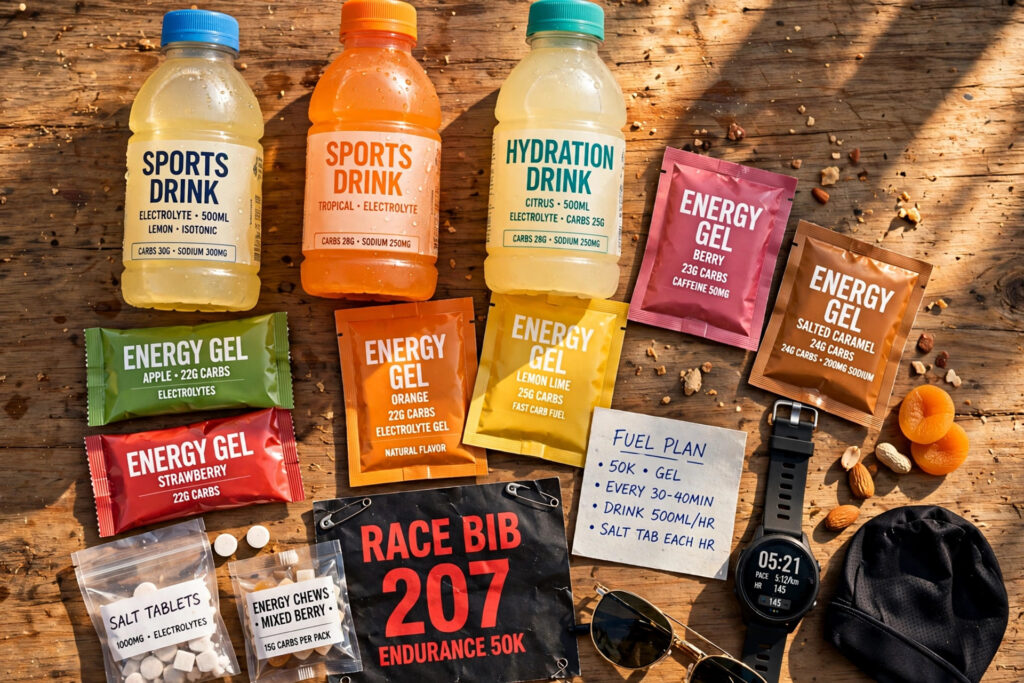
Picture a marathoner racing for three hours in 40-degree heat, taking in 90 grams of carbs per hour — gels and sports drink, exactly what the guidelines recommend.
That’s 270 grams of carbohydrate over the race. At 27% unused, roughly 73 grams of that never gets burned as drink fuel. That’s about 292 calories of fuel your body expected to have, but didn’t.
Where does the energy come from instead? Your glycogen stores. The study found total carbohydrate burning stayed about the same — around 1.8 grams per minute — which means the body quietly raided its internal reserves to cover the shortfall. And that’s the real danger: your glycogen tank is limited, so you hit the wall earlier than your fuelling plan says you should. Your plan was built for 20 degrees. Your body is racing in 40.
Push the intake higher and the maths gets worse, not better. Elite athletes now take 120 grams per hour or more. Over three hours that’s 360 grams — and 27% of it is about 97 grams, nearly 390 calories of fuel that never arrives.
Heat Acclimation Helps — Just Not Your Fuel
Here’s the part that surprised even the researchers.
The nine days of heat acclimation worked exactly as expected on every marker they checked. The riders’ core temperatures were lower, both at rest and during exercise. Their blood plasma volume expanded. Their heart rates dropped. They found the exercise less hard and less uncomfortable.
By every normal measure, they had adapted to the heat beautifully.
But their ability to burn the carbs they drank? Unchanged. Still stuck at that same reduced rate.
Lead author Dr. Tim Podlogar from Exeter University was blunt about it: acclimation improves your ability to cope with the heat, but it did not rescue the reduction in the body’s capacity to use ingested carbohydrates. The same barrier was still there.
That matters because heat acclimation is the standard advice for anyone racing somewhere hot. Spend ten days training in the heat, and you’ll be fine — for your temperature, your heart rate, your comfort. But your fuelling still needs a different plan.
What Athletes Should Actually Do
So what do you change? The researchers’ advice is refreshingly simple — and it starts with what NOT to do.
Don’t cut your carbs. That’s the first instinct when you learn a quarter of them go unused, and it’s the wrong one. “Do not cut back on carbs in the heat,” Podlogar said. “Your gut is still absorbing them, so they are getting into your body, and eating less would only leave you with even less fuel.” Keep your intake the same as in cooler conditions, then adjust everything around it:
Drink more, on purpose. Your body needs fluid to make sweat and cool itself down. If you’re short on water, your core temperature climbs, and everything gets worse. Getting your hydration right is half the battle — here’s our full guide to staying properly hydrated during training and racing.
Practise your race fuelling in the heat. Don’t try a new gel strategy on race day in 40-degree weather. Train your gut in warm conditions so eating and drinking at race intensity feels automatic. That includes figuring out how much fluid you can actually get down alongside your carbs when you’re pouring sweat.
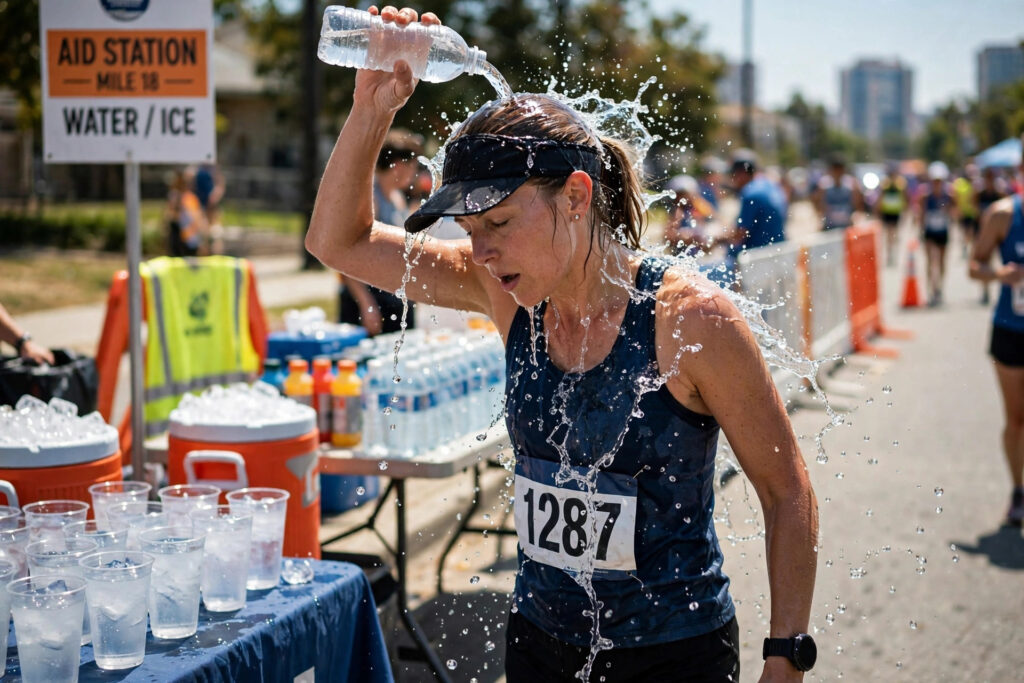
Use every cooling trick available. Cold drinks, ice slushies, ice socks tucked into your kit, pouring water over your head and neck at aid stations — the researchers specifically recommend all of them. Anything that keeps your core temperature down helps your body do its job.
Front-load your glycogen. Since your body leans harder on internal stores in the heat, starting the race with full glycogen tanks matters even more than usual. That means getting what you eat before you train right in the days before the event, not just on the morning of it.
Respect the conditions. If you’re training for a hot race, heat training like sauna sessions can help your body adapt — just remember that adaptation won’t fix your fuelling. Plan for the 27% gap, don’t assume it away.
Myth vs. Fact: Carbs in the Heat
Myth: “If I feel sick in the heat, my stomach can’t handle the carbs.”
Fact: The study found gut absorption stayed normal in 40-degree heat. Nausea in the heat is real, but it’s not because your stomach stopped absorbing carbs — the blockage is further down the line, where glucose leaves the blood.
Myth: “Heat training fixes your fuelling.”
Fact: Nine days of acclimation improved temperature, heart rate and comfort — but carb oxidation stayed 27% lower. Acclimation is essential. It just doesn’t solve this particular problem.
Myth: “I’ll just eat less and rely on my fitness.”
Fact: Eating less leaves you with even less fuel. Your body is already pulling extra from glycogen stores to cover the gap. Cutting intake widens the gap.
FAQs
Do carbs really stop working in the heat?
Not entirely — but about 27% of the carbs you drink during exercise go unused at 40°C compared to 20°C, according to this November 2026 study on carbs in extreme heat in The Journal of Physiology. Your gut still absorbs them normally; the problem is that your muscles don’t take up and burn the glucose from your blood at the usual rate.
Will heat acclimation fix my fuelling?
No. Nine days of heat training improved the cyclists’ core temperature, plasma volume and heart rate, but their ingested-carb oxidation stayed just as low. Acclimation helps you cope with heat — it doesn’t restore your fuel use.
Should I eat more carbs to make up for the 27%?
The researchers say no — don’t chase the gap by overloading. Keep your normal intake, because your gut is already absorbing what you take in. Instead, focus on drinking enough fluid, cooling yourself down, and starting with full glycogen stores. More carbs on top of a system that can’t use them won’t help and could upset your stomach.
The Bottom Line
Here’s the takeaway to carry into your next hot race: your fuelling plan was probably built for cool weather, and carbs in extreme heat don’t behave the way your plan assumes.
About a quarter of the carbs you drink won’t get burned as fuel — not because your stomach fails, but because heat puts up a barrier between your blood and your muscles. Nine days of heat training won’t remove that barrier, even though it’ll make you feel far more comfortable.
So don’t eat less. Don’t panic. Just plan for it: same carbs, more fluid, practised fuelling in warm conditions, and every cooling trick you can get your hands on. The heat takes a cut of your fuel whether you like it or not — the athletes who handle it best are the ones who know it’s coming.
This article is for general information only and is not medical advice. If you have a medical condition, take medication, or are training for an event in extreme heat, talk to a doctor or a qualified sports nutritionist before changing your fuelling plan.