Functional fitness exercises are transforming the perception of exercises among people—and with a reason. Rather than just being concerned about your appearance, functional training makes you move more easily, feel stronger, and carry out all your daily actions without any difficulty. Whether it is hauling the groceries, climbing the stairs, or just running around with your kids, these activities are the ones that help your body to operate as a single, strong, and effective machine.
Functional fitness exercise is an intelligent way to train in case you desire workouts that will transfer to the real world as a source of strength, balance, and mobility.
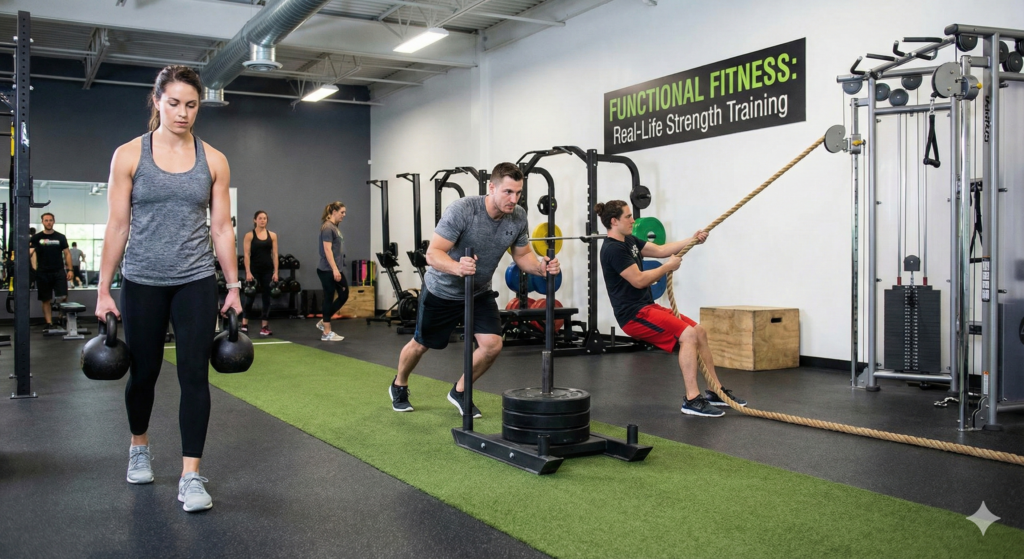
What are Functional Fitness Exercises?
Functional Fitness exercises are those that replicate everyday activities. They simultaneously work on several muscle groups and enhance your whole body movement.
As opposed to the isolated gym exercises, functional training deals with:
Natural movement patterns
Power, stability, and control.
Core stability and posture
Its purpose is straightforward: to make your body work better in everyday life.
The importance of Functional Fitness Exercises.
We bend, lift, push, pull, and twist in our daily activities. Functional fitness training will equip your body to perform such actions and minimize the chances of getting injured as well as enhance overall performance.
The main advantages of functional fitness training include improved strength, mobility, balance, and coordination.
Enhances general power and mobility.
Improves balance and coordination.
Supports joint health
Boosts core strength
Helps prevent injuries
Appropriate for any fitness level.
It is not only athletes who can be functionally fit. This program is designed for anyone who wants to increase their movement and maintain an active lifestyle over time.
These are the main principles of functional fitness exercises.
Functional training has some key principles that distinguish it as compared to conventional exercises.
Full-Body Movement
Majority of functional fitness activities involve multiple muscle groups simultaneously, and hence, workouts are more effective.
Core Engagement
The core has a significant role in stabilizing your body during functional movements.
Multi-Plane Motion
The exercises prepare your body to move forward, backward, sideways, and rotationally—as in real life.
These are some of the best workouts you can perform in the fitness center.
These are some of the best functional fitness exercises that you can add to your routine.
Squats
Squats are one of the most convenient functional exercises, imitating sitting down and standing up.
Benefits:
Strengthens legs and glutes
Engages the core
Improves hip mobility
Lunges
Lunges enhance balance and coordination, and they make the lower body stronger.
Why they work:
Train single-leg stability
Improve posture
Enhance lower-body strength
Push-Ups
Push-ups are one of the traditional functional fitness exercises, and they develop upper-body and core strength.
They help with:
Pushing movements
Shoulder stability
Core control
Deadlifts
Deadlifts also impart beneficial lifting habits, which are needed in everyday life.
Key benefits:
Strengthen the back and legs
Improve posture
Minimize the risk of lower-back injury.
Planks
Planks develop core stability, and it underlies virtually all the movements you undertake.
Why planks matter:
Make strong, deep core muscles.
Improve balance
Support spinal health
Introduction to Functional Fitness Exercises.
When you are starting out in functional training, go slow and emphasize correct form.
Beginner-friendly tips:
Do bodyweight exercises initially.
Pay attention to movements that are controlled.
Start with short workouts
Rest when needed
Such simple exercises as bodyweight squats, wall push-ups, and step-ups make excellent beginnings.
Home Workout: Functional Fitness.
Another good thing about functional fitness training is that you do not have to go to the gym.
You can perform simple exercises at home.
Bodyweight squats
Lunges
Planks
Glute bridges
Standing marches
These activities do not need much or any equipment, and they can be performed in any location.
Traditional vs. Functional Fitness Workouts.
The conventional exercises tend to separate the body parts with the help of machines. Exercises relating to functional fitness are movement-oriented and coordinated.
Key Differences
Functional training enhances daily movement.
Conventional exercises emphasize muscle isolation.
Functional exercises more naturally incorporate core exercises.
They are both valuable; however, functional fitness has more practical advantages in life.
How frequently do you do functional fitness workouts?
For the majority of individuals, functional fitness activities may be performed 3–5 times a week.
Suggested routine:
2–3 full-body workouts weekly.
Combine power, equilibrium, and mobility activities.
Allow rest days for recovery
It is more about consistency than intensity.
Common Mistakes to Avoid
The following are some of the mistakes to avoid when doing functional fitness exercises:
Ignoring the proper form.
Skipping warm-ups
Moving too fast too soon
Neglecting recovery
To achieve long-term success, it is important to listen to your body.
Conclusion:
Functional fitness exercises are the best method for developing real-world strength, enhancing movement, and maintaining long-term health. You will feel stronger, more balanced, and more assured of yourself in your daily life by training your body to move naturally and efficiently.
Functional fitness exercises can be scaled to suit your requirements whether you are a novice at fitness or an advanced fitness participant. Learn to be consistent, have the correct shape, and work step by step, and your body will serve you with gratitude.
Questions and Answers (FAQs).
What are the functional fitness exercises?
Functional fitness exercises enhance the way your body moves with the normal actions in that they train the body to move the different body parts in unison in a more efficient manner.
Can functional fitness exercises be good when one is a beginner?
Yes. They are adaptable and can be changed easily and are applicable to all fitness levels.
Are exercise programs for weight loss that use functional fitness effective?
Yes. Such exercises are calorie-burning, muscle-building, and metabolism-enhancing when regular.
Will I require functional fitness exercise equipment?
No. Most functional exercises are performed with the help of bodyweight, but later, the resistance band or dumbbells may be introduced.
What is the duration of effective fitness training?
The majority of exercises take 20–45 minutes, depending on intensity and fitness.
Are functional fitness exercises possible in older adults?
Absolutely. Specifically, functional training proves advantageous in enhancing balance in older adults, their mobility, and their independence.
